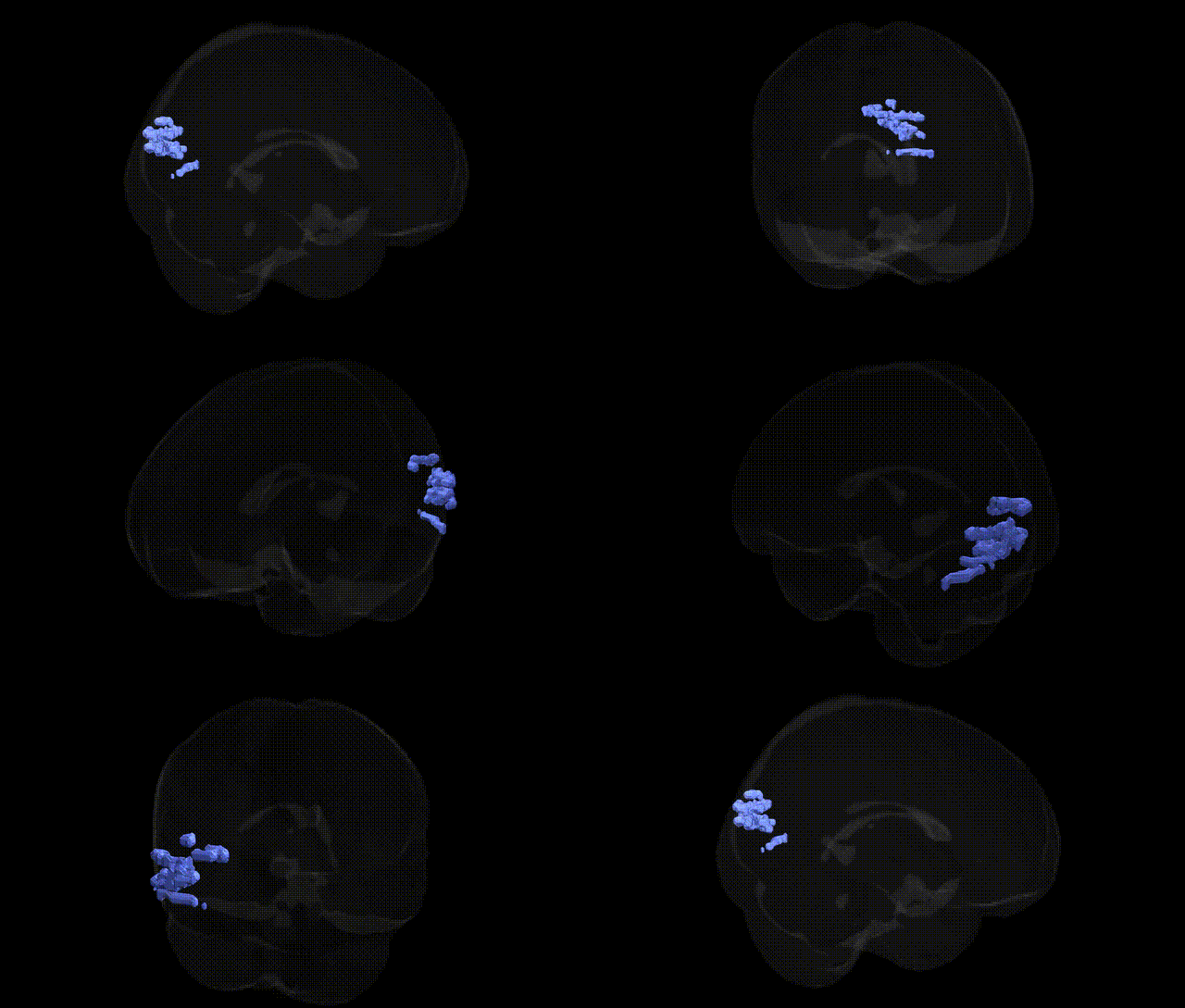
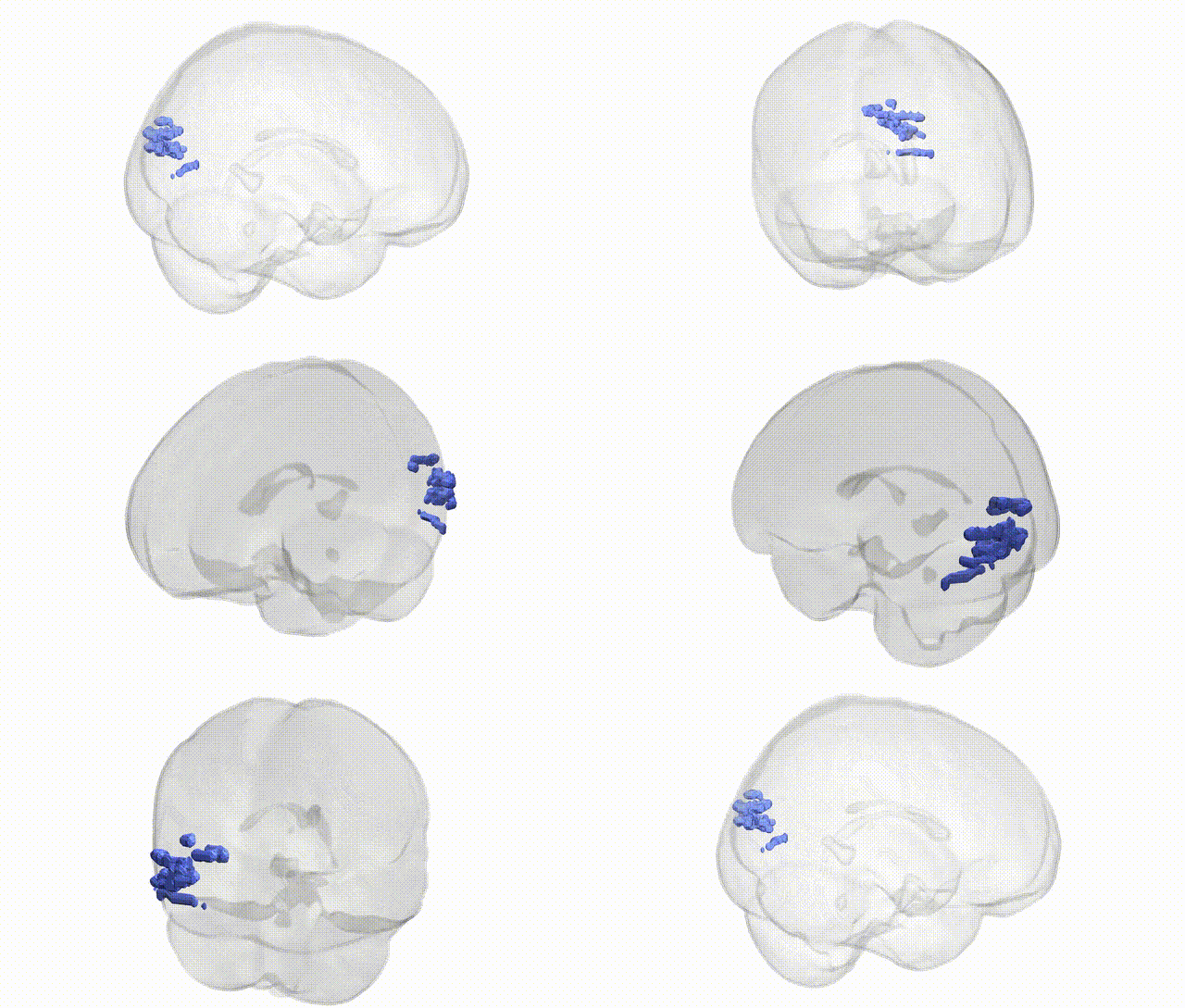
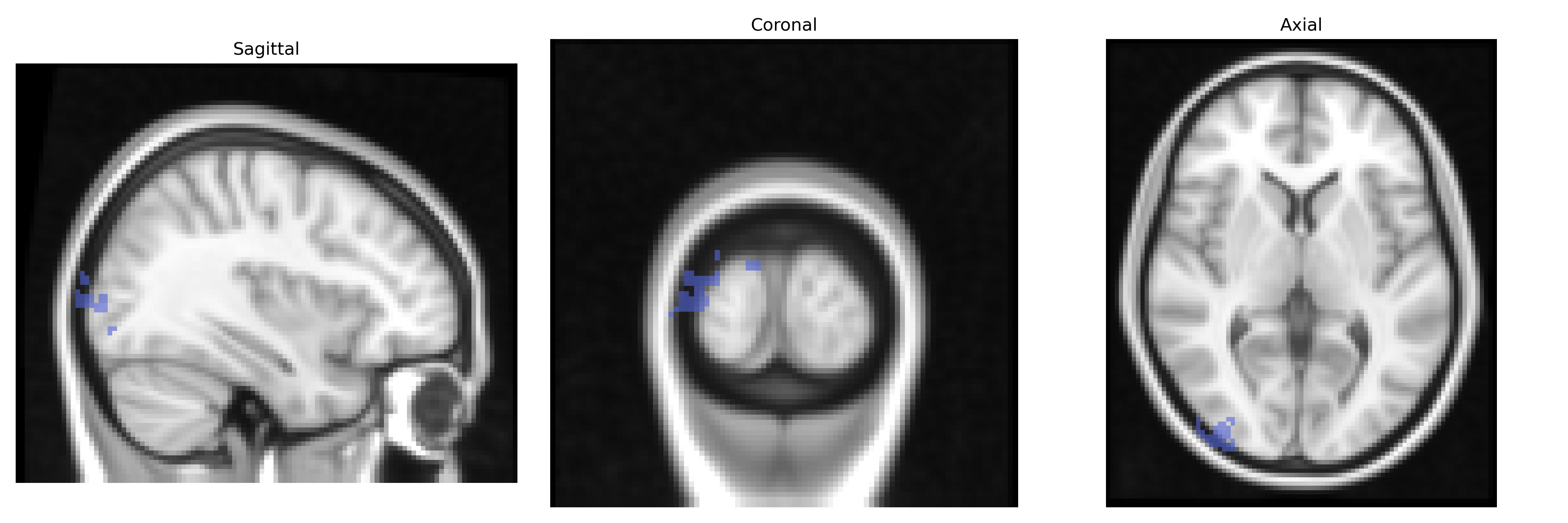
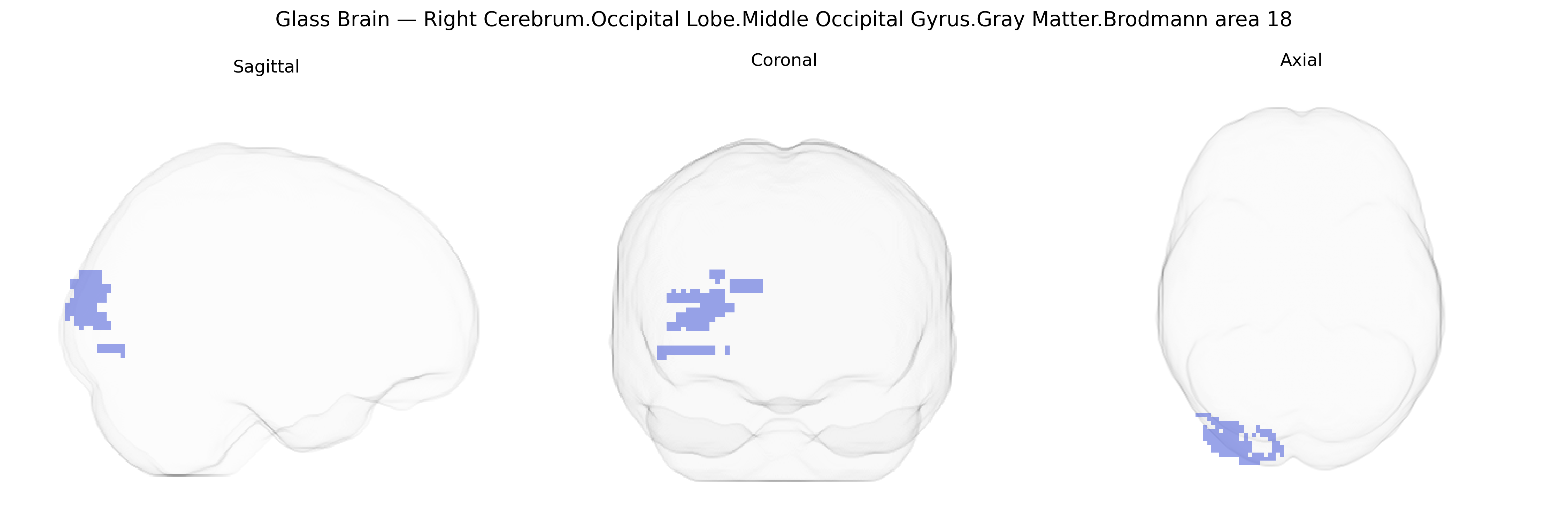
The bilateral Right Cerebrum Occipital Lobe Middle Occipital Gyrus Gray Matter Brodmann area 18 corresponds to the secondary visual cortex (visual association area) situated in the occipital lobe, adjacent to the primary visual cortex (area 17). This region is involved in early-stage visual processing and integration, including the analysis of orientation, spatial frequency, and more complex features derived from primary visual inputs, contributing to the perception of form, motion, and visual patterns. It receives dense afferent projections from area 17 and relays processed information to higher-order visual areas in the dorsal and ventral streams, supporting functions such as object recognition and visuospatial analysis. There is no direct link for this exact Talairach-defined region; see the related structure Brodmann area 18.
The bilateral right middle occipital gyrus gray matter in Brodmann area 18 (secondary visual cortex, V2) has been implicated in several genetic and GWAS findings focused on visual processing, brain structure, and neuropsychiatric traits. Large-scale neuroimaging genetics consortia such as ENIGMA and UK Biobank have identified multiple common variants affecting occipital cortical thickness and surface area, many enriched in genes involved in synaptic development, axon guidance, and neurogenesis (e.g., variants near genes like HDAC9, KIAA0586, and DAAM2 in visual and occipital regions), although specific loci are typically reported at lobar or regional occipital levels rather than precisely BA18. Occipital visual association cortex, including BA18, frequently shows structural and functional alterations in genetically influenced disorders such as schizophrenia, bipolar disorder, major depressive disorder, and autism spectrum conditions, with polygenic risk scores for these disorders correlating with differences in occipital gray matter measures and visual processing activation. GWAS of visual acuity and refractive error (myopia) have also highlighted genes expressed in visual cortex and occipital areas, suggesting cortical contributions to genetically mediated visual traits. In dyslexia and other reading-related disorders with strong heritability, variants in genes such as DCDC2, KIAA0319, and ROBO1 have been linked to atypical activation and connectivity in occipital and occipito-temporal visual association regions, including BA18, during reading and visual word recognition. Additionally, GWAS of resting-state networks and task-based fMRI have associated variants in neurodevelopmental and synaptic genes with differences in activation in secondary visual cortex during basic visual perception tasks. Overall, genetic influences on this BA18 region appear largely indirect, acting through broad neurodevelopmental, synaptic, and visual-system pathways that shape occipital morphology and function, rather than through variants uniquely specific to this Talairach-defined subregion.
Overview generated by GPT-4o (2026).
Region ID: 307
Hemisphere: bilateral
Atlas: Talairach labels 2mm
Full Quality Version: Download MP4
Full Quality Version: Download MP4
Wali Sidiqyar*, Gaurav Rudravaram*, Elyssa M. McMaster, Trent M. Schwartz, Adam M. Saunders, Kurt G. Schilling, Bennett A. Landman "Introducing SPINS: A Shared Public Visualization Library of Neuroanatomical Structures." Medical Imaging with Deep Learning- short paper
This resource is licensed under CC0 1.0 Universal (Public Domain).