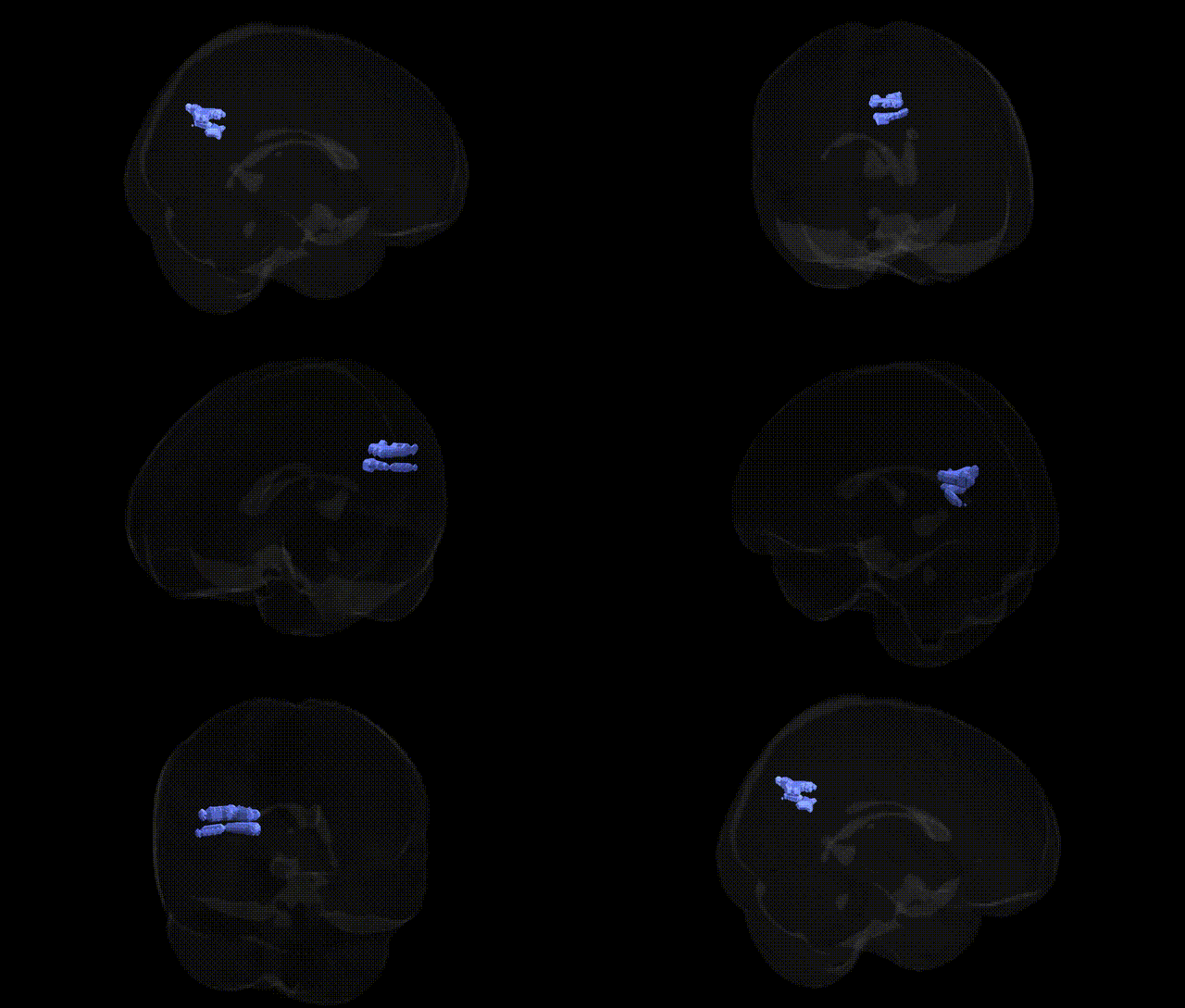
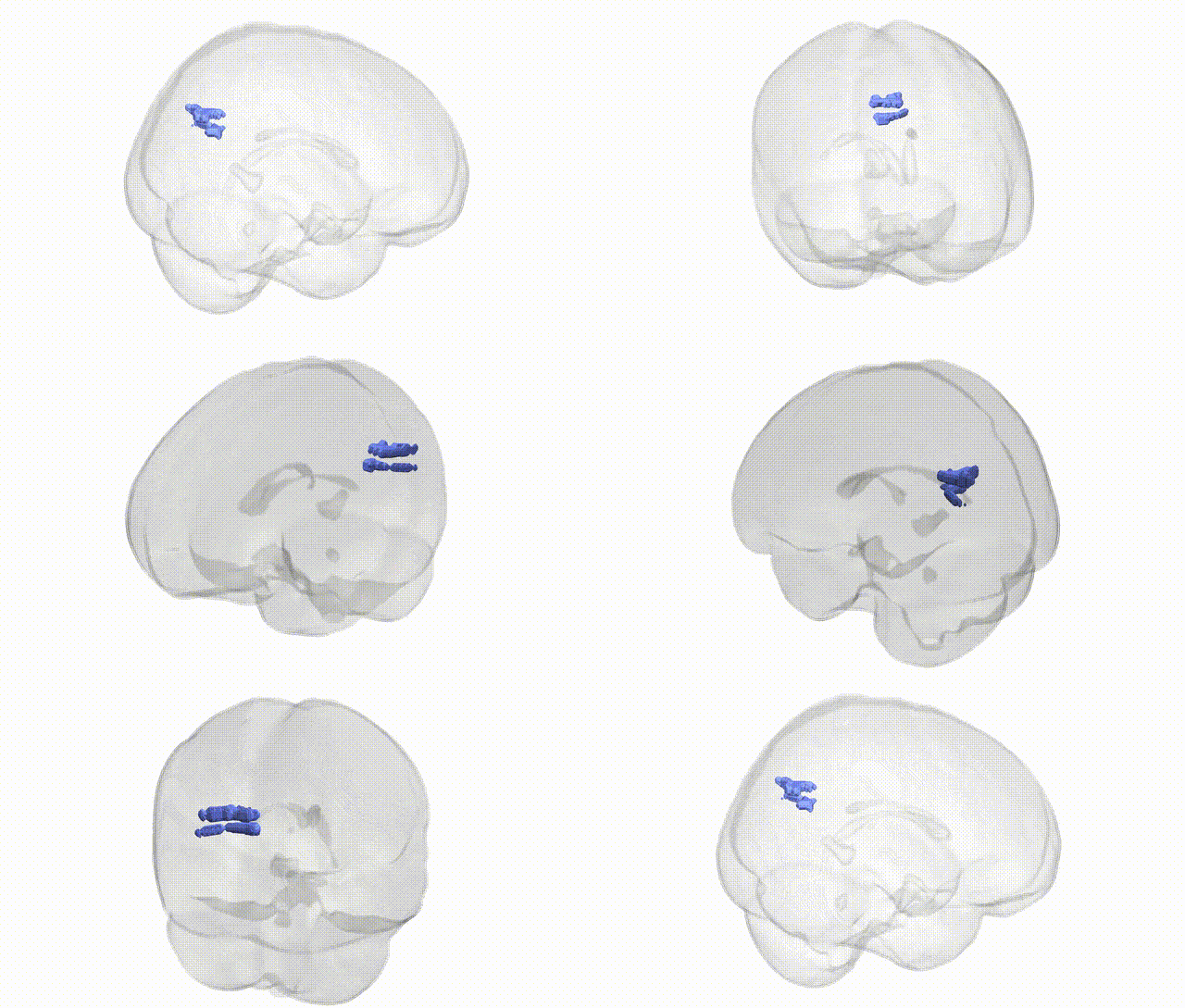
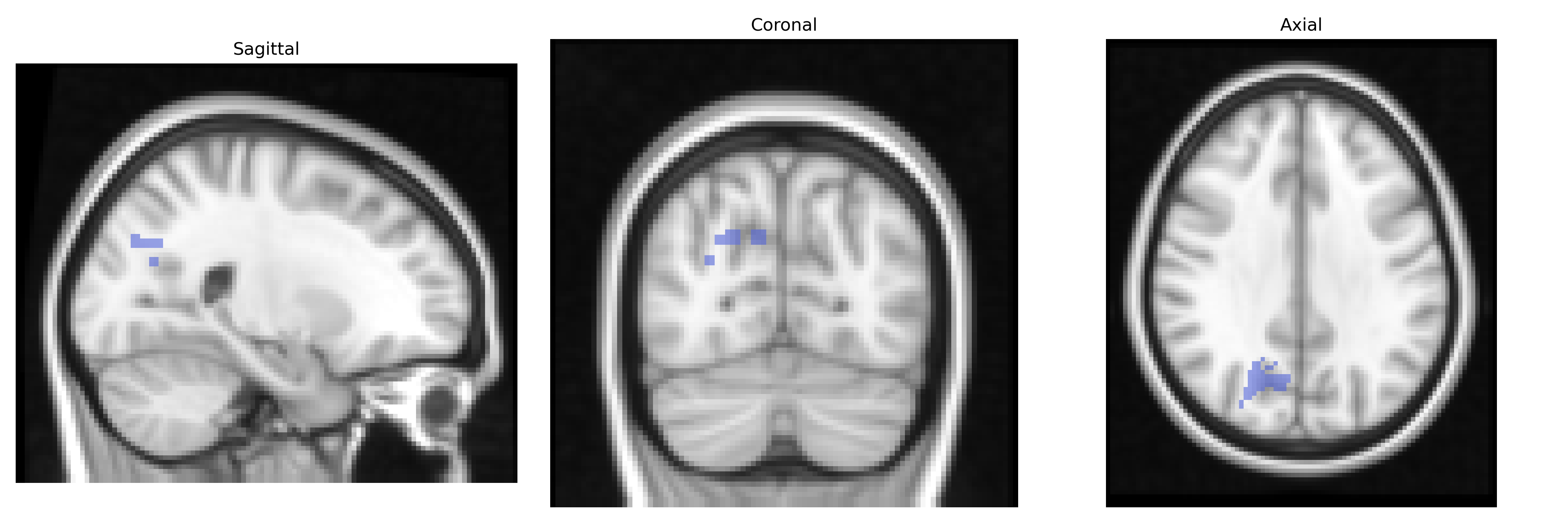
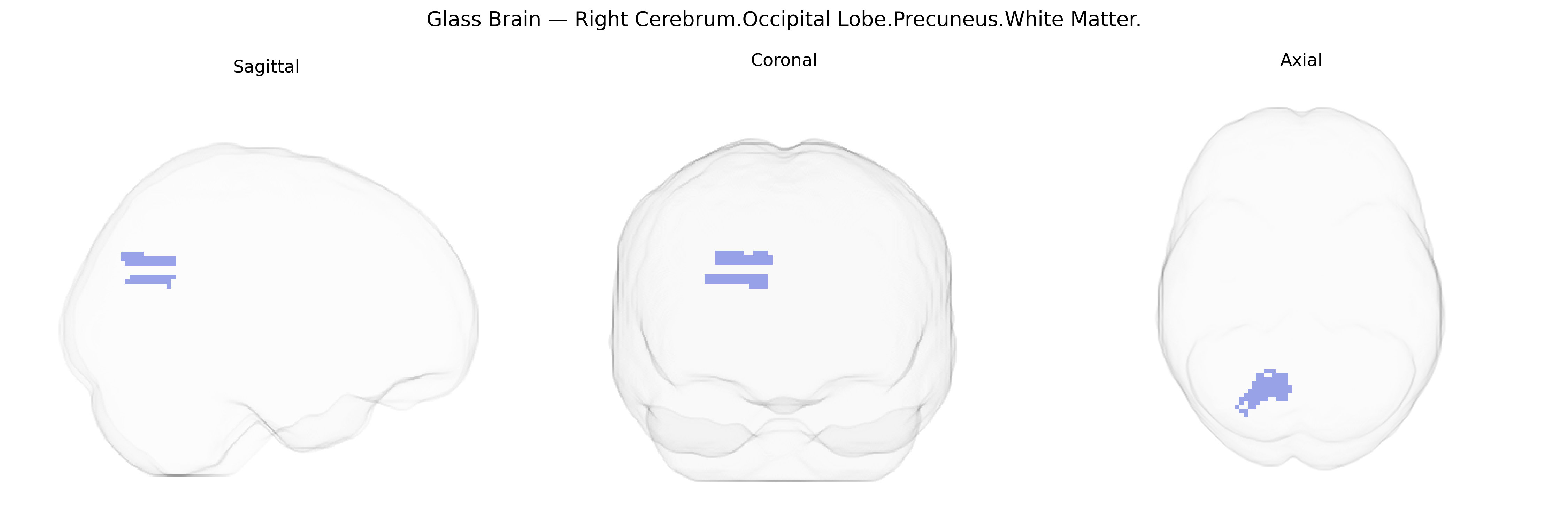
The bilateral Right Cerebrum.Occipital Lobe.Precuneus.White Matter corresponds to the deep myelinated fiber tracts within the precuneus region, a medial parietal cortex area bordering the occipital lobe, as defined in the Talairach 2mm Atlas. Although primarily associated with the parietal lobe, the precuneus participates in visuospatial processing, self-related cognition, episodic memory, and integration of sensory information, with its white matter comprising association, commissural, and projection fibers linking precuneus cortex to occipital, parietal, frontal, and limbic regions. These fibers support large-scale brain networks, including the default mode network, and facilitate communication necessary for higher-order integration of visual and cognitive functions. There is no direct link for this specific white matter subdivision; a closely related cortical region is the Precuneus.
The bilateral Right Cerebrum.Occipital Lobe.Precuneus.White Matter region (Talairach 2 mm Atlas) falls within the broader precuneus/medial parietal territory, a hub of the default mode network, and its genetic associations largely mirror those identified for precuneus structure and connectivity rather than this specific micro-anatomical label. Large-scale neuroimaging GWAS (e.g., ENIGMA, UK Biobank) have linked common variants in genes such as APOE, CLU, CR1, BIN1, and PICALM to reduced white matter integrity and volume in precuneus-adjacent regions, particularly in the context of Alzheimer’s disease risk and amyloid-related degeneration. Polygenic risk scores for schizophrenia, major depressive disorder, bipolar disorder, and autism spectrum disorder have been associated with altered precuneus volume, cortical thickness, or white matter microstructure, implicating neurodevelopmental and synaptic genes (e.g., CACNA1C, GRIN2A, DRD2) in structural variation of this region. Imaging-genetics work has also tied variants in axon guidance and myelination-related genes (e.g., NRG1, ERBB4, MAG, MBP) to changes in occipital–parietal white matter tracts that traverse or border the precuneus, influencing measures such as fractional anisotropy and mean diffusivity. Trait-related GWAS using brain imaging endophenotypes report associations between precuneus white matter measures and polygenic architecture for cognitive performance, intelligence, and mind-wandering/default-mode activity, reflecting genes involved in synaptic plasticity (BDNF, CNTNAP2) and cortical development. While no large GWAS has isolated the Talairach-defined “Right Cerebrum.Occipital Lobe.Precuneus.White Matter” label as a distinct phenotype, converging genetic evidence from Alzheimer’s disease, psychiatric disorders, cognitive traits, and white matter microstructure supports this region as a genetically sensitive hub in large-scale brain networks, with risk and resilience variants shaping its structural integrity and connectivity.
Overview generated by GPT-4o (2026).
Region ID: 822
Hemisphere: bilateral
Atlas: Talairach labels 2mm
Full Quality Version: Download MP4
Full Quality Version: Download MP4
Wali Sidiqyar*, Gaurav Rudravaram*, Elyssa M. McMaster, Trent M. Schwartz, Adam M. Saunders, Kurt G. Schilling, Bennett A. Landman "Introducing SPINS: A Shared Public Visualization Library of Neuroanatomical Structures." Medical Imaging with Deep Learning- short paper
This resource is licensed under CC0 1.0 Universal (Public Domain).