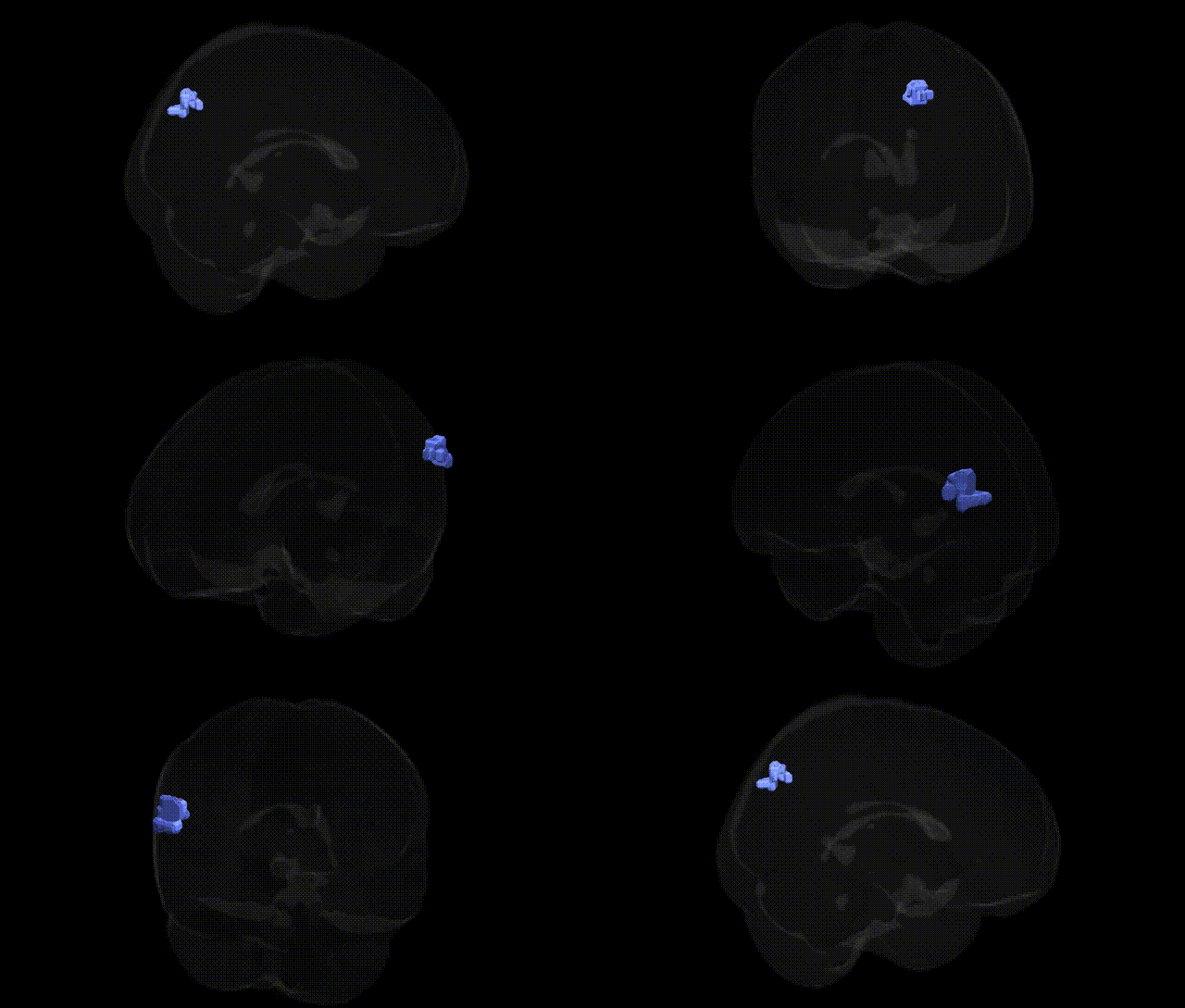
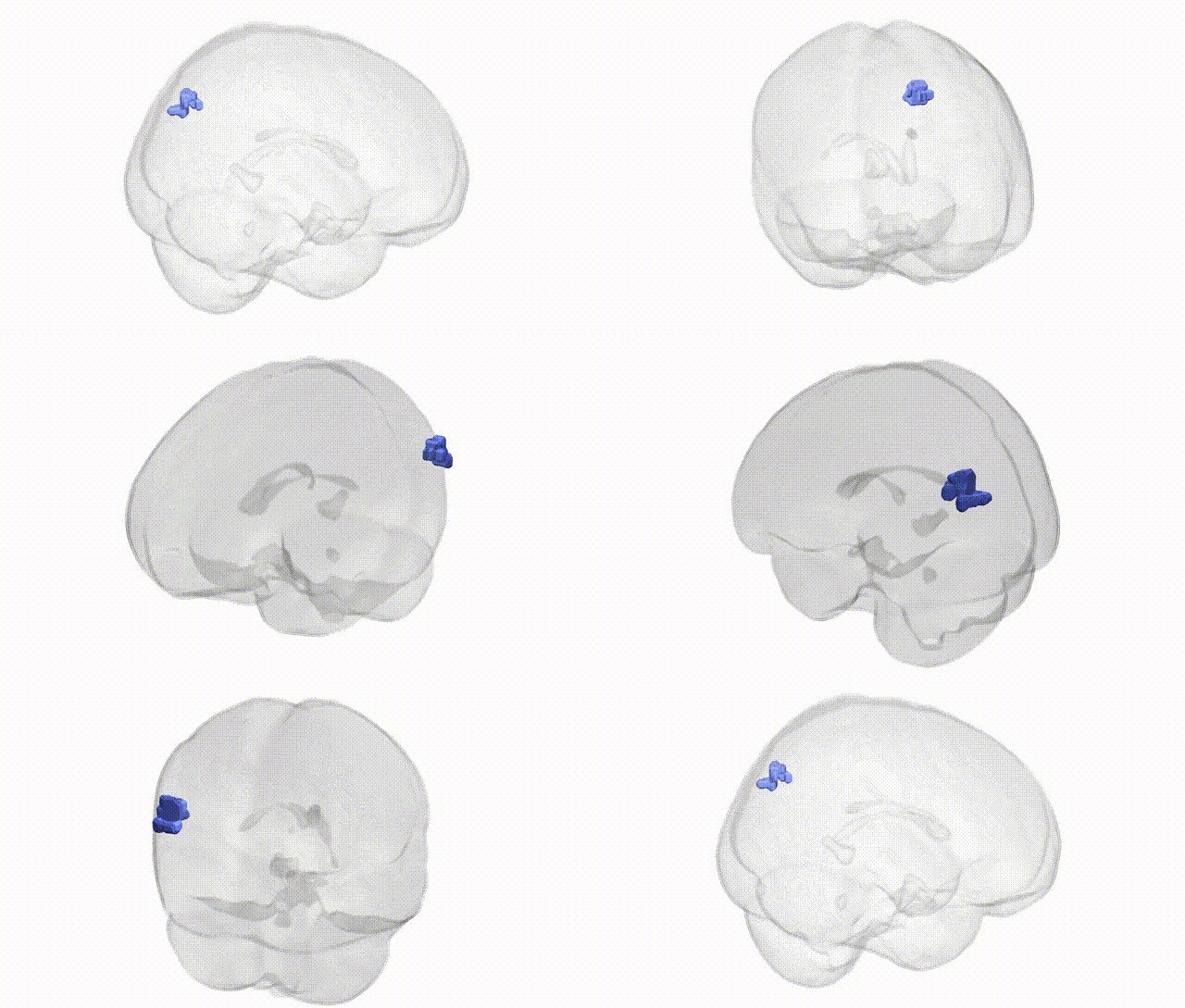
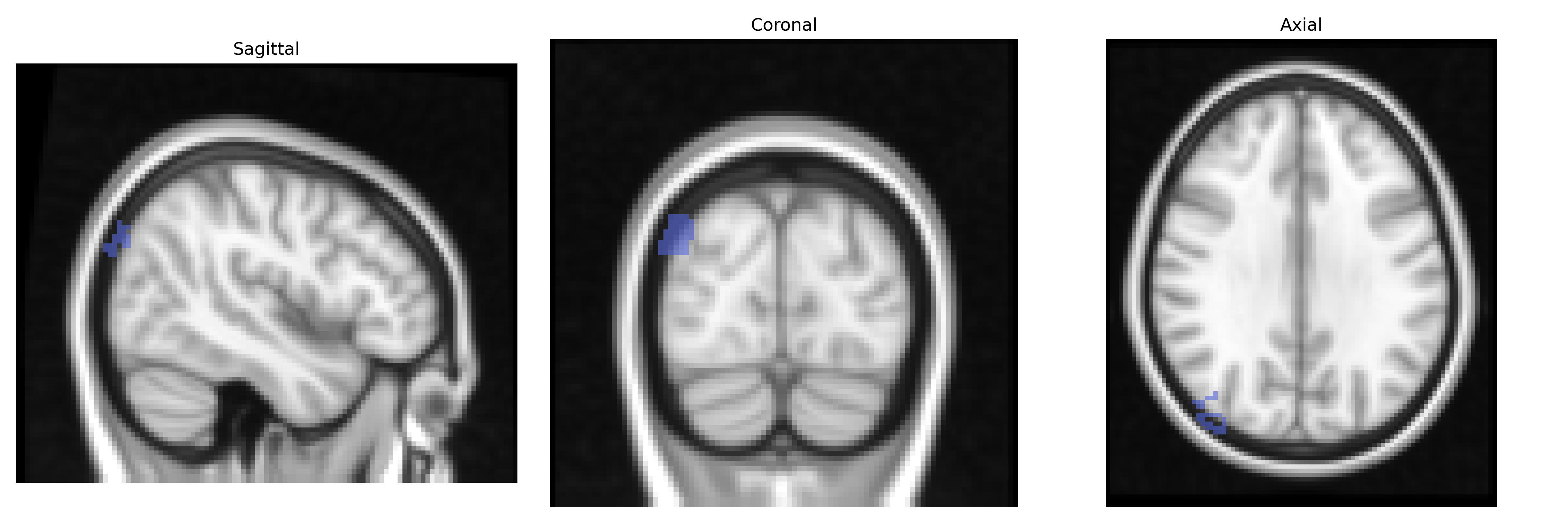
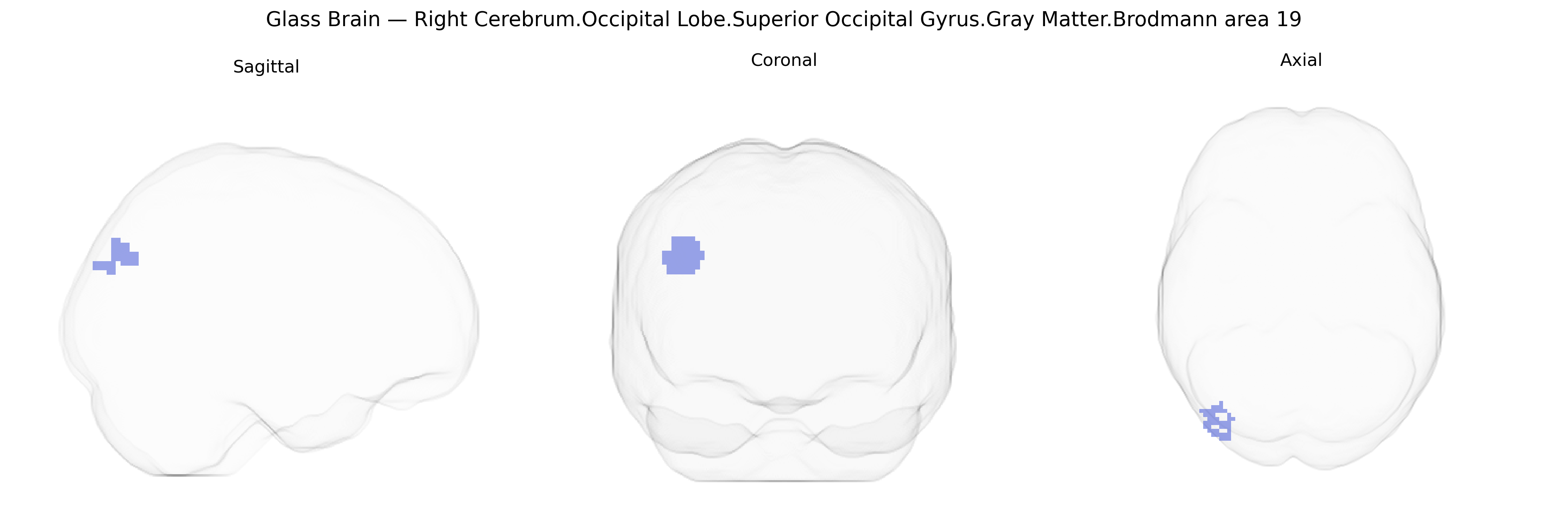
The bilateral Right Cerebrum.Occipital Lobe.Superior Occipital Gyrus.Gray Matter.Brodmann area 19 corresponds to higher-order visual association cortex situated dorsally within the occipital lobe, extending anteriorly from primary and secondary visual areas (BA17–18). This region participates in complex processing of visual information, including integration of motion, form, and spatial features, and contributes to visual object recognition, visuospatial analysis, and aspects of visual attention. Neuronal populations here receive convergent input from earlier visual areas and project to parietal and temporal association cortices, supporting multimodal integration within dorsal and ventral visual streams. Cytoarchitectonically, BA19 exhibits a well-developed granular layer IV and prominent supragranular layers, reflecting dense thalamocortical and corticocortical connectivity. There is no direct link for this exact Talairach label; a closely related structure is Brodmann area 19.
Brodmann area 19 in the bilateral right superior occipital gyrus (gray matter) is a higher-order visual association region, and genetic associations linked to this area largely emerge from imaging genetics and GWAS of brain structure and visual processing traits. Variants near or within genes influencing neurodevelopment and synaptic function—such as those regulating cortical thickness, surface area, and gray matter volume—have been associated with occipital and visual association cortices, including BA19, through large-scale MRI-based GWAS (e.g., ENIGMA and UK Biobank studies), though findings are usually reported at the lobe or occipital subregion level rather than Talairach-based micro-anatomy. Polygenic influences on visual cortex morphology overlap with genes implicated in neurodevelopmental and psychiatric disorders (such as schizophrenia and autism spectrum conditions), where case–control and imaging–genetic studies sometimes show altered BA19 structure or function associated with risk variants in synaptic, glutamatergic, and chromatin-remodeling pathways, but these are rarely specific to BA19. GWAS of visual acuity, refractive error, and reading-related traits have identified loci affecting the integrity and development of visual pathways, with downstream structural correlates in occipital association cortex, while studies of migraine with visual aura and certain forms of epilepsy have reported functional and structural changes in BA19 linked to broader genetic susceptibility loci (e.g., ion channel and cortical excitability genes). Overall, genetic associations for this precise Talairach-defined bilateral right BA19 region are indirect and largely inferred from broader occipital and visual association cortex GWAS, with no widely replicated, region-specific variants uniquely tied to this exact anatomical label.
Overview generated by GPT-4o (2026).
Region ID: 849
Hemisphere: bilateral
Atlas: Talairach labels 2mm
Full Quality Version: Download MP4
Full Quality Version: Download MP4
Wali Sidiqyar*, Gaurav Rudravaram*, Elyssa M. McMaster, Trent M. Schwartz, Adam M. Saunders, Kurt G. Schilling, Bennett A. Landman "Introducing SPINS: A Shared Public Visualization Library of Neuroanatomical Structures." Medical Imaging with Deep Learning- short paper
This resource is licensed under CC0 1.0 Universal (Public Domain).