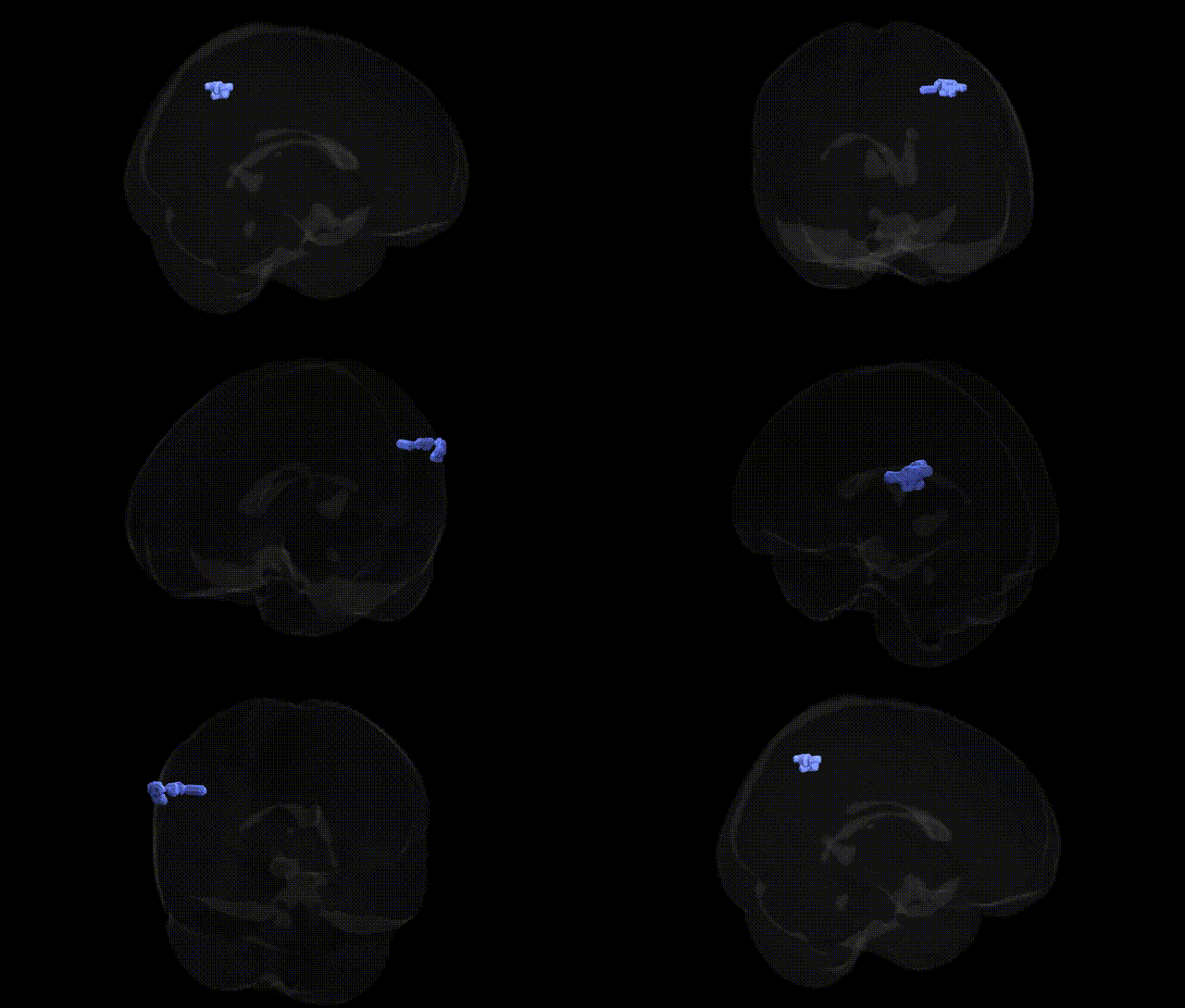
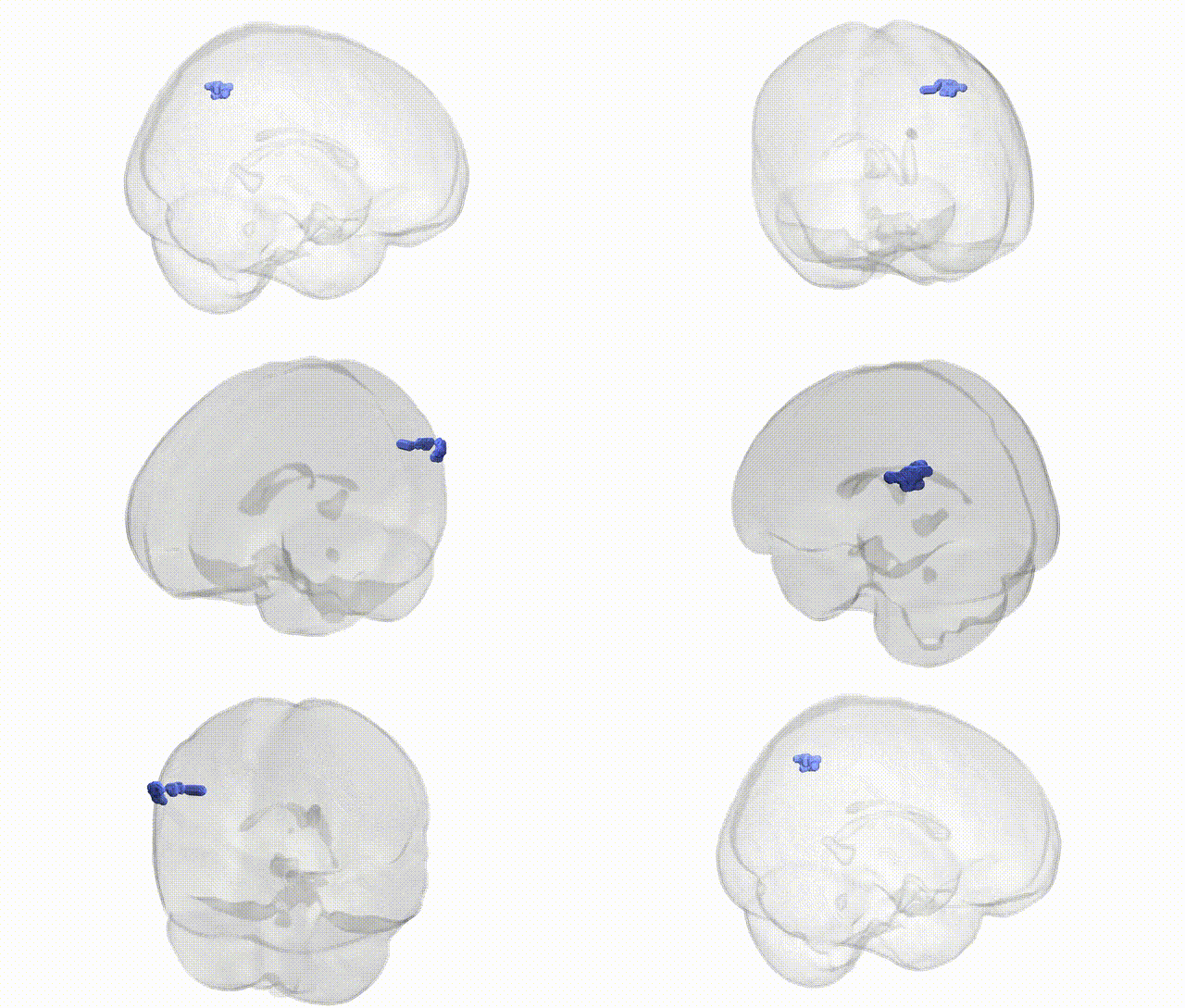
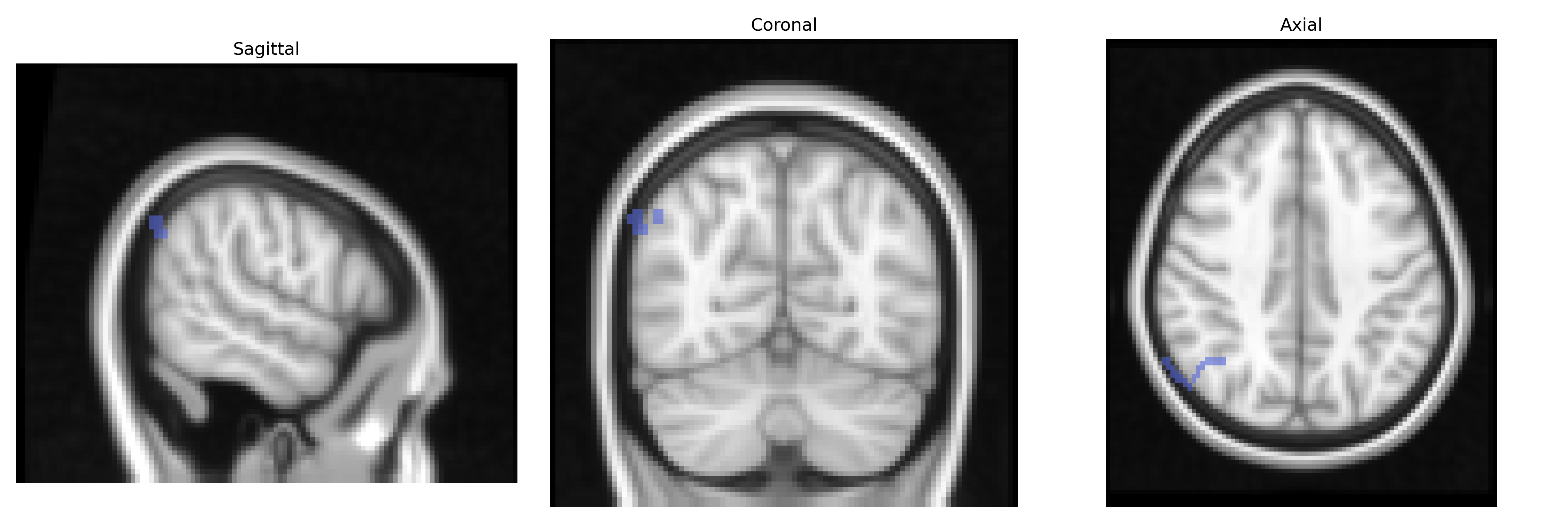
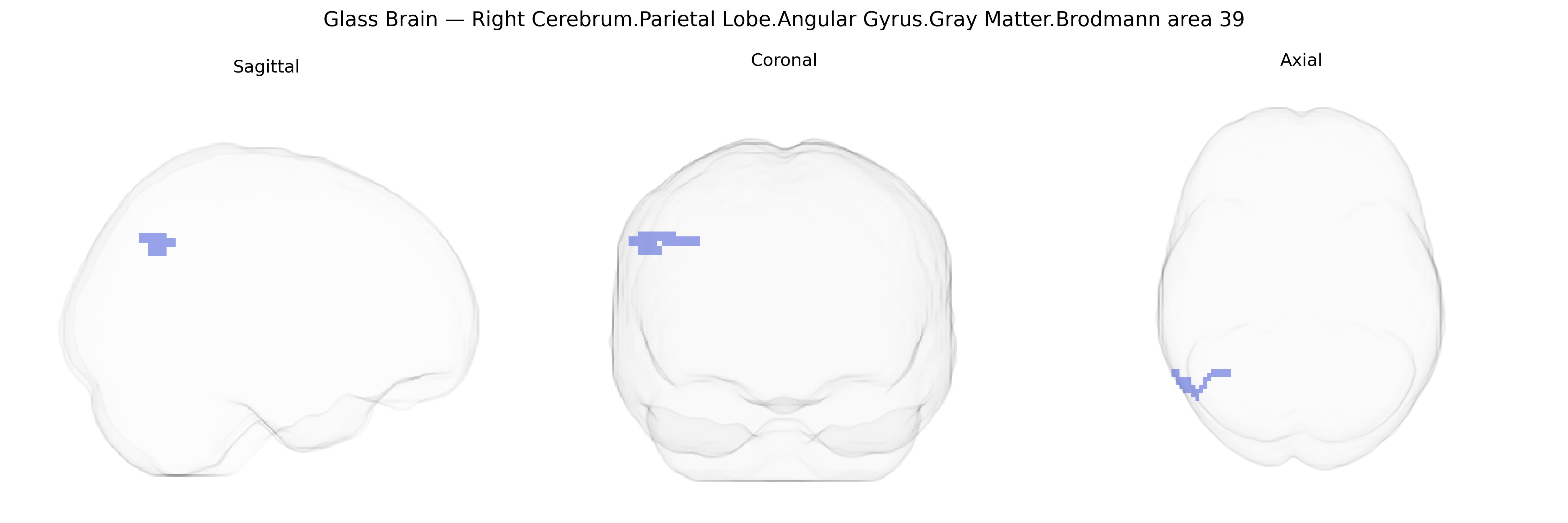
The bilateral Right Cerebrum.Parietal Lobe.Angular Gyrus.Gray Matter.Brodmann area 39, as defined in the Talairach 2 mm atlas, corresponds to the right angular gyrus within the inferior parietal lobule, a heteromodal associative cortical region implicated in the integration of visual, auditory, and somatosensory information. Brodmann area 39 in this territory is involved in language-related functions (including semantic processing, reading, and aspects of comprehension), number processing, spatial cognition, and theory of mind, and serves as a key node in the default mode and language networks. Structurally, its gray matter comprises layered neocortex receiving multimodal afferents from temporal, occipital, and parietal association areas and projecting to widespread cortical and subcortical regions, supporting higher-order cognitive operations that require cross-modal association and symbolic manipulation. Angular gyrus
The bilateral right angular gyrus (BA39) has been implicated in genetic studies primarily through its roles in language, semantic processing, number cognition, and social cognition, rather than via region-specific loci from Talairach-based GWAS. Large neuroimaging GWAS (e.g., ENIGMA, UK Biobank) have identified variants in and near genes such as HMGA2, IGF1, KIAA0586, and several neuronal development and synaptic genes that influence cortical thickness or surface area in inferior parietal and temporo-parietal association cortices, a territory that includes BA39; however, these findings typically map to broader parietal or temporo-parietal regions rather than the angular gyrus in isolation. Genetic risk for schizophrenia, major depression, ADHD, and autism spectrum disorder has been associated with structural and functional alterations in BA39, often as part of default-mode or language networks, through polygenic risk score and imaging-genetics analyses, with risk alleles in synaptic, glutamatergic, and neurodevelopmental pathways (e.g., CACNA1C, C4A, GRIN2A) linked to altered activation and connectivity involving the angular gyrus. In addition, GWAS of reading ability, dyslexia, and educational attainment have implicated variants in genes associated with axon guidance, neuronal migration, and cortical patterning, with downstream imaging work repeatedly highlighting BA39 as a hub for phonological and semantic integration, though again without single-gene, BA39-specific associations. Overall, genetic influences on the right angular gyrus appear to be mediated through polygenic effects on association cortex development, connectivity, and vulnerability to neuropsychiatric and cognitive phenotypes, rather than discrete loci uniquely tied to this Talairach-defined region.
Overview generated by GPT-4o (2026).
Region ID: 970
Hemisphere: bilateral
Atlas: Talairach labels 2mm
Full Quality Version: Download MP4
Full Quality Version: Download MP4
Wali Sidiqyar*, Gaurav Rudravaram*, Elyssa M. McMaster, Trent M. Schwartz, Adam M. Saunders, Kurt G. Schilling, Bennett A. Landman "Introducing SPINS: A Shared Public Visualization Library of Neuroanatomical Structures." Medical Imaging with Deep Learning- short paper
This resource is licensed under CC0 1.0 Universal (Public Domain).