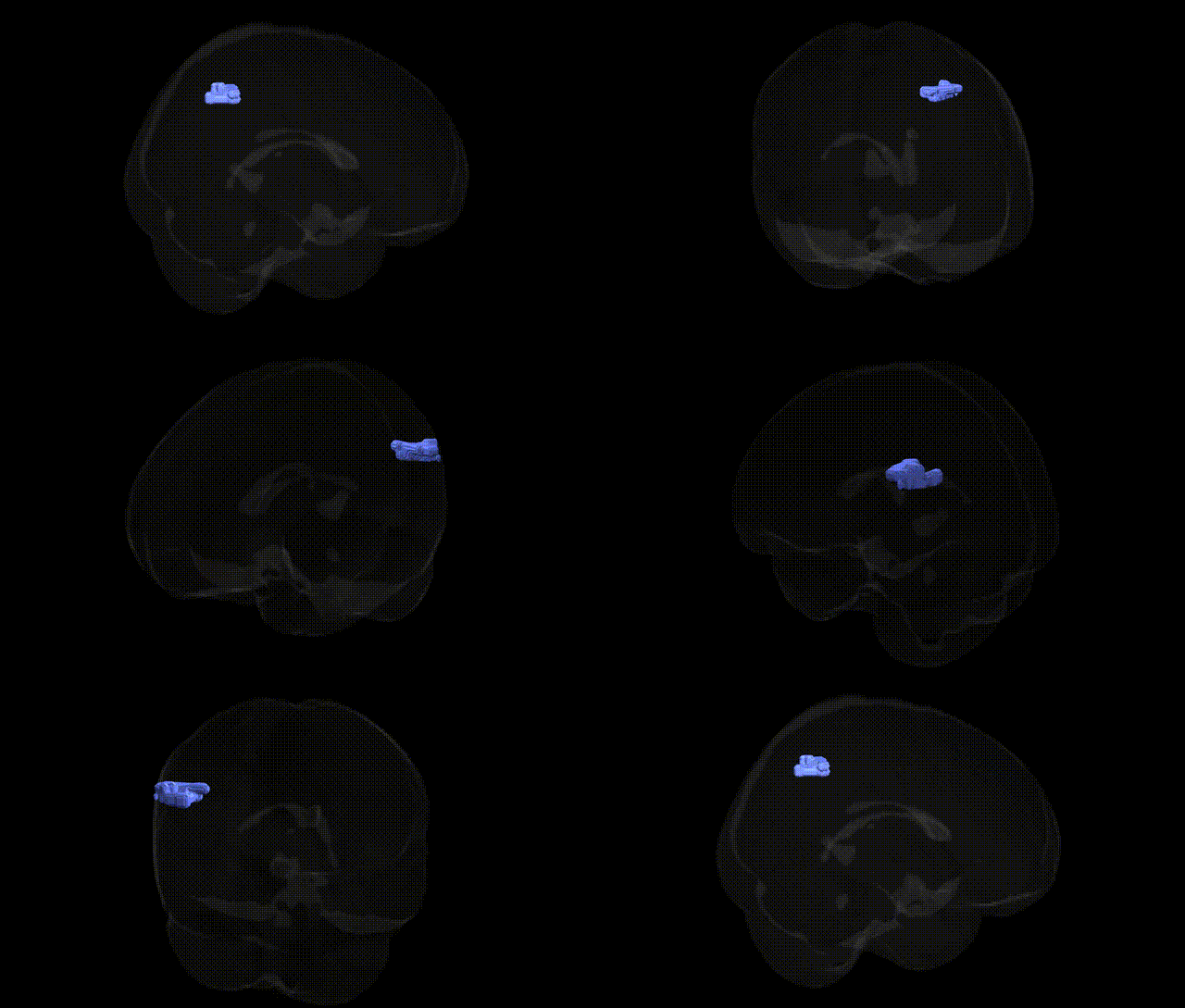
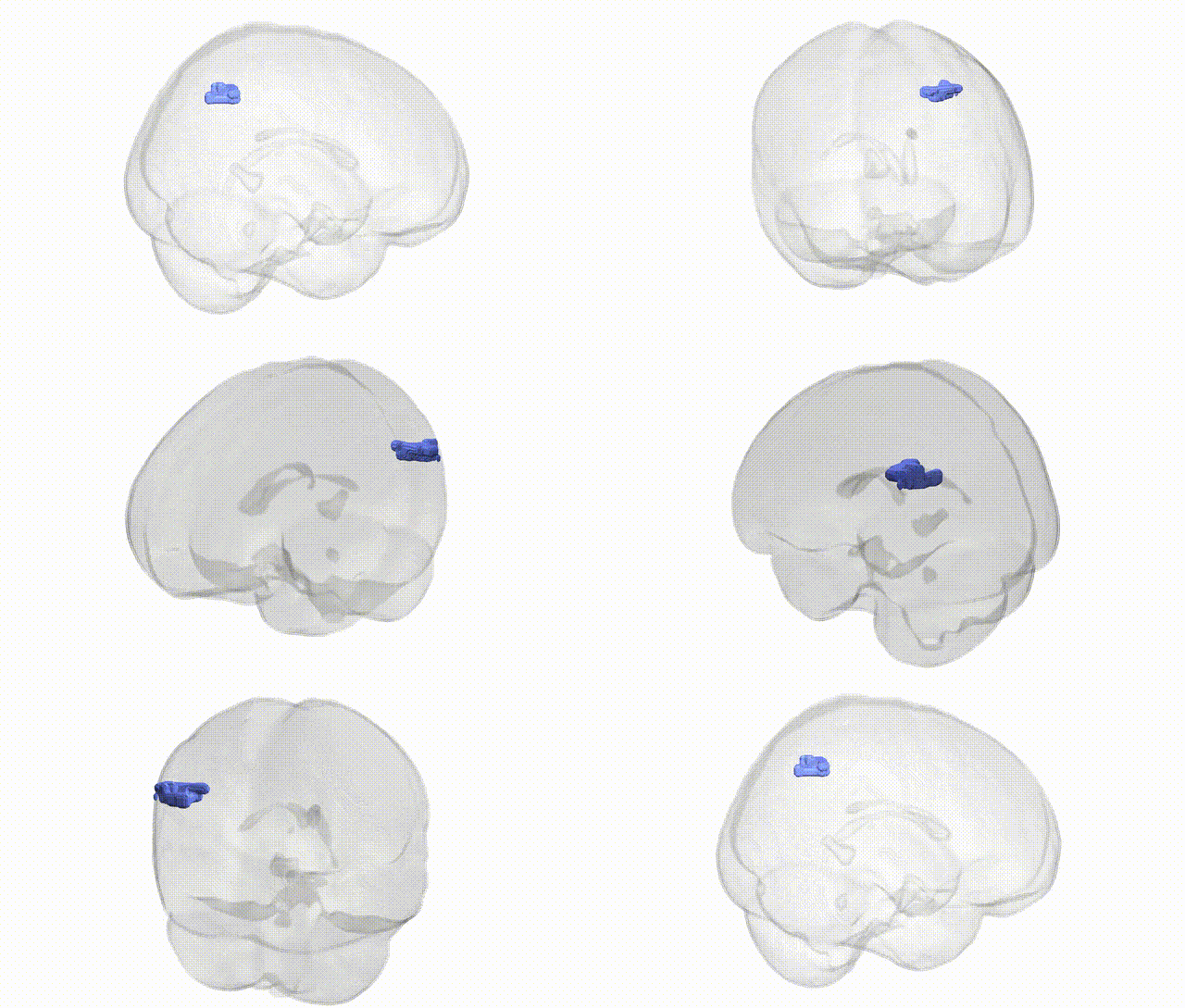
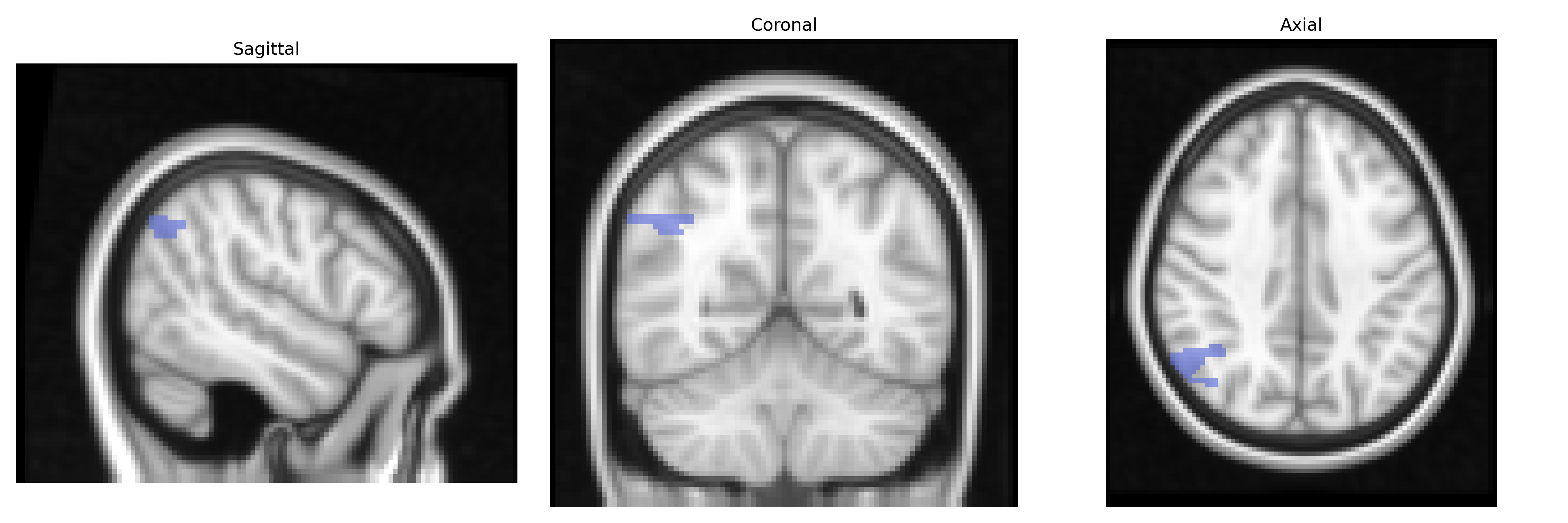
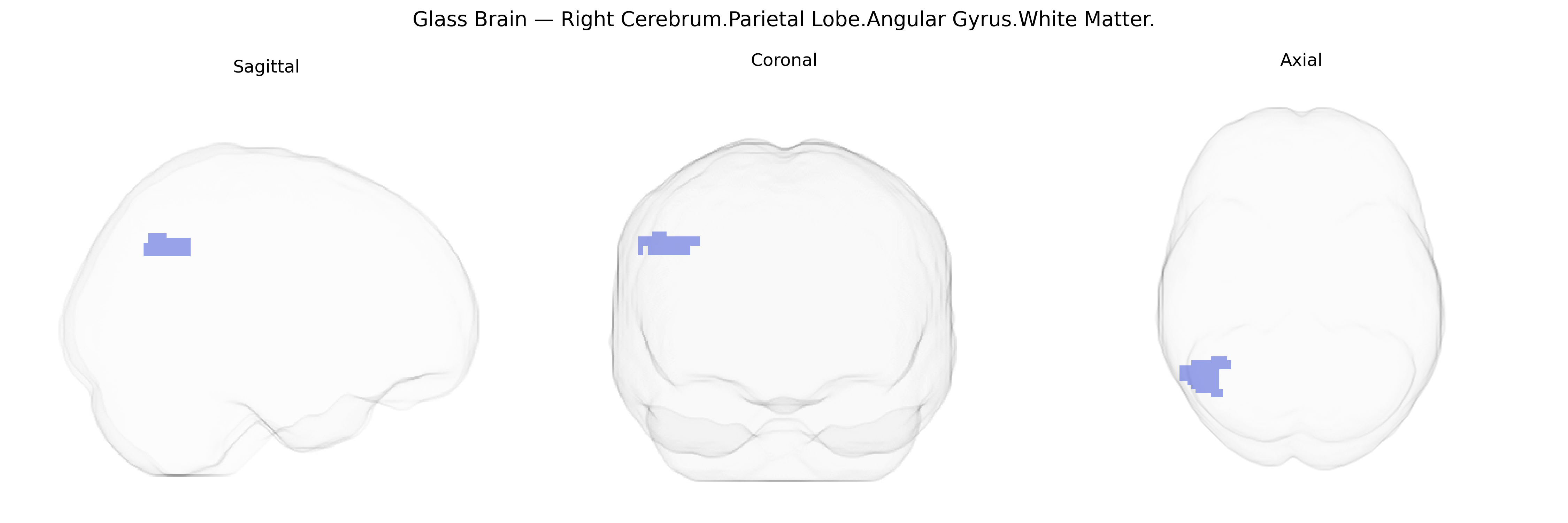
The bilateral Right Cerebrum.Parietal Lobe.Angular Gyrus.White Matter corresponds to the subcortical fiber pathways underlying the angular gyrus in the right parietal lobe, as defined in the Talairach 2 mm Atlas. This white matter region contains association fibers that interconnect the angular gyrus with other parietal areas, temporal cortex, and frontal regions, supporting large-scale networks involved in language, reading, number processing, spatial cognition, and multimodal integration. Although the Talairach label specifies right-sided anatomy, bilateral designation reflects homologous white matter tracts in both hemispheres. These fibers contribute to connectivity within the inferior parietal lobule and are critical for the integration of visual, auditory, and somatosensory information necessary for complex cognitive operations. There is no direct link for this specific white matter label; a related cortical structure is the Angular gyrus.
Genetic associations specifically targeting the bilateral Right Cerebrum.Parietal Lobe.Angular Gyrus.White Matter region from the Talairach 2 mm atlas are not well resolved at fine-grained parcellation levels, but GWAS and imaging-genetics studies implicate nearby parietal and temporoparietal white-matter pathways—and the angular gyrus region more broadly—in several traits and disorders. Large-scale GWAS of brain structure (e.g., ENIGMA and UK Biobank) have identified common variants in loci such as 17q21.31 (including MAPT/KANSL1), 6q22 (around RSPO3), and 3p24 (near MAPT-related networks) that influence global and regional white-matter microstructure (fractional anisotropy, mean diffusivity) in parietal association tracts that traverse or border the angular gyrus, including superior longitudinal fasciculus and posterior parts of the arcuate fasciculus. Polygenic risk for schizophrenia, bipolar disorder, and major depressive disorder has been associated with altered white-matter integrity in parietal and temporoparietal regions, and specific risk variants in genes such as CACNA1C, ZNF804A, and NRG1 have been linked to disrupted connectivity in fronto-parietal and temporoparietal networks that incorporate angular gyrus white matter. In autism spectrum conditions, common and rare variants in synaptic and axon-guidance genes (e.g., CNTNAP2, NRXN1) have been related to atypical long-range connectivity involving parietal association areas, while dyslexia and language-related GWAS point to genes like DCDC2, KIAA0319, and FOXP2 that influence white-matter properties in temporoparietal language pathways overlapping the angular gyrus region. Cognitive GWAS (intelligence, educational attainment) identify polygenic influences on association-cortex morphology and connectivity, with parietal and angular-gyrus–adjacent white matter repeatedly implicated in mediation analyses of genetic effects on higher-order cognition, although these effects are generally distributed and not limited to this specific Talairach label. Overall, the genetic architecture of this region’s white matter is highly polygenic and shared with broader association networks, with most findings arising from voxelwise or tract-based diffusion MRI GWAS rather than atlas-specific labels.
Overview generated by GPT-4o (2026).
Region ID: 966
Hemisphere: bilateral
Atlas: Talairach labels 2mm
Full Quality Version: Download MP4
Full Quality Version: Download MP4
Wali Sidiqyar*, Gaurav Rudravaram*, Elyssa M. McMaster, Trent M. Schwartz, Adam M. Saunders, Kurt G. Schilling, Bennett A. Landman "Introducing SPINS: A Shared Public Visualization Library of Neuroanatomical Structures." Medical Imaging with Deep Learning- short paper
This resource is licensed under CC0 1.0 Universal (Public Domain).