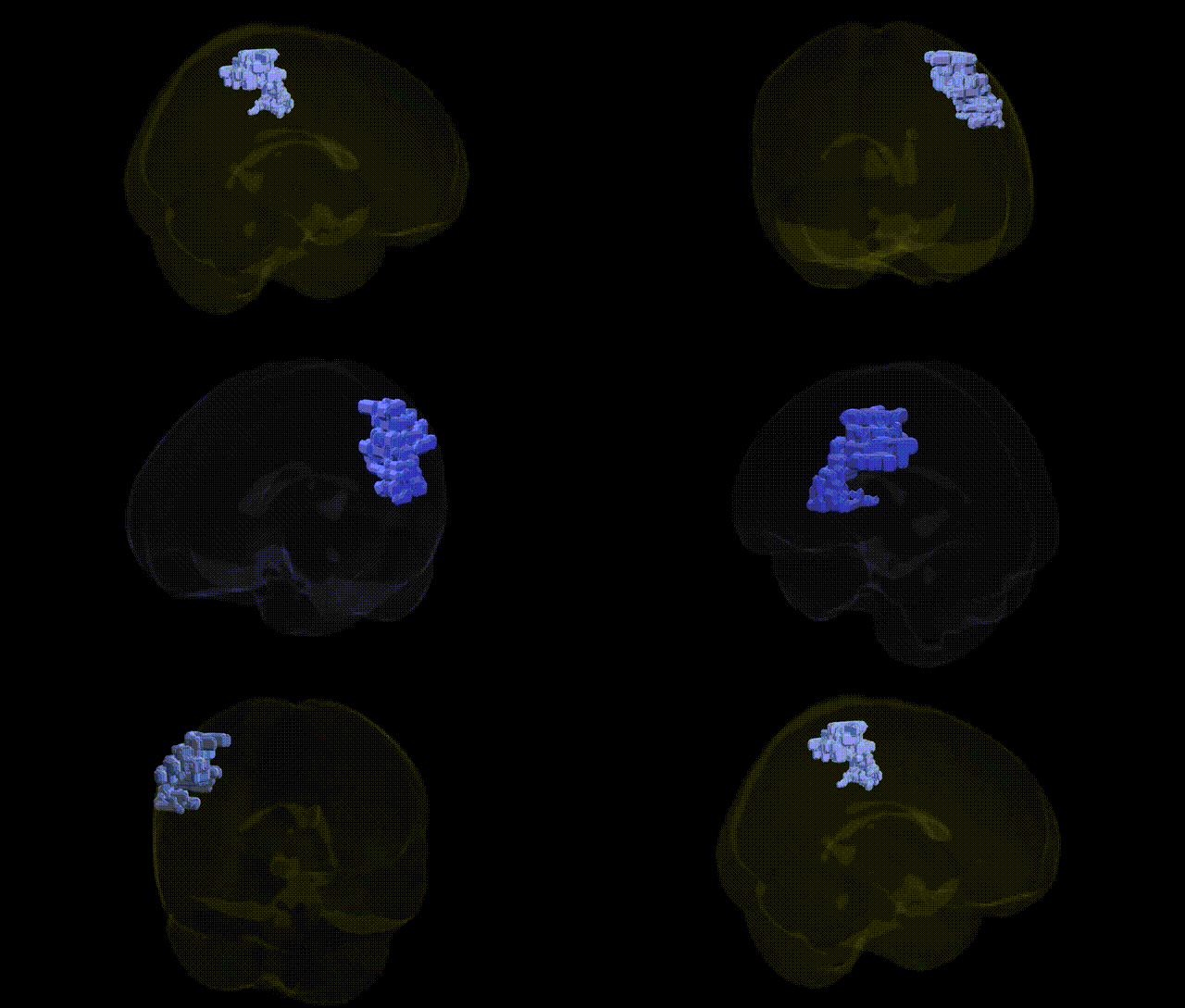
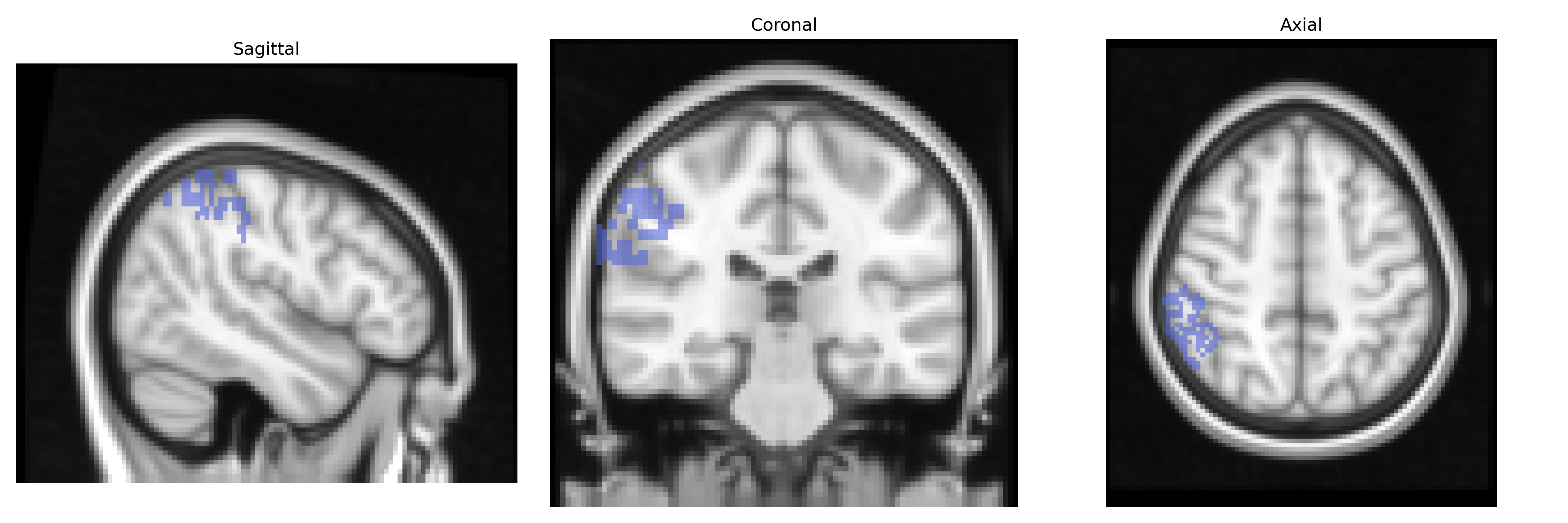
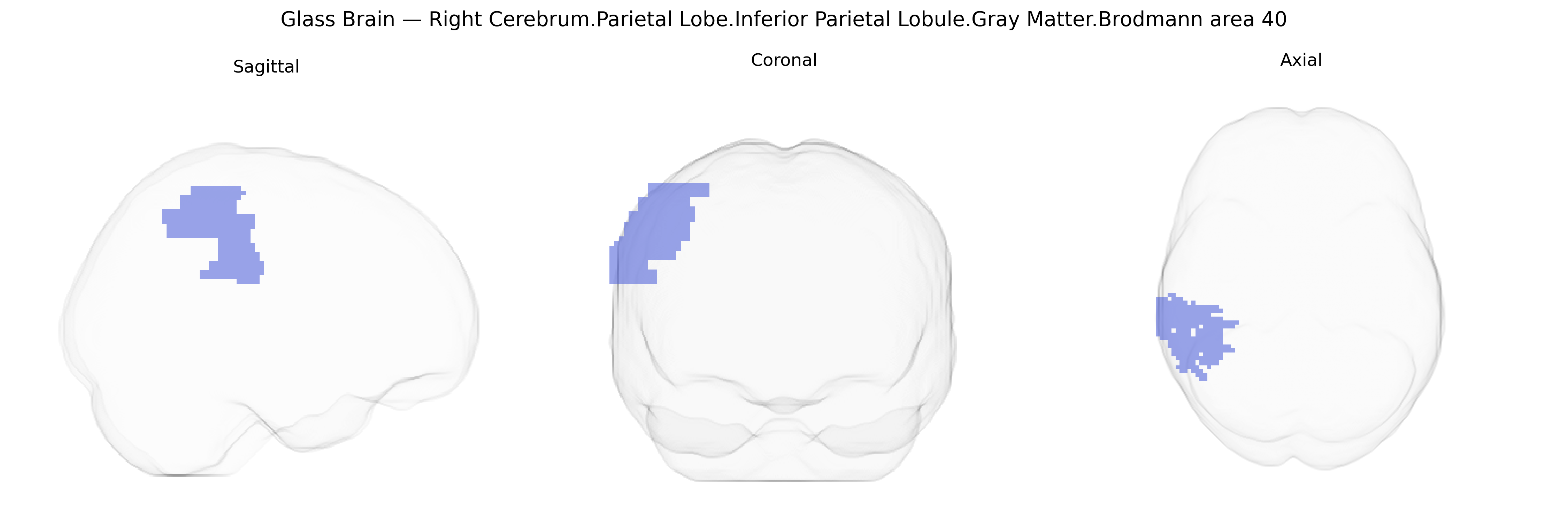
The bilateral Right Cerebrum.Parietal Lobe.Inferior Parietal Lobule.Gray Matter.Brodmann area 40 corresponds to a cortical territory in the supramarginal gyrus of the inferior parietal lobule, situated at the posterior end of the lateral fissure. This region integrates multimodal sensory information, contributing critically to phonological processing, speech perception, language comprehension, and aspects of reading and writing, as well as to spatial attention, body schema, and praxis. It participates in higher-order cognitive functions such as working memory and social cognition through extensive connections with temporal, frontal, and occipital cortices. A direct Wikipedia article for this specific Talairach-defined region does not exist; a closely related structure is the Supramarginal gyrus.
The bilateral right inferior parietal lobule gray matter in Brodmann area 40 (Talairach labels 2 mm Atlas) has been repeatedly implicated in genetic studies of cognitive and neuropsychiatric traits, particularly through imaging genetics and GWAS of brain structure and function. Large-scale GWAS of cortical thickness and surface area (e.g., ENIGMA, UK Biobank) have identified variants in genes involved in neurodevelopment (such as MEF2C, BDNF, and DCC among others) that influence parietal lobe morphology, including inferior parietal regions, which in turn are associated with general cognitive ability, educational attainment, and working memory performance. Functional imaging genetics work has linked polymorphisms in dopaminergic and glutamatergic genes (e.g., COMT Val158Met, DRD2, GRM3) to activation patterns in BA40 during attention, language processing, and numerical cognition tasks, suggesting that common variants modulate parietal network efficiency. GWAS of neurodevelopmental and psychiatric disorders—such as schizophrenia, autism spectrum disorder, and attention-deficit/hyperactivity disorder—have identified risk loci in synaptic and axon guidance genes (e.g., CACNA1C, CNTNAP2, and others) that are associated with altered parietal connectivity and gray matter in BA40, consistent with the region’s role in social cognition and attentional control. Additionally, imaging genetics studies on Alzheimer’s disease risk alleles (including APOE ε4 and loci near CLU and PICALM) have reported associations with atrophy, hypometabolism, or disconnection in inferior parietal regions, linking genetic susceptibility to BA40’s involvement in episodic memory networks. Together, these findings suggest that genetic variation affecting neurodevelopment, synaptic plasticity, and neurotransmission contributes to structural and functional differences in right BA40, which in turn are associated with cognitive performance and vulnerability to multiple neuropsychiatric and neurodegenerative conditions.
Overview generated by GPT-4o (2026).
Region ID: 881
Hemisphere: bilateral
Atlas: Talairach labels 2mm
Full Quality Version: Download MP4
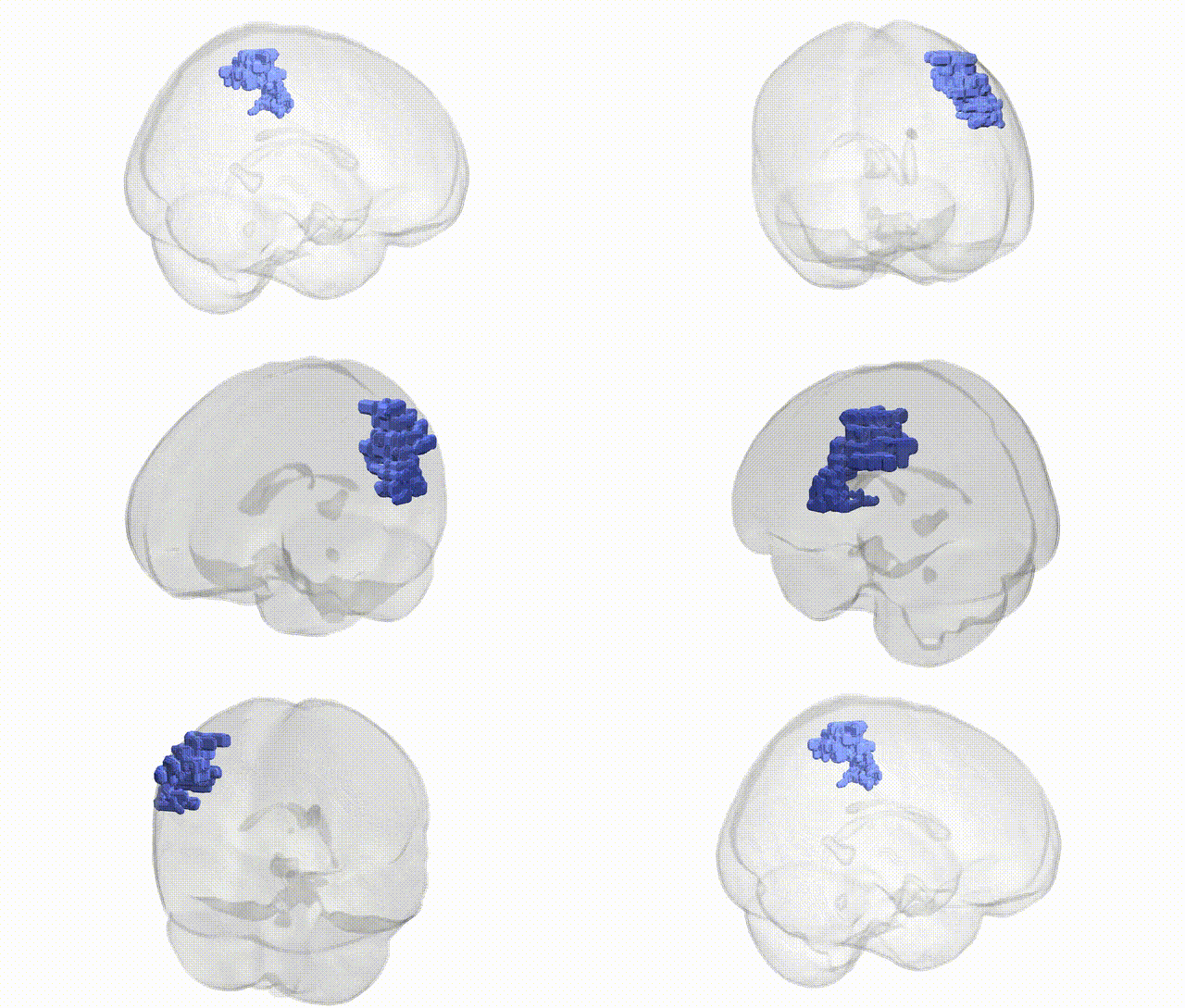
Full Quality Version: Download MP4
Wali Sidiqyar*, Gaurav Rudravaram*, Elyssa M. McMaster, Trent M. Schwartz, Adam M. Saunders, Kurt G. Schilling, Bennett A. Landman "Introducing SPINS: A Shared Public Visualization Library of Neuroanatomical Structures." Medical Imaging with Deep Learning- short paper
This resource is licensed under CC0 1.0 Universal (Public Domain).