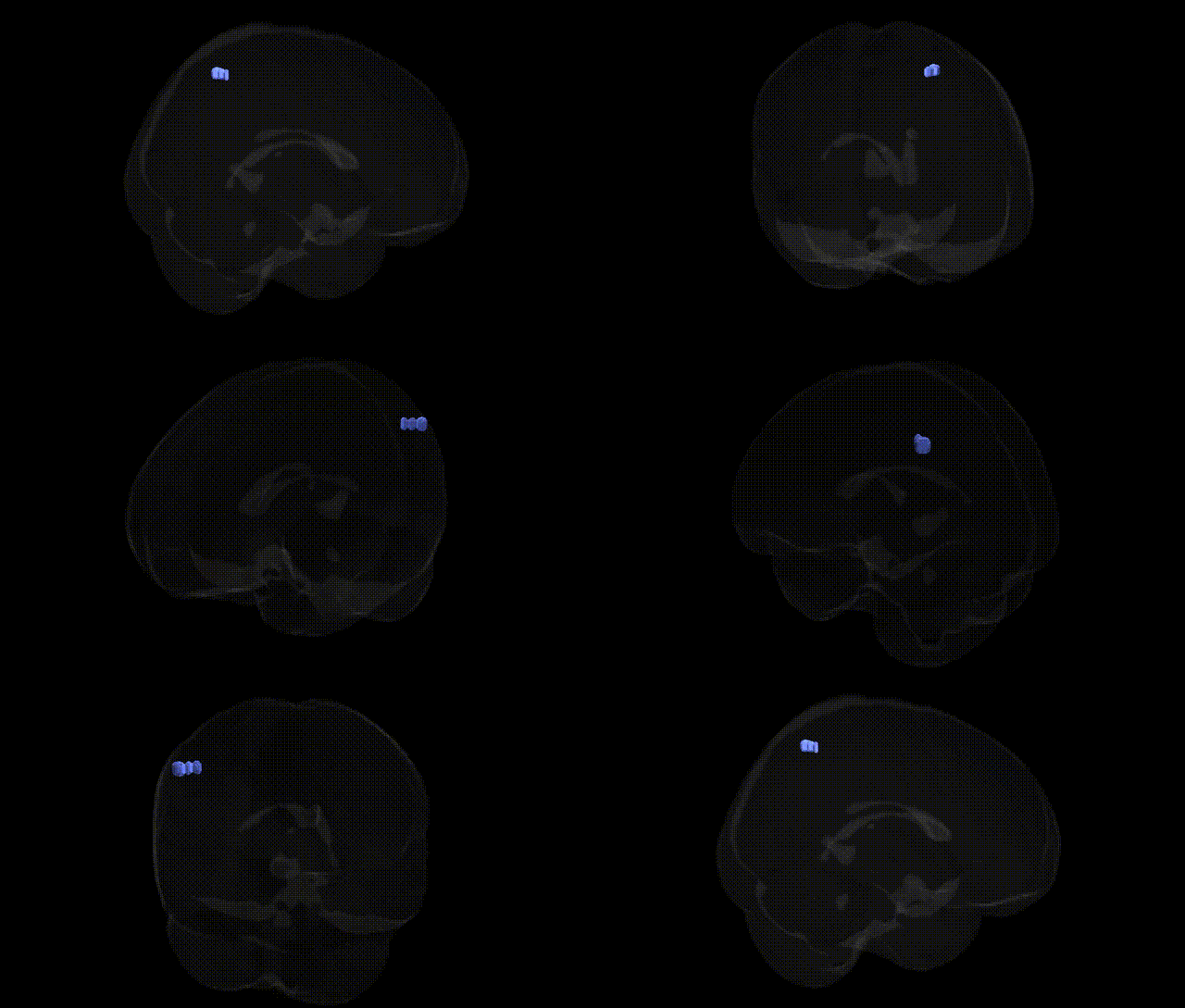
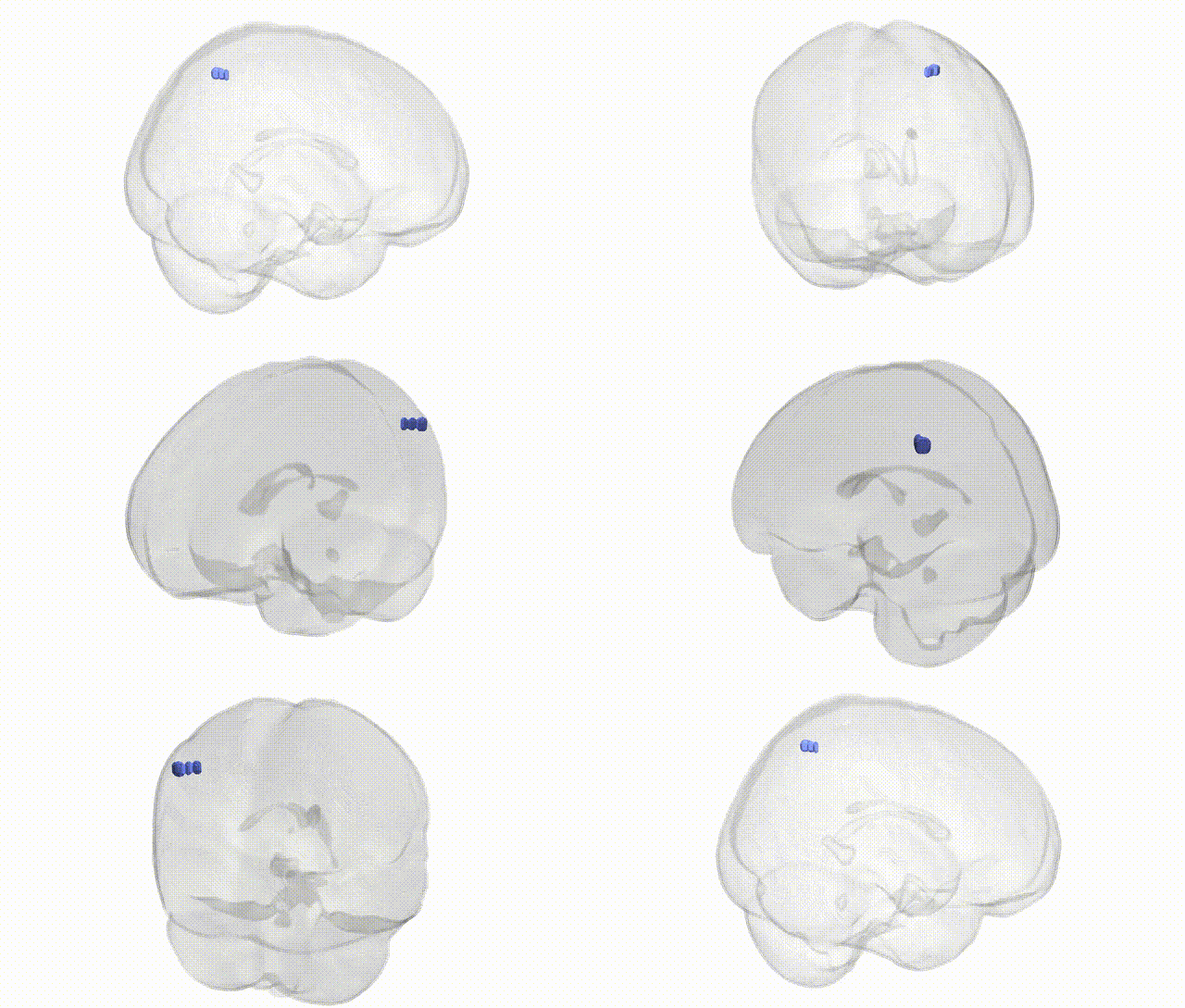
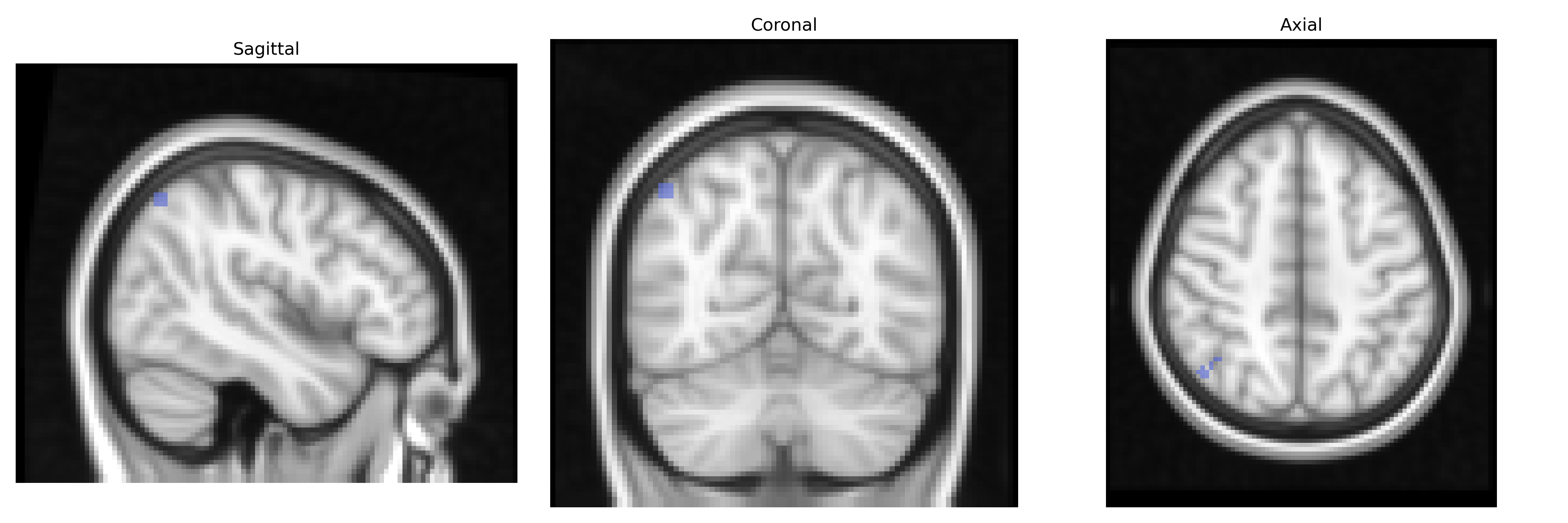
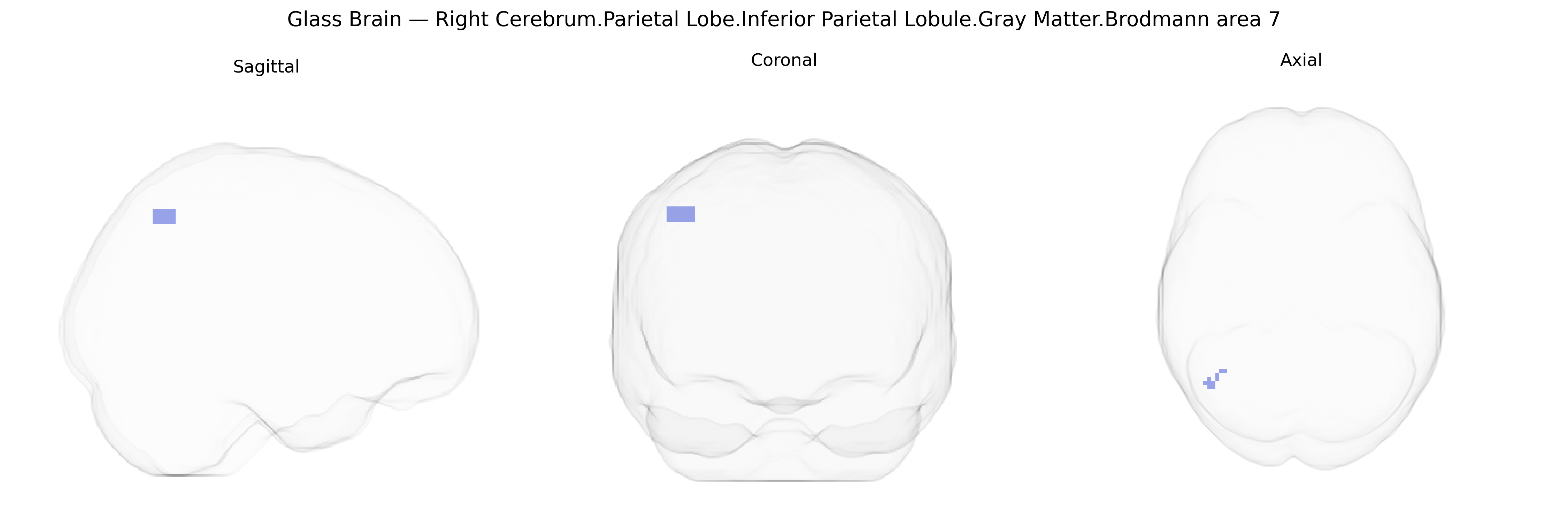
The bilateral Right Cerebrum.Parietal Lobe.Inferior Parietal Lobule.Gray Matter.Brodmann area 7 corresponds to a portion of the superior and posterior parietal cortex involved in the integration of visual, somatosensory, and proprioceptive information for spatial awareness, visuomotor coordination, and attention. As part of the dorsal stream of cortical processing, this region contributes to the representation of extrapersonal space, guidance of eye and limb movements, and higher-order aspects of sensorimotor transformation. Neurons in Brodmann area 7 participate in constructing internal models of the environment and body position, supporting functions such as visually guided reaching, object localization, and aspects of mental imagery related to spatial relationships. There is no direct link for this exact Talairach-defined bilateral region; a closely related structure is Brodmann area 7.
The bilateral right inferior parietal lobule (IPL) gray matter in Brodmann area 7, as defined in the Talairach 2 mm atlas, has been implicated in multiple genetic and GWAS-based findings, primarily through imaging genetics studies linking common variants to cortical thickness, surface area, and functional activation. Variants in genes related to synaptic plasticity and neurodevelopment—such as BDNF (e.g., Val66Met), COMT, and several glutamatergic and GABAergic pathway genes—have been associated with structural and functional variation in parietal association cortex, including BA7, often in the context of working memory, visuospatial attention, and higher-order cognitive integration. Large-scale GWAS of brain morphology (e.g., ENIGMA consortium studies) have identified polygenic influences on parietal lobe gray matter volume and thickness, with significant loci in neurodevelopmental and cell-adhesion genes (such as those near HMGA2 and IGF1) contributing to interindividual differences, although signals rarely map uniquely to BA7. Genetic risk for schizophrenia, bipolar disorder, and major depression—indexed by polygenic risk scores—has been linked to altered structure and connectivity of the inferior parietal lobule, suggesting that BA7 participates in distributed networks affected by psychiatric risk variants. GWAS of intelligence, educational attainment, and cognitive performance have also reported correlations between polygenic scores for these traits and structural measures in parietal association areas, supporting a role for genetically influenced parietal morphology, including BA7, in cognitive ability. Additionally, some autism spectrum disorder and attention-deficit/hyperactivity disorder imaging genetics studies have reported associations between disorder-related risk variants and altered activation or connectivity of BA7 during attention, social cognition, and visuospatial tasks, though findings are typically network-level rather than region-specific and rely heavily on parietal involvement in dorsal attention and default-mode subsystems.
Overview generated by GPT-4o (2026).
Region ID: 1044
Hemisphere: bilateral
Atlas: Talairach labels 2mm
Full Quality Version: Download MP4
Full Quality Version: Download MP4
Wali Sidiqyar*, Gaurav Rudravaram*, Elyssa M. McMaster, Trent M. Schwartz, Adam M. Saunders, Kurt G. Schilling, Bennett A. Landman "Introducing SPINS: A Shared Public Visualization Library of Neuroanatomical Structures." Medical Imaging with Deep Learning- short paper
This resource is licensed under CC0 1.0 Universal (Public Domain).