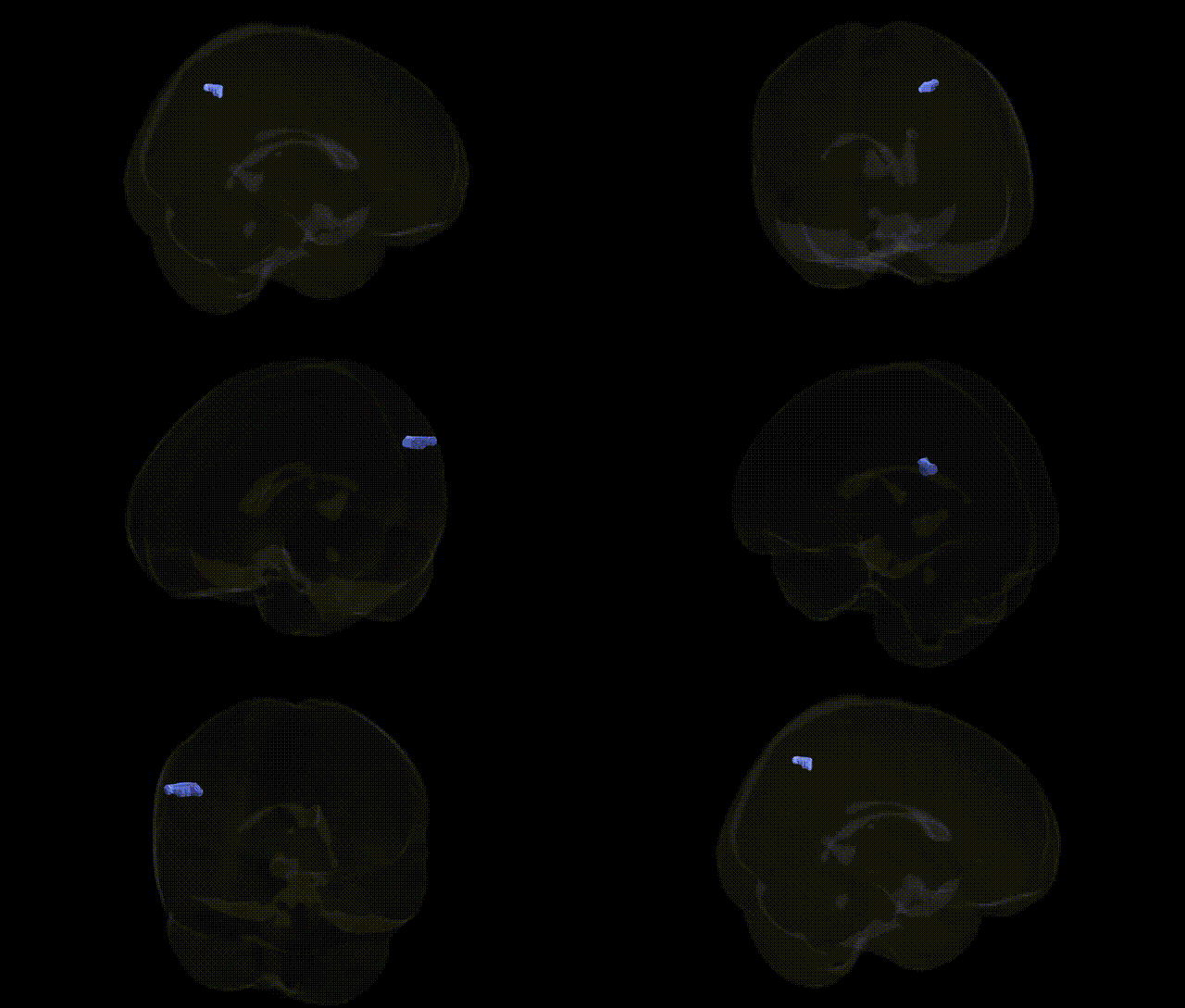
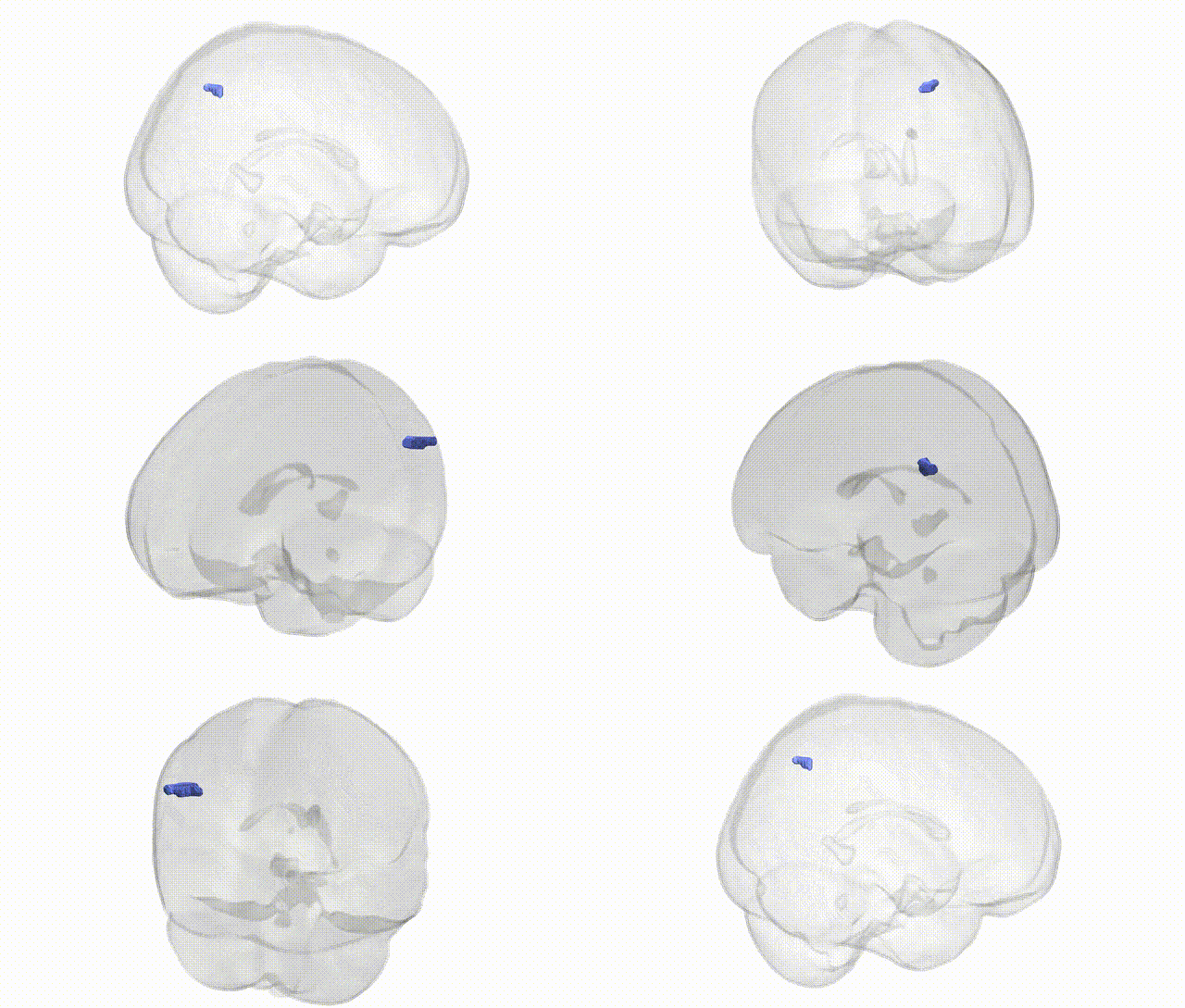
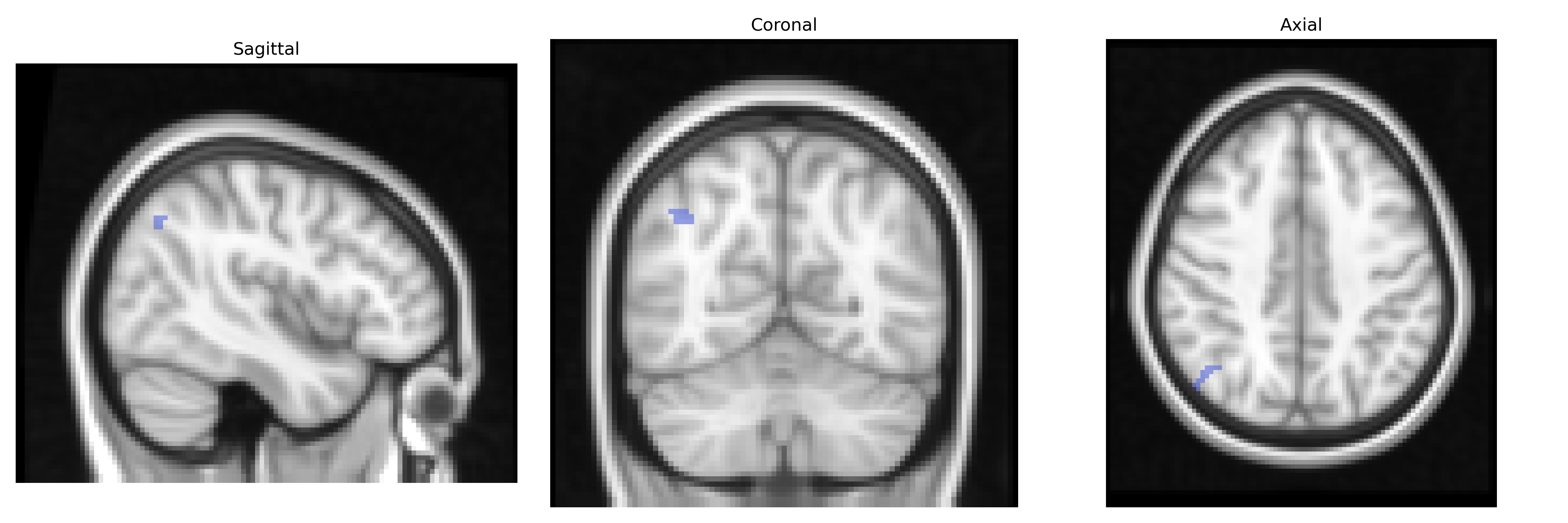
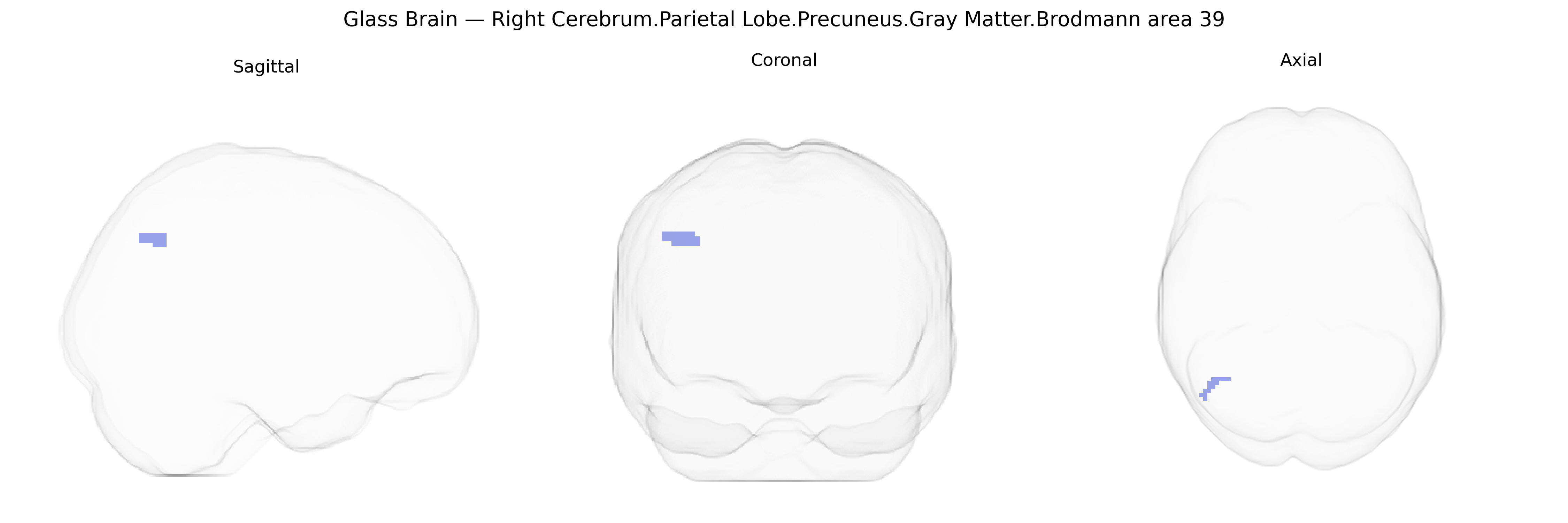
The bilateral Right Cerebrum.Parietal Lobe.Precuneus.Gray Matter.Brodmann area 39 corresponds predominantly to the right angular gyrus region within the inferior parietal lobule, bordering the precuneus medially. Brodmann area 39 is an association cortex that integrates multimodal sensory information (visual, auditory, and somatosensory) and plays key roles in language-related processes (such as reading and semantic processing), spatial cognition, number processing, and aspects of social cognition and theory of mind. In the right hemisphere, this region is particularly implicated in visuospatial integration, attention reorientation, and components of episodic memory retrieval. As part of the heteromodal association cortex, BA39 participates in large-scale networks including the default mode and fronto-parietal networks, contributing to higher-order cognitive functions that require integration of distributed information across the brain. There is no direct Wikipedia article for this exact Talairach label; a closely related structure is the Angular gyrus.
The bilateral right precuneus gray matter in Brodmann area 39 (parietal lobe, as indexed in the Talairach 2 mm atlas) has been repeatedly implicated in genetic studies of brain structure and function, although most work targets the broader precuneus or inferior parietal/temporoparietal regions rather than this precise atlas-defined unit. Twin and family studies indicate high heritability of precuneus cortical thickness and surface area, with polygenic influences broadly overlapping those for general cognitive ability, default mode network connectivity, and cortical morphology. Large-scale GWAS of regional cortical thickness and surface area (e.g., ENIGMA, UK Biobank) have identified risk loci in or near genes involved in neurodevelopment and synaptic function (such as KIAA0586, CENPW, and microtubule/axon guidance genes) that modulate parietal and precuneus anatomy, although these associations are typically reported for composite parietal or medial parietal regions rather than Brodmann area 39 alone. Functionally, genetic variation affecting Alzheimer’s disease risk (including APOE ε4 and loci near CLU, PICALM, and CR1) is associated with atrophy, hypometabolism, and disrupted connectivity in the precuneus/temporoparietal junction, a core hub of early Alzheimer’s pathology. Schizophrenia, major depression, and autism spectrum disorder GWAS have also shown convergent effects on default mode network nodes, including the precuneus and angular gyrus, with polygenic risk scores correlating with altered gray matter volume or resting-state connectivity in this territory. Additional GWAS and imaging-genetics work link precuneus and BA39-related variation to traits such as intelligence, memory, mind-wandering, and self-referential processing via distributed polygenic influences on cortical development and network organization, but no single gene or variant appears uniquely specific to the bilateral right BA39 gray matter as defined by the Talairach 2 mm atlas.
Overview generated by GPT-4o (2026).
Region ID: 989
Hemisphere: bilateral
Atlas: Talairach labels 2mm
Full Quality Version: Download MP4
Full Quality Version: Download MP4
Wali Sidiqyar*, Gaurav Rudravaram*, Elyssa M. McMaster, Trent M. Schwartz, Adam M. Saunders, Kurt G. Schilling, Bennett A. Landman "Introducing SPINS: A Shared Public Visualization Library of Neuroanatomical Structures." Medical Imaging with Deep Learning- short paper
This resource is licensed under CC0 1.0 Universal (Public Domain).