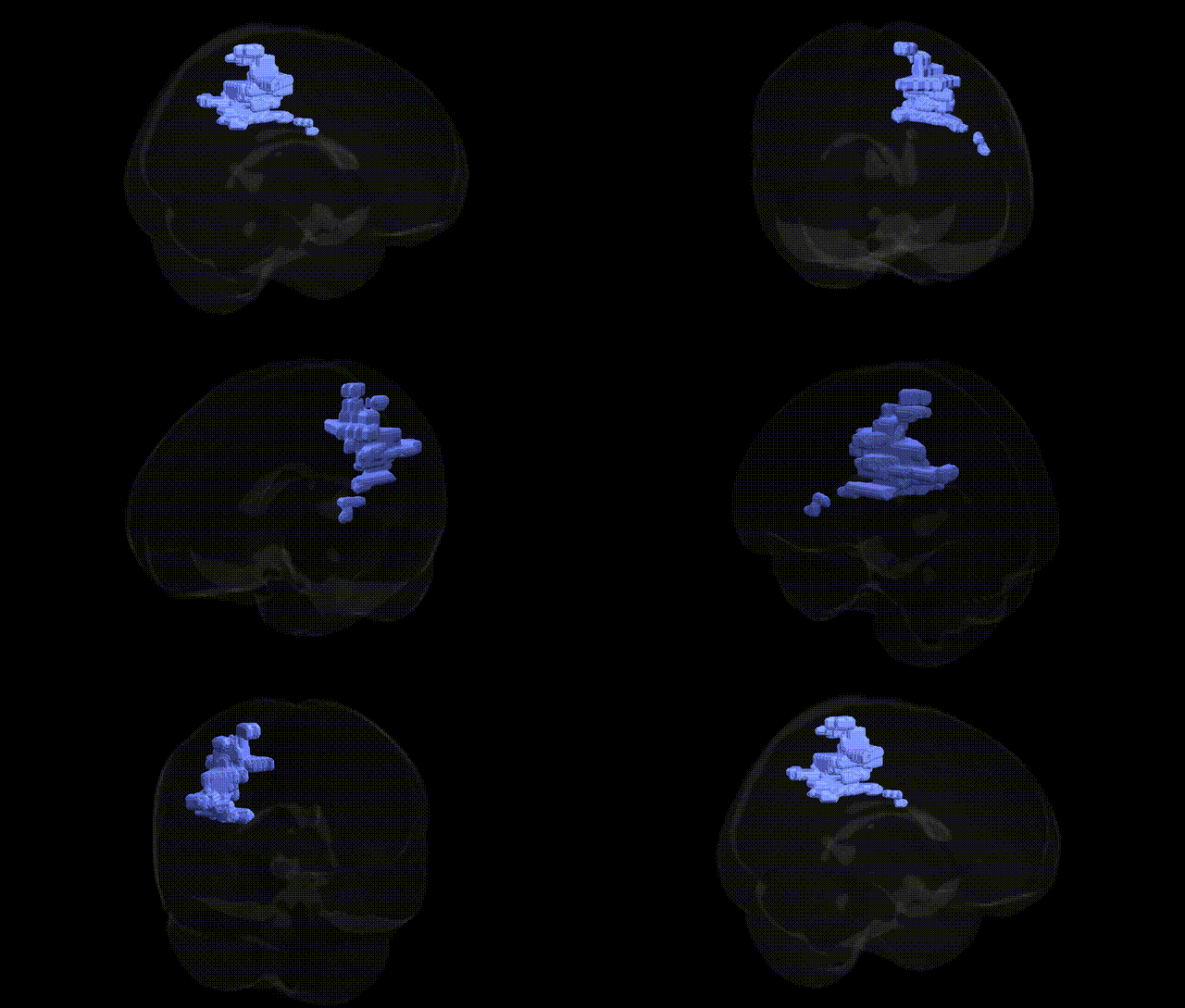
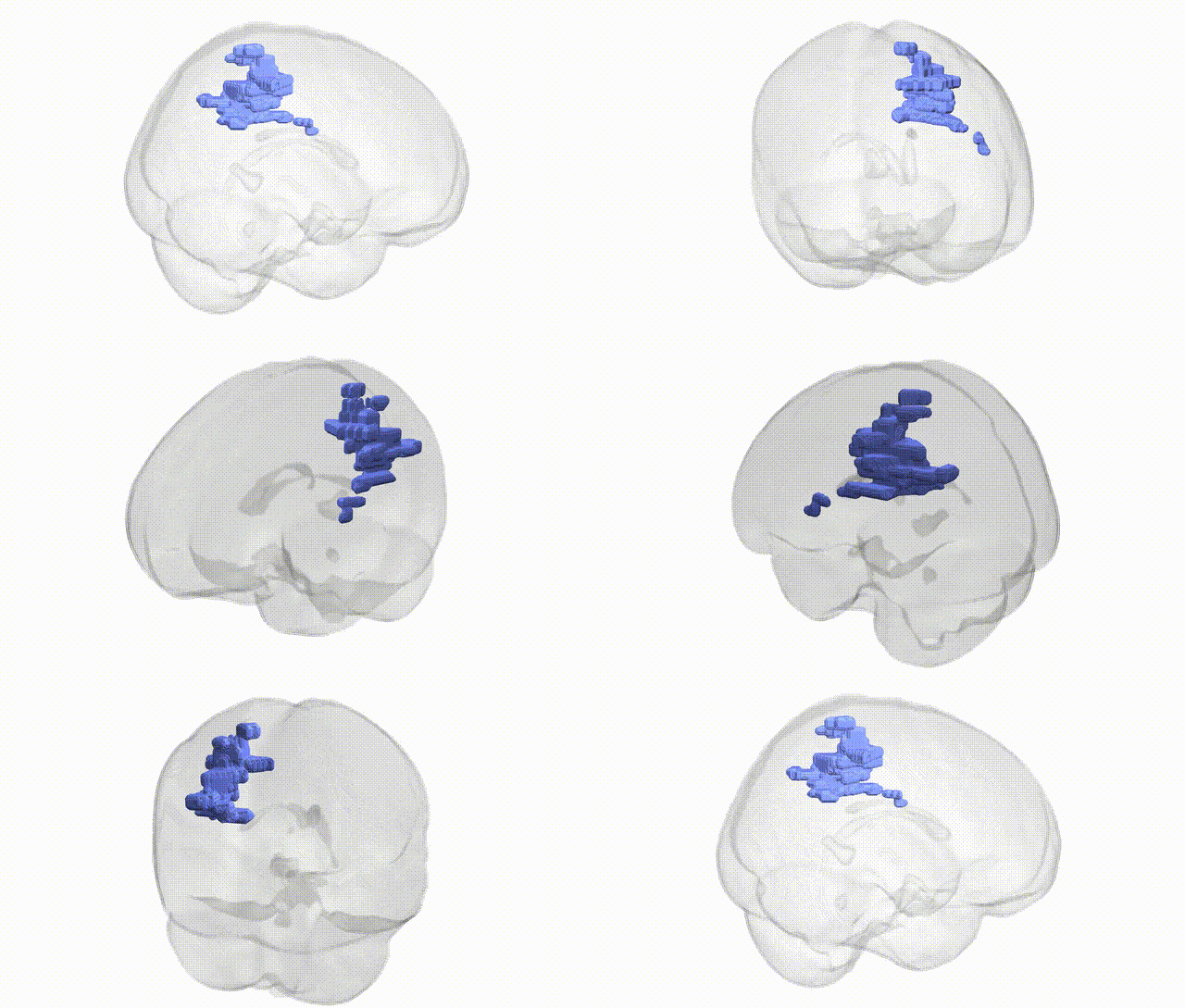
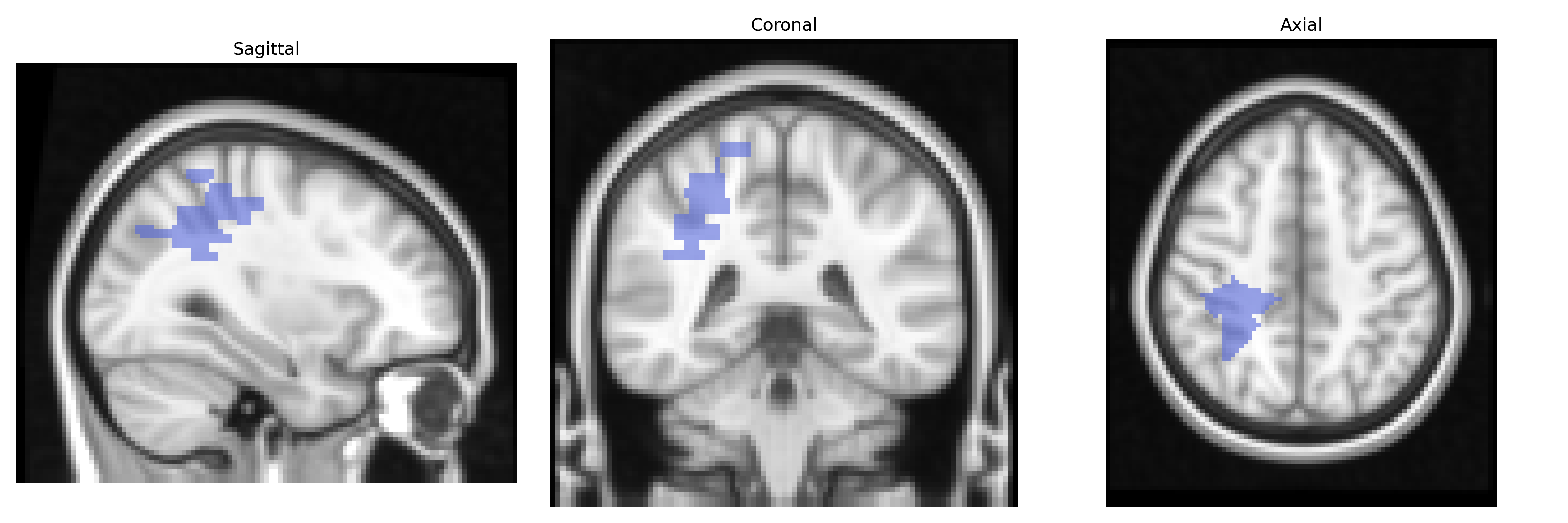
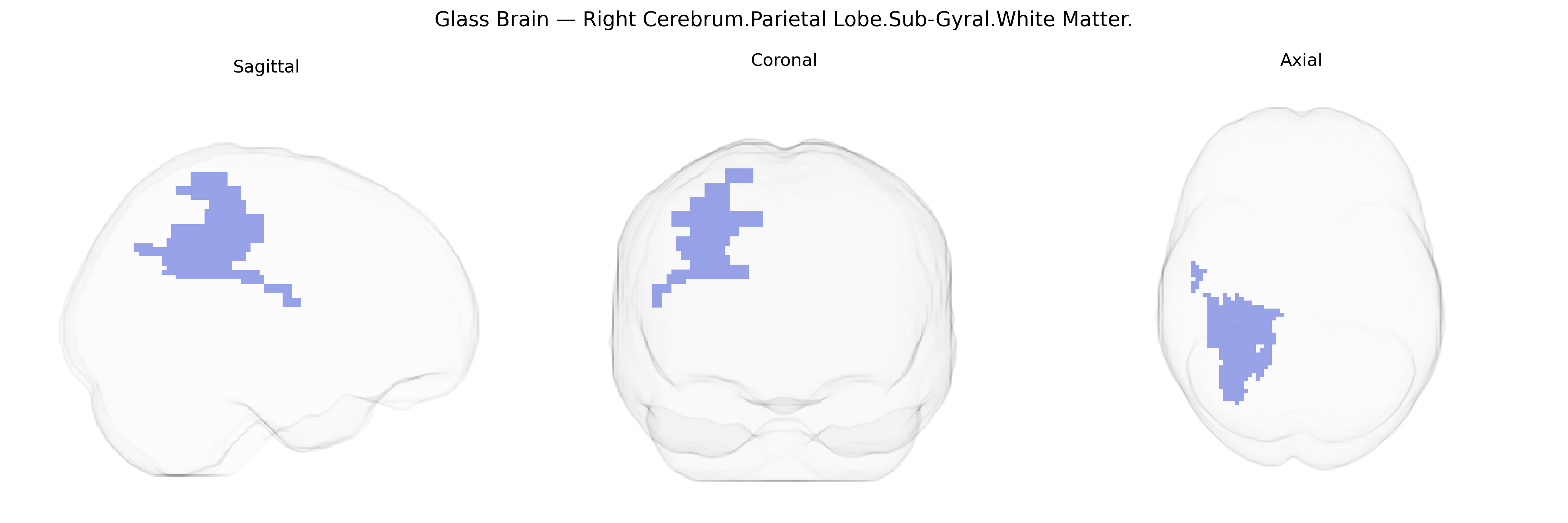
The bilateral Right Cerebrum.Parietal Lobe.Sub-Gyral.White Matter refers to deep parietal lobe white matter beneath the cortical gyri of the right hemisphere, encompassing association fiber tracts that interconnect parietal regions with frontal, temporal, and occipital cortices. This sub-gyral white matter plays a key role in integrating somatosensory, visuospatial, and attentional information by supporting communication between primary sensory areas and higher-order multimodal association cortices. Functionally, these fibers contribute to processes such as spatial orientation, body schema representation, and coordinated sensorimotor integration, and are often involved in large-scale networks underlying attention and visuospatial cognition. There is no direct Wikipedia article for this specific sub-gyral white matter region; a closely related structure is the Parietal lobe.
The bilateral Right Cerebrum Parietal Lobe Sub-Gyral White Matter region (Talairach 2 mm atlas) has been implicated indirectly in genetic studies through its role in major white matter tracts supporting sensorimotor integration, attention, visuospatial processing, and higher-order cognition, rather than as a uniquely targeted locus. GWAS and imaging-genetics work on white matter microstructure (including diffusion tensor imaging measures such as fractional anisotropy and mean diffusivity in parietal association tracts like the superior longitudinal fasciculus) have identified common variants in genes involved in axon guidance, myelination, and synaptic function—such as NRG1, ERBB4, CNTNAP2, and multiple loci within oligodendrocyte-related pathways—that influence parietal white matter integrity. Large GWAS of brain imaging phenotypes (e.g., UK Biobank and ENIGMA) have reported polygenic effects on regional white matter volume and connectivity that overlap with genetic architectures of cognitive performance, educational attainment, and general intelligence, suggesting shared genetic influences on parietal white matter and cognitive traits. In clinical genetics, variants increasing risk for schizophrenia, bipolar disorder, major depression, ADHD, and autism spectrum disorder have been associated with altered parietal white matter structure and connectivity, consistent with widespread effects of neurodevelopmental and synaptic genes rather than region-specific mutations. Additionally, risk alleles for neurodegenerative and cerebrovascular disorders (e.g., APOE ε4 for Alzheimer’s disease and loci affecting small-vessel disease) are linked to white matter changes that frequently involve parietal regions, reflecting vulnerability of association fibers coursing through this sub-gyral white matter. Overall, genetic findings point to a polygenic, network-level influence on parietal white matter properties, with this region participating in widely distributed circuits affected by many neurodevelopmental, psychiatric, cognitive, and vascular risk genes.
Overview generated by GPT-4o (2026).
Region ID: 798
Hemisphere: bilateral
Atlas: Talairach labels 2mm
Full Quality Version: Download MP4
Full Quality Version: Download MP4
Wali Sidiqyar*, Gaurav Rudravaram*, Elyssa M. McMaster, Trent M. Schwartz, Adam M. Saunders, Kurt G. Schilling, Bennett A. Landman "Introducing SPINS: A Shared Public Visualization Library of Neuroanatomical Structures." Medical Imaging with Deep Learning- short paper
This resource is licensed under CC0 1.0 Universal (Public Domain).