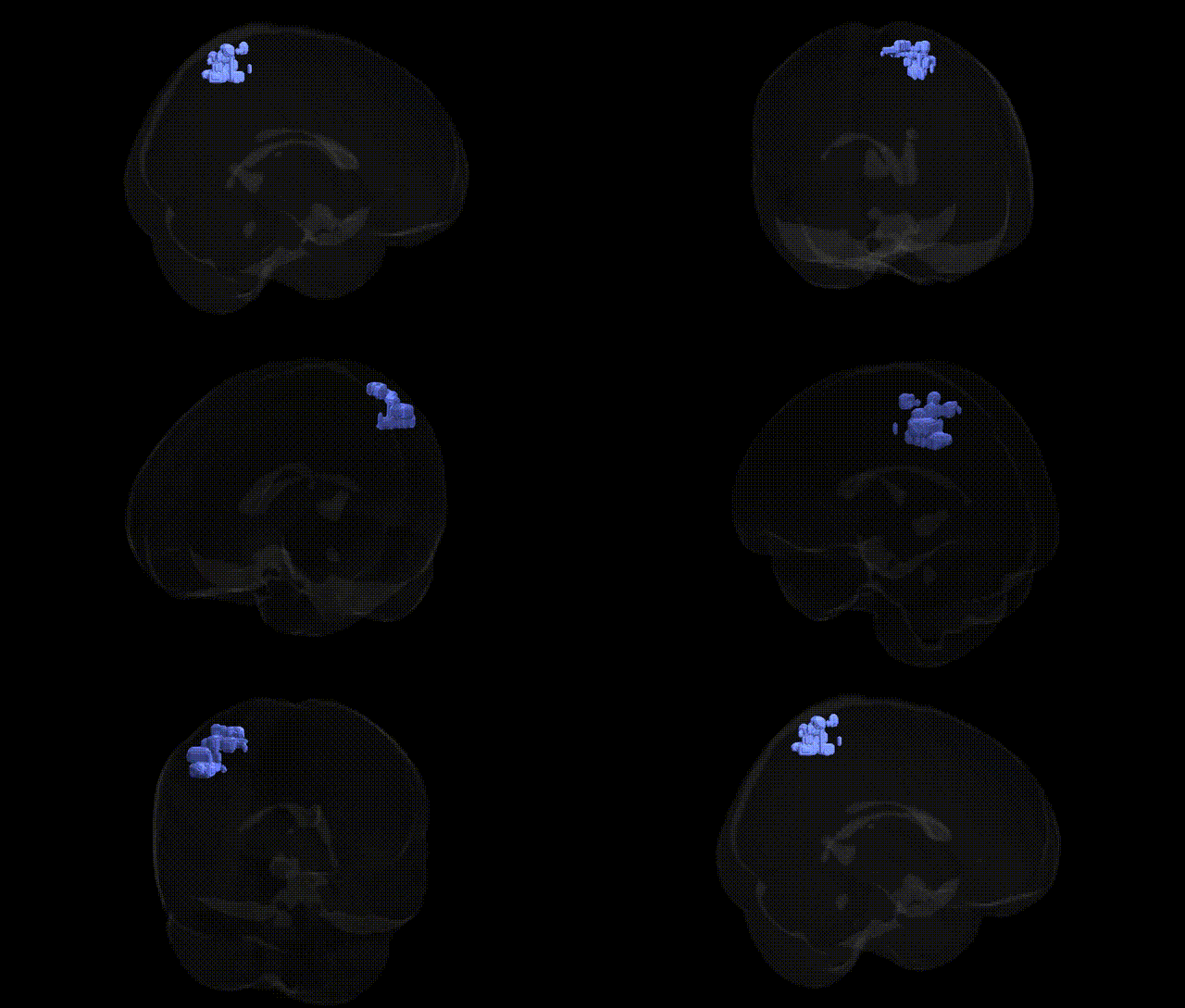
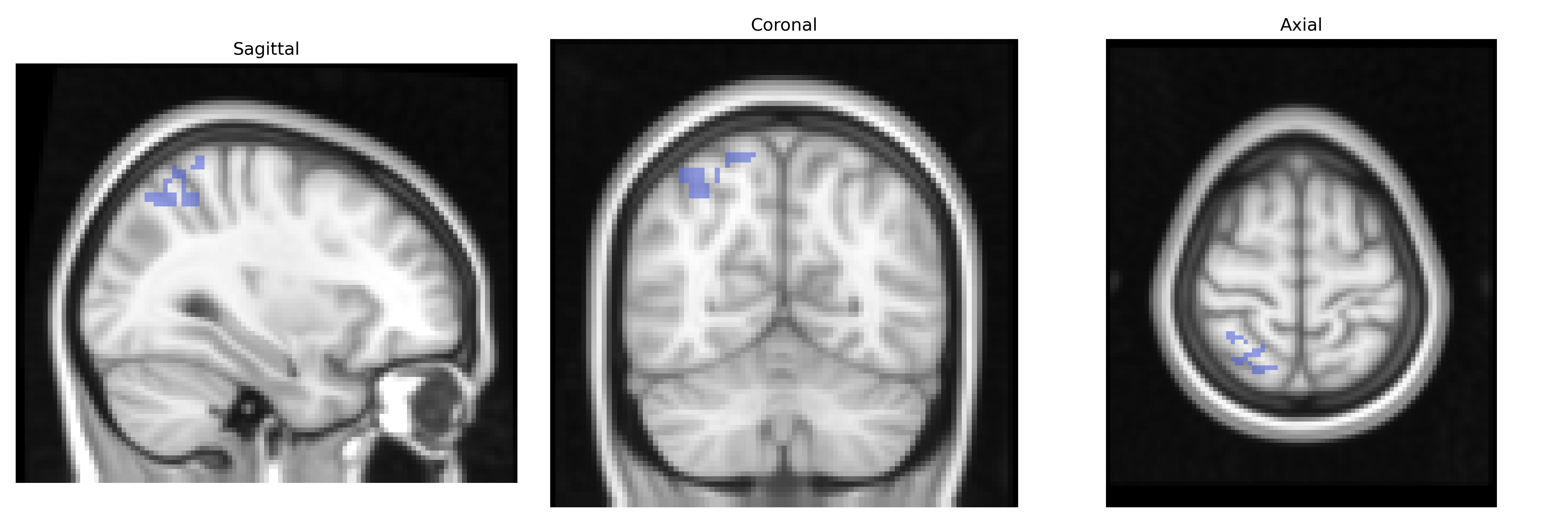
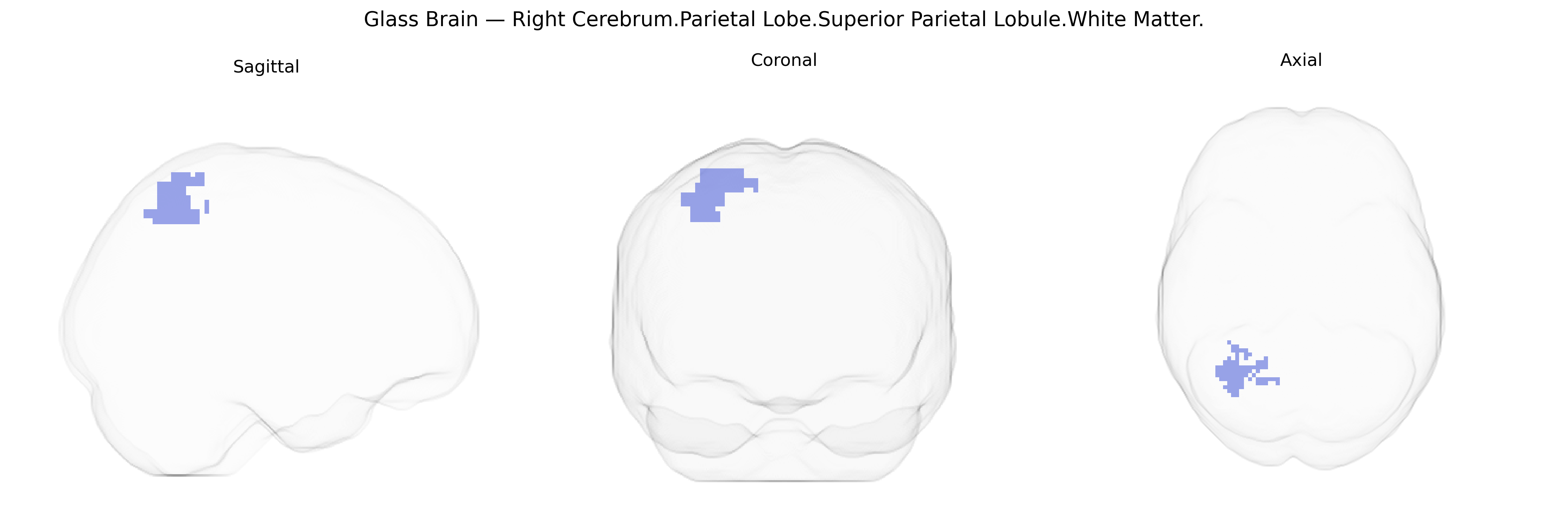
The bilateral Right Cerebrum.Parietal Lobe.Superior Parietal Lobule.White Matter corresponds to the subcortical fiber pathways underlying the superior parietal lobule in the right hemisphere, involved in integrating somatosensory, visual, and spatial information for higher-order sensorimotor processing. These white matter tracts connect the superior parietal cortex with adjacent parietal areas, premotor and motor regions, and occipital visual areas, supporting functions such as visuospatial attention, body representation, and the coordination of goal-directed movements. Damage to this region’s white matter can contribute to deficits in spatial perception, visuomotor integration, and aspects of praxis. There is no direct link for the specific white matter subdivision; see the related cortical region: Superior parietal lobule.
Genetic associations involving the bilateral Right Cerebrum.Parietal Lobe.Superior Parietal Lobule.White Matter, as defined in the Talairach 2 mm atlas, largely emerge from genome-wide imaging genetics studies that link common variants to white-matter microstructure and parietal functional connectivity rather than to this specific label per se. Variants in genes affecting axonal development and myelination—such as CNTNAP2, NRG1, MAG, and oligodendrocyte-related pathways—have been implicated in diffusion tensor imaging (DTI) measures (e.g., fractional anisotropy) in superior parietal and adjacent parietal white matter tracts. Large GWAS of brain structure (e.g., ENIGMA and UK Biobank-derived studies) have identified multiple loci influencing parietal cortical thickness and surface area, including variants near genes such as HMGA2, IGF1, and various neurodevelopmental transcription factors, which often show parallel effects on connected white matter. Functionally, genetic variation in dopaminergic and glutamatergic systems (e.g., COMT, GRIN2B) has been associated with superior parietal activation and connectivity during visuospatial attention and working memory, traits that depend on the integrity of underlying parietal white matter. Clinical GWAS implicate parietal white-matter networks, including the superior parietal lobule, in neurodevelopmental disorders such as ADHD and autism spectrum disorder, as well as in schizophrenia and major depression, through polygenic risk scores that predict alterations in parietal connectivity and microstructure. Additional links have been reported for intelligence, educational attainment, and sensorimotor performance, with polygenic influences on parietal white-matter integrity mediating aspects of higher-order cognition and visuospatial processing, although specific, well-replicated SNP–region associations for this exact Talairach white-matter label remain limited and are typically embedded in broader parietal or whole-brain imaging-genetics findings.
Overview generated by GPT-4o (2026).
Region ID: 1042
Hemisphere: bilateral
Atlas: Talairach labels 2mm
Full Quality Version: Download MP4
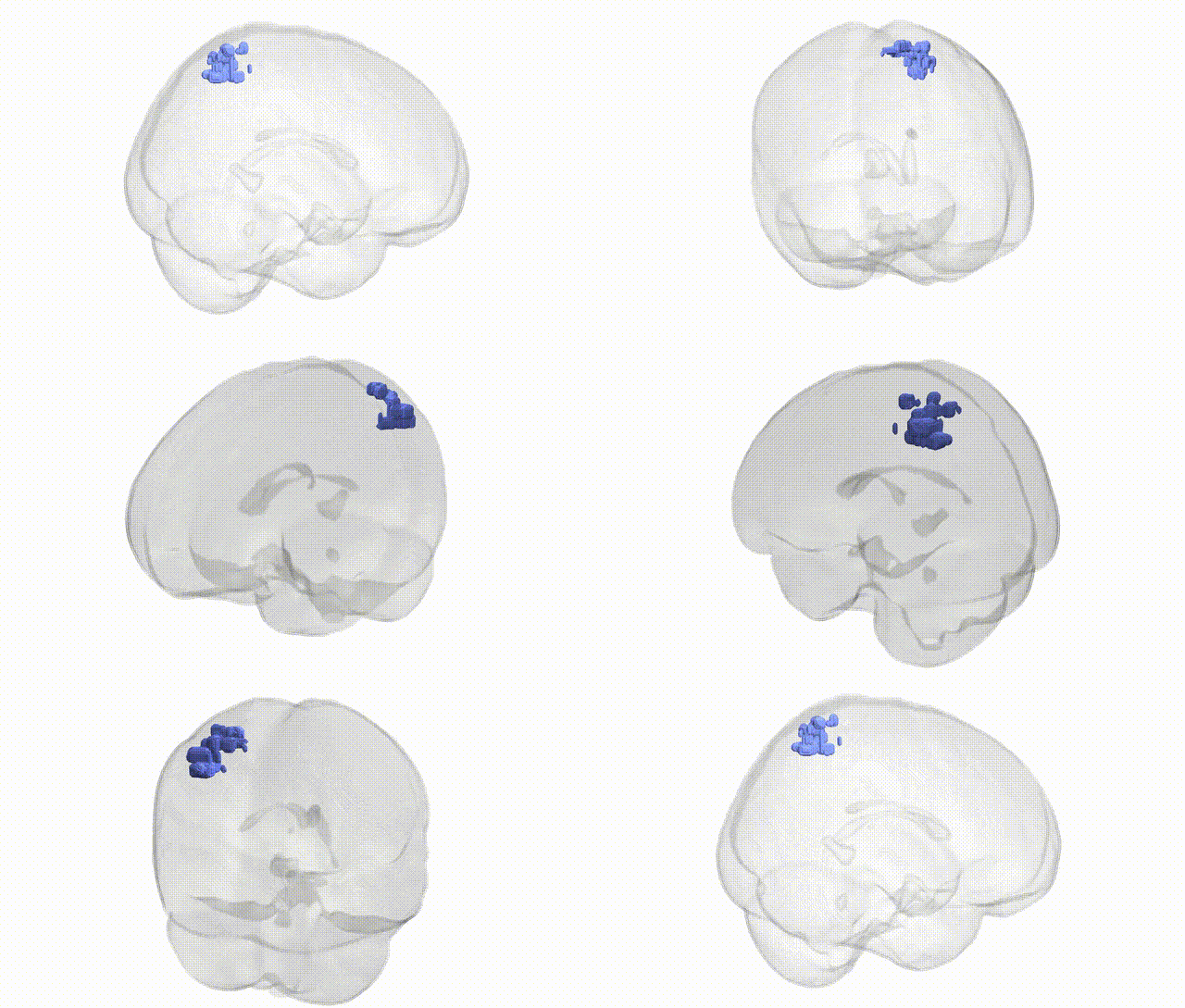
Full Quality Version: Download MP4
Wali Sidiqyar*, Gaurav Rudravaram*, Elyssa M. McMaster, Trent M. Schwartz, Adam M. Saunders, Kurt G. Schilling, Bennett A. Landman "Introducing SPINS: A Shared Public Visualization Library of Neuroanatomical Structures." Medical Imaging with Deep Learning- short paper
This resource is licensed under CC0 1.0 Universal (Public Domain).