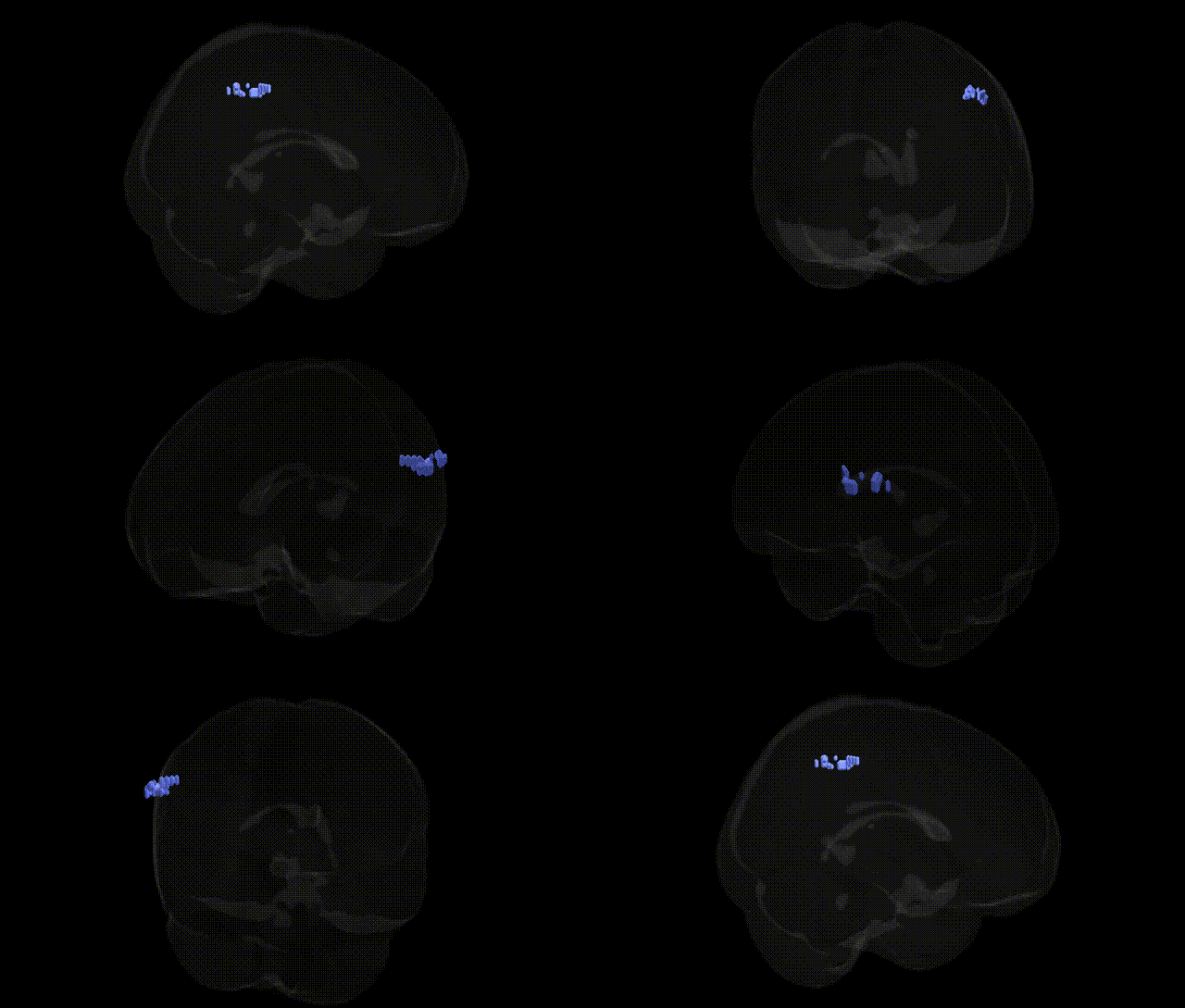
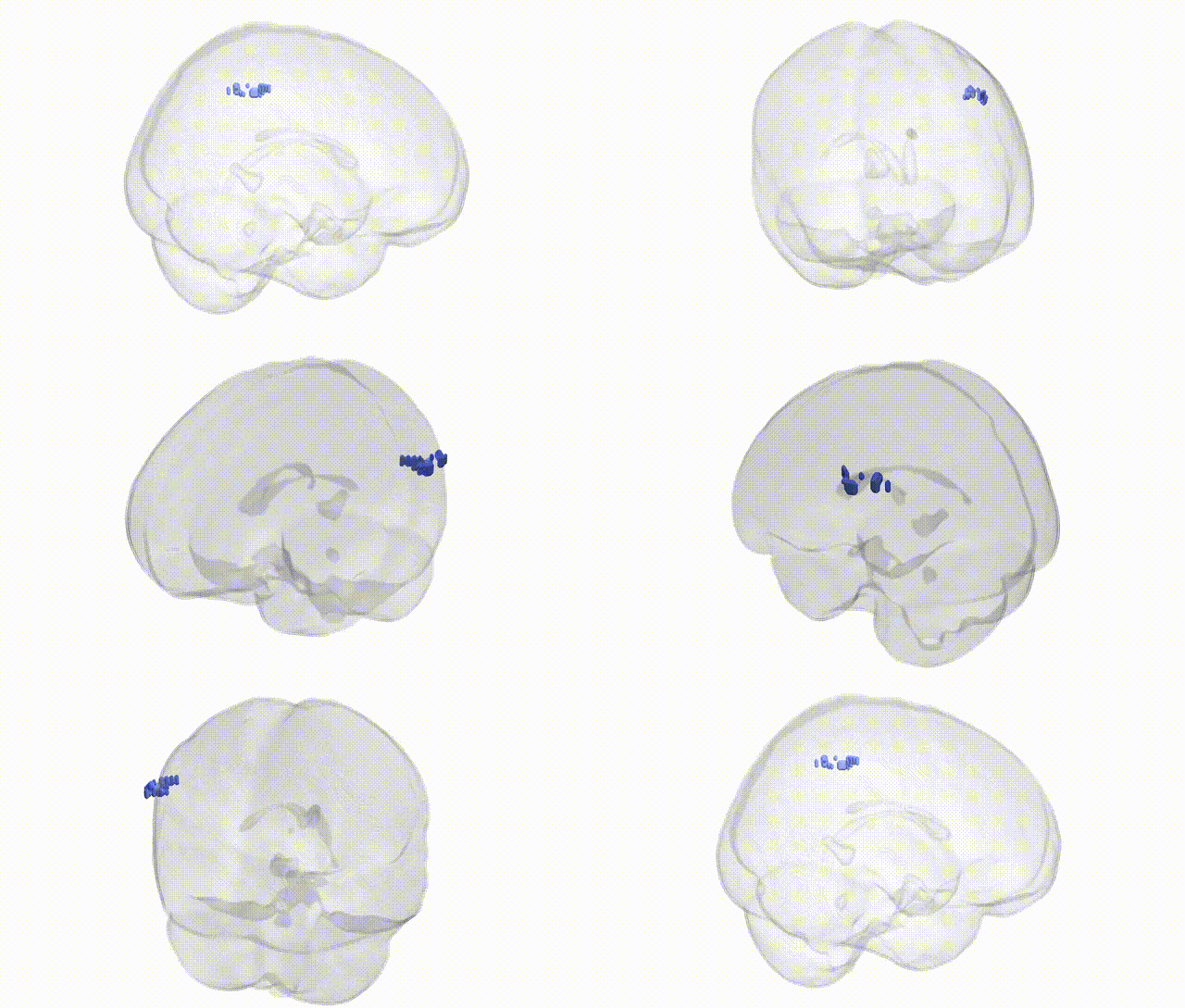
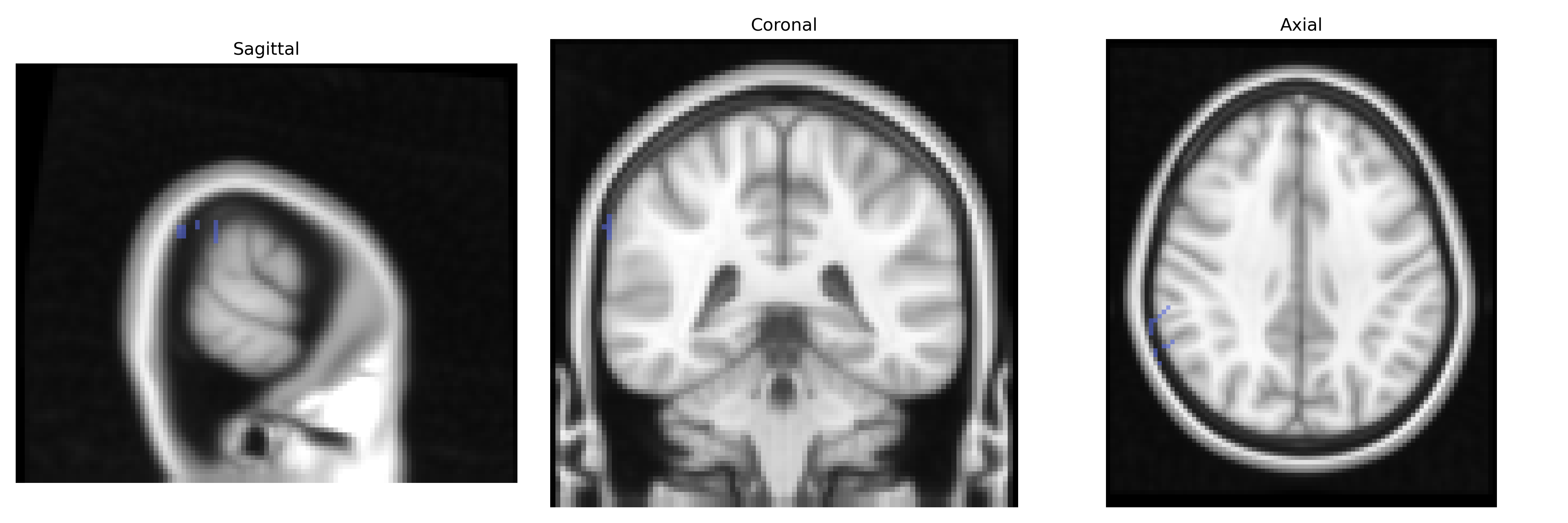
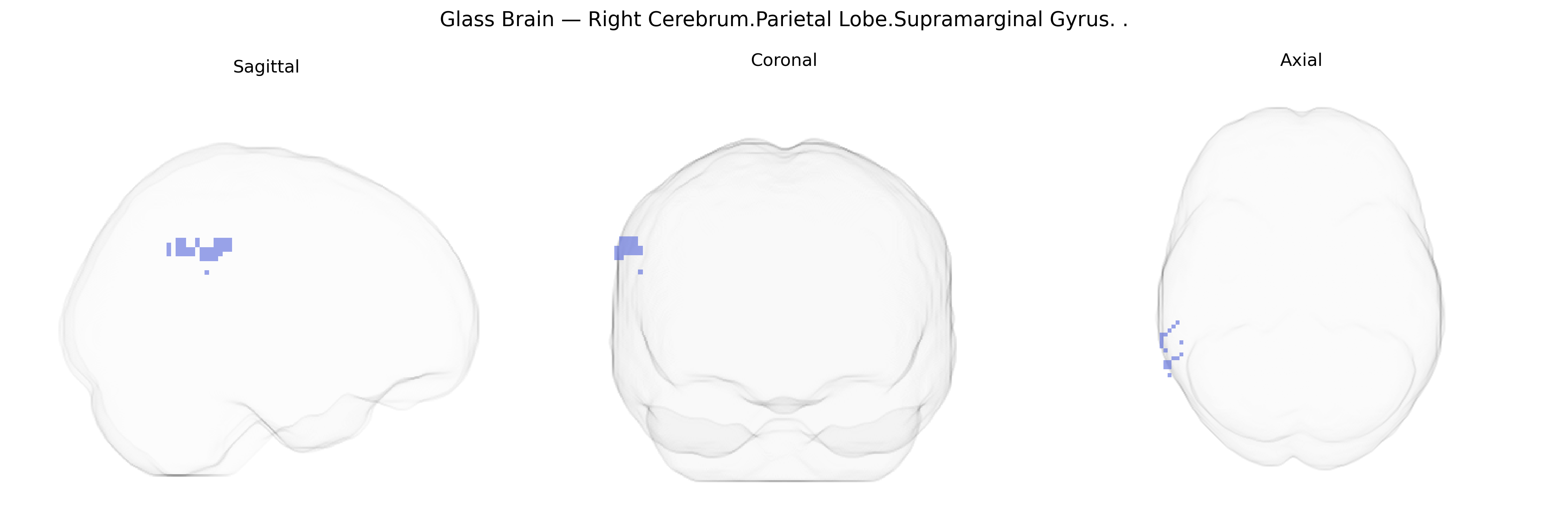
The bilateral Right Cerebrum.Parietal Lobe.Supramarginal Gyrus corresponds to the supramarginal gyrus of the inferior parietal lobule, a curved cortical structure that caps the posterior end of the lateral (Sylvian) fissure and forms part of the perisylvian language network. It is involved in phonological processing, verbal working memory, reading and spelling, sensorimotor integration, and aspects of social cognition such as empathy and perspective-taking. Functionally, it participates in mapping auditory and visual inputs onto articulatory representations, integrating somatosensory information for hand and tool use, and contributing to the discrimination of self versus other actions. Lesions in this region have been associated with conduction aphasia, disorders of praxis, and deficits in spatial attention and body schema, reflecting its position at the interface of language, multimodal sensory integration, and higher-order cognitive control. Supramarginal gyrus
The right supramarginal gyrus, a multimodal association area within the parietal lobe implicated in language, social cognition, and attention, has been indirectly associated with genetic variation through neuroimaging and genome-wide association studies that link cortical structure and function to specific loci. Large-scale GWAS of cortical thickness and surface area (e.g., ENIGMA and UK Biobank studies) have identified common variants in genes involved in neurodevelopment, axon guidance, and synaptic function (such as those in Wnt signaling and cell adhesion pathways) that influence parietal association cortex morphology, including supramarginal regions. This area has shown volumetric and functional alterations associated with genetic risk for dyslexia and other language disorders, autism spectrum disorder, schizophrenia, and attention-deficit/hyperactivity disorder, with implicated genes often related to neuronal migration, synaptic plasticity, and glutamatergic signaling (for example, CNTNAP2, FOXP2-related networks, and several schizophrenia risk loci showing parietal cortical effects). Polygenic risk scores for major psychiatric conditions and cognitive traits (general intelligence, educational attainment, reading ability) have been correlated with structural and functional measures in the supramarginal gyrus, suggesting a distributed genetic architecture whereby numerous common variants exert small additive effects on this region’s anatomy and connectivity. However, most associations are regional (parietal or temporoparietal cortex) rather than specifically limited to the bilateral right supramarginal gyrus, and current evidence supports a broad polygenic influence on its development and function rather than a small set of region-specific genes.
Overview generated by GPT-4o (2026).
Region ID: 883
Hemisphere: bilateral
Atlas: Talairach labels 2mm
Full Quality Version: Download MP4
Full Quality Version: Download MP4
Wali Sidiqyar*, Gaurav Rudravaram*, Elyssa M. McMaster, Trent M. Schwartz, Adam M. Saunders, Kurt G. Schilling, Bennett A. Landman "Introducing SPINS: A Shared Public Visualization Library of Neuroanatomical Structures." Medical Imaging with Deep Learning- short paper
This resource is licensed under CC0 1.0 Universal (Public Domain).