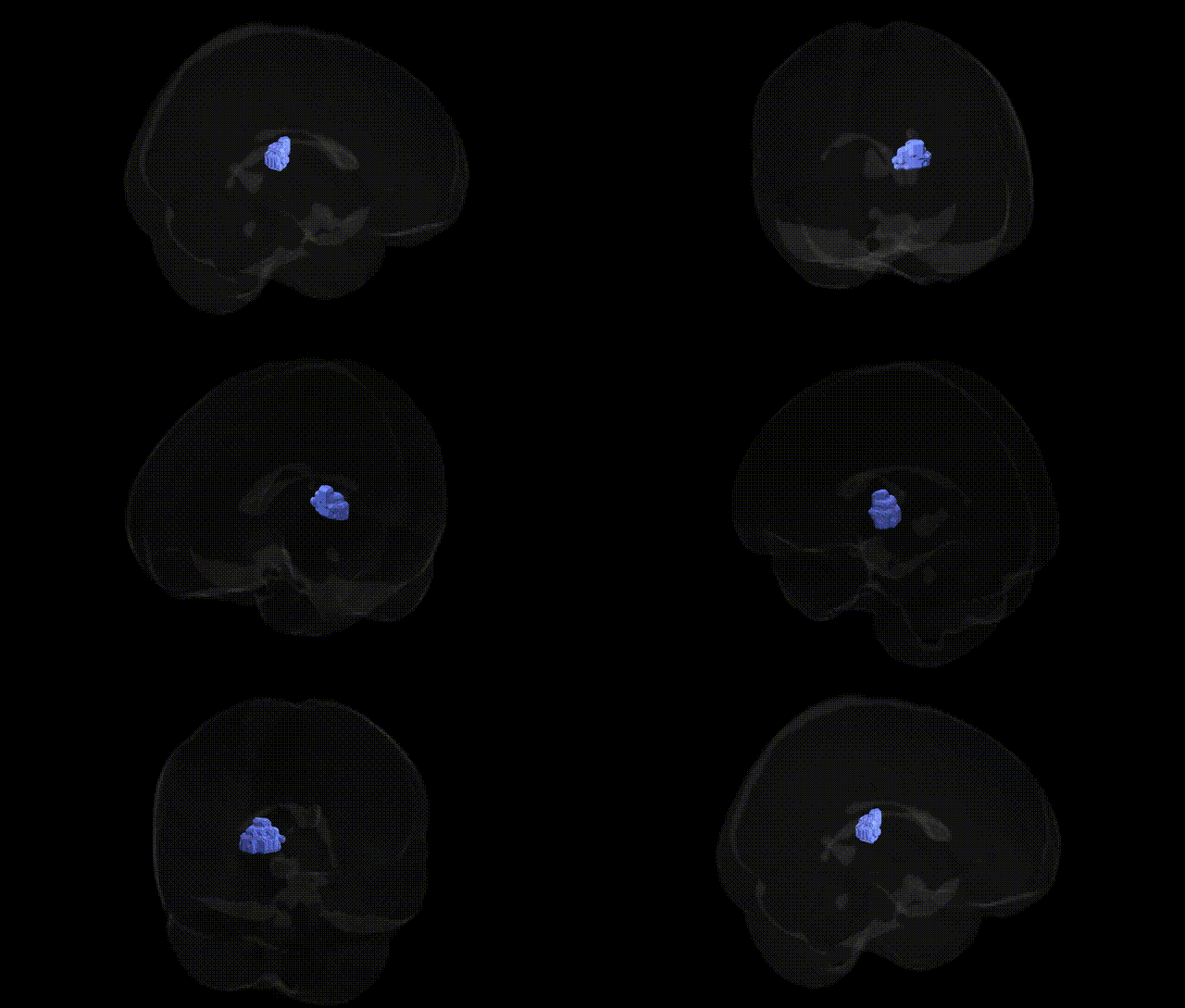
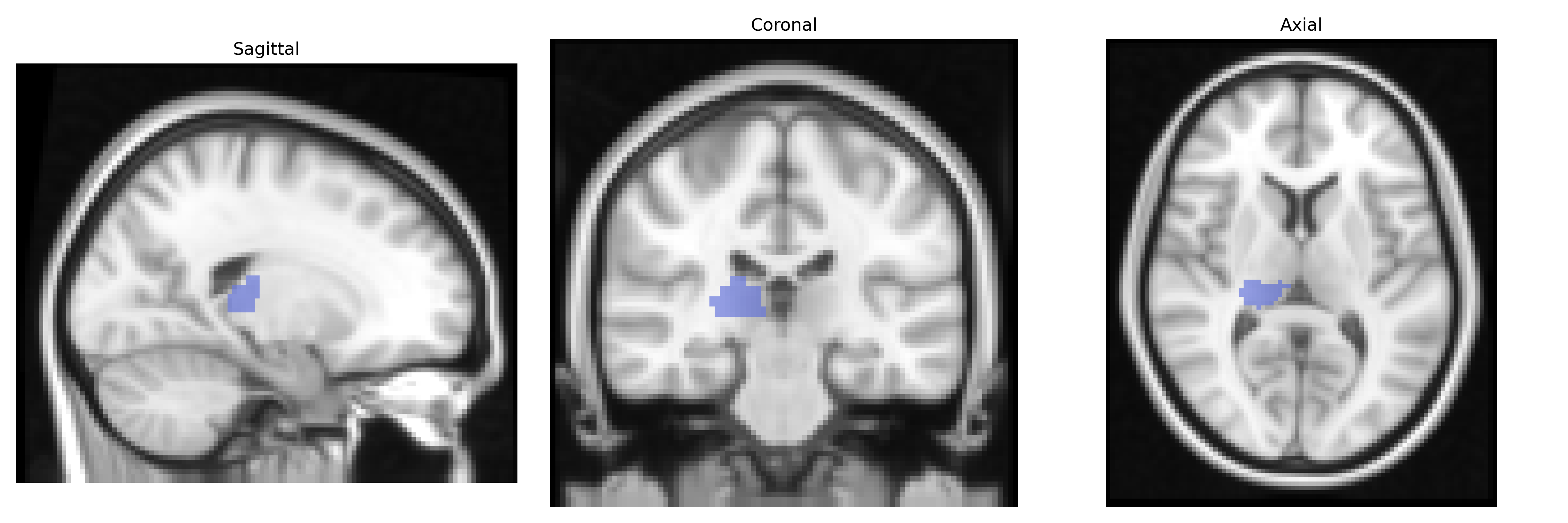
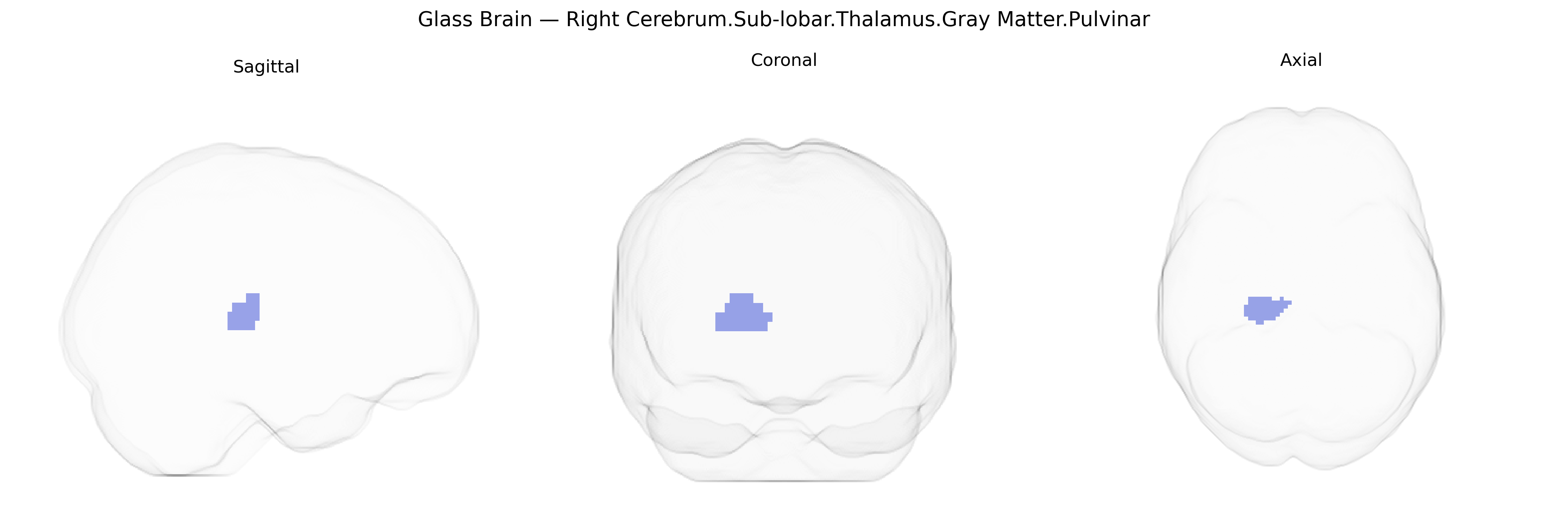
The bilateral Right Cerebrum.Sub-lobar.Thalamus.Gray Matter.Pulvinar corresponds to the pulvinar nuclei of the thalamus, a large posterior thalamic complex involved in visual processing, attentional control, and higher-order sensory integration. As part of the sub-lobar gray matter of the right cerebrum, the pulvinar receives extensive input from the visual cortex and superior colliculus and projects to parietal, temporal, and occipital association areas, contributing to the coordination of visuospatial attention, eye movements, and the filtering of sensory information relevant for perception and cognition. Functionally, the pulvinar is implicated in orienting to salient stimuli, modulating cortical synchrony, and supporting processes such as object recognition and visual awareness, with bilateral involvement important for integrated hemispheric communication in attentional and visual networks. There is no direct Wikipedia article for this specific Talairach label; a closely related structure is the thalamus: Thalamus.
The pulvinar nucleus of the thalamus, as defined in the Talairach 2 mm Atlas (Right Cerebrum, Sub-lobar, Thalamus, Gray Matter, Pulvinar), has been implicated in multiple genetic and genome-wide association studies through its roles in visual attention, sensory integration, and large-scale network connectivity. While few GWAS focus specifically on pulvinar volume, thalamic and subcortical structure GWAS (e.g., ENIGMA and UK Biobank analyses) have identified common variant associations in loci near genes such as DLG2, SLC39A8, and C4A that influence thalamic morphology and connectivity, likely encompassing pulvinar subregions. Pulvinar-related functional networks have been linked to neuropsychiatric disorders in genetic imaging studies, including schizophrenia (with polygenic risk affecting thalamo-cortical connectivity), bipolar disorder, and major depressive disorder, where risk variants in synaptic and immune-related genes modulate thalamic network function. Autism spectrum disorder and ADHD GWAS and polygenic risk studies have also implicated thalamic-pulvinar circuitry in altered attention and social processing. Additionally, genetic influences on visual attention, reading and language traits, and cognitive performance have been associated with pulvinar-involved networks, though these findings typically arise from imaging-genetics work on thalamic connectivity rather than pulvinar-specific volume GWAS, so current evidence supports the pulvinar as an important node through which broadly acting neurodevelopmental and synaptic genetic variants exert their effects.
Overview generated by GPT-4o (2026).
Region ID: 623
Hemisphere: bilateral
Atlas: Talairach labels 2mm
Full Quality Version: Download MP4
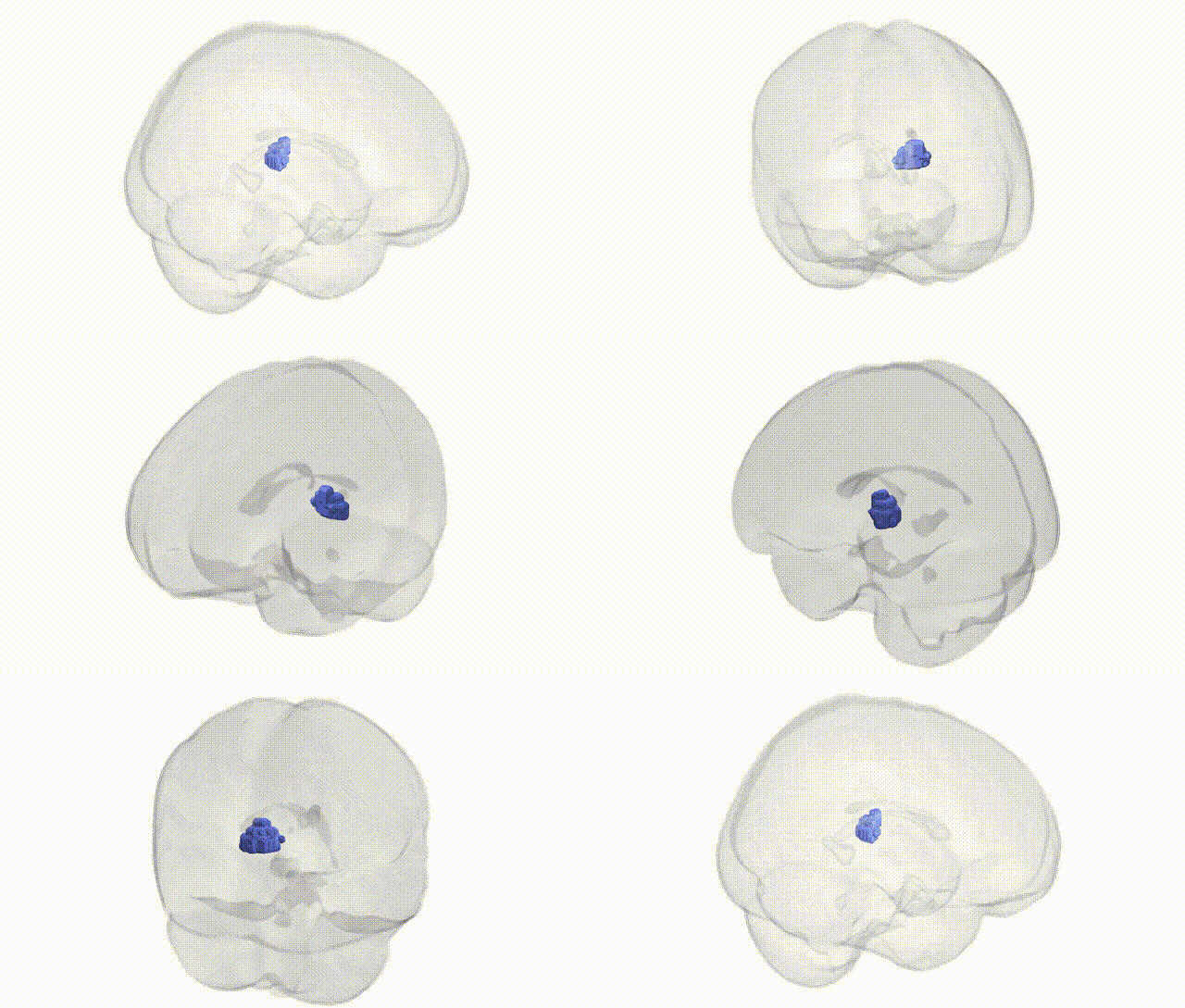
Full Quality Version: Download MP4
Wali Sidiqyar*, Gaurav Rudravaram*, Elyssa M. McMaster, Trent M. Schwartz, Adam M. Saunders, Kurt G. Schilling, Bennett A. Landman "Introducing SPINS: A Shared Public Visualization Library of Neuroanatomical Structures." Medical Imaging with Deep Learning- short paper
This resource is licensed under CC0 1.0 Universal (Public Domain).