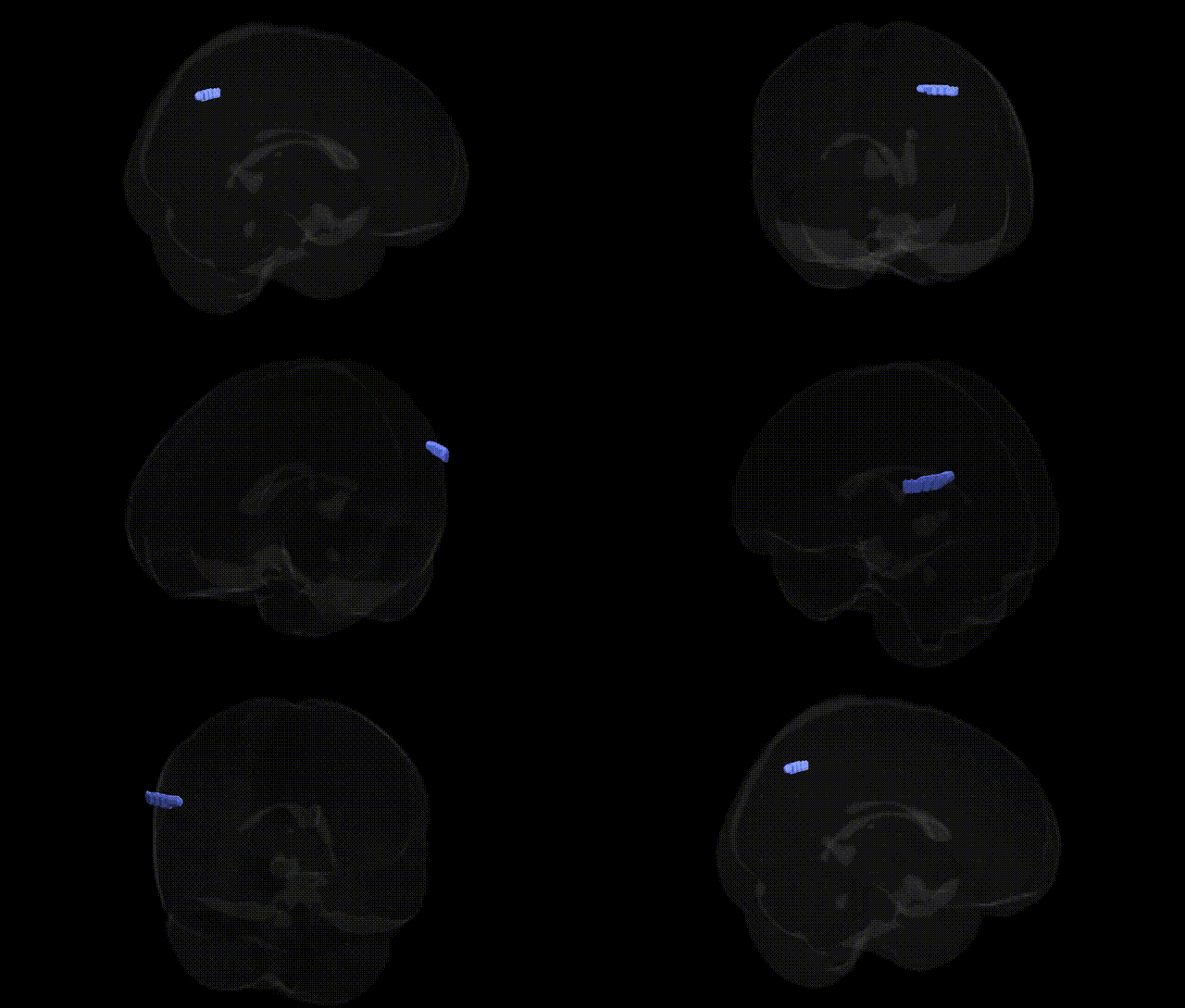
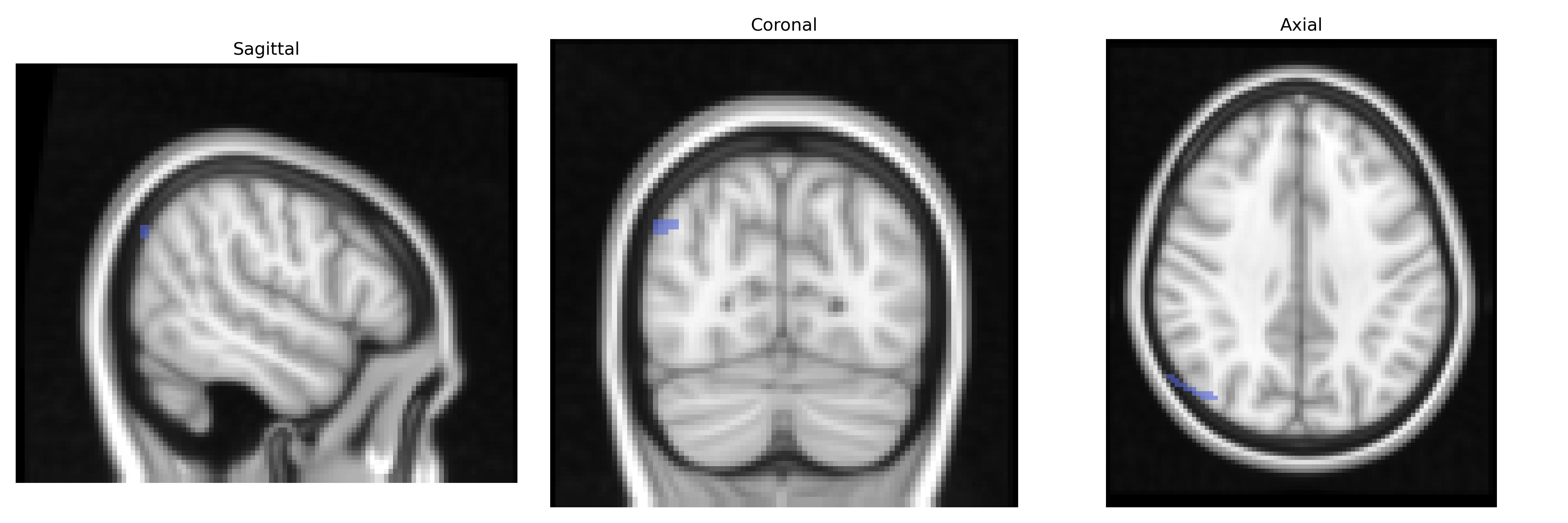
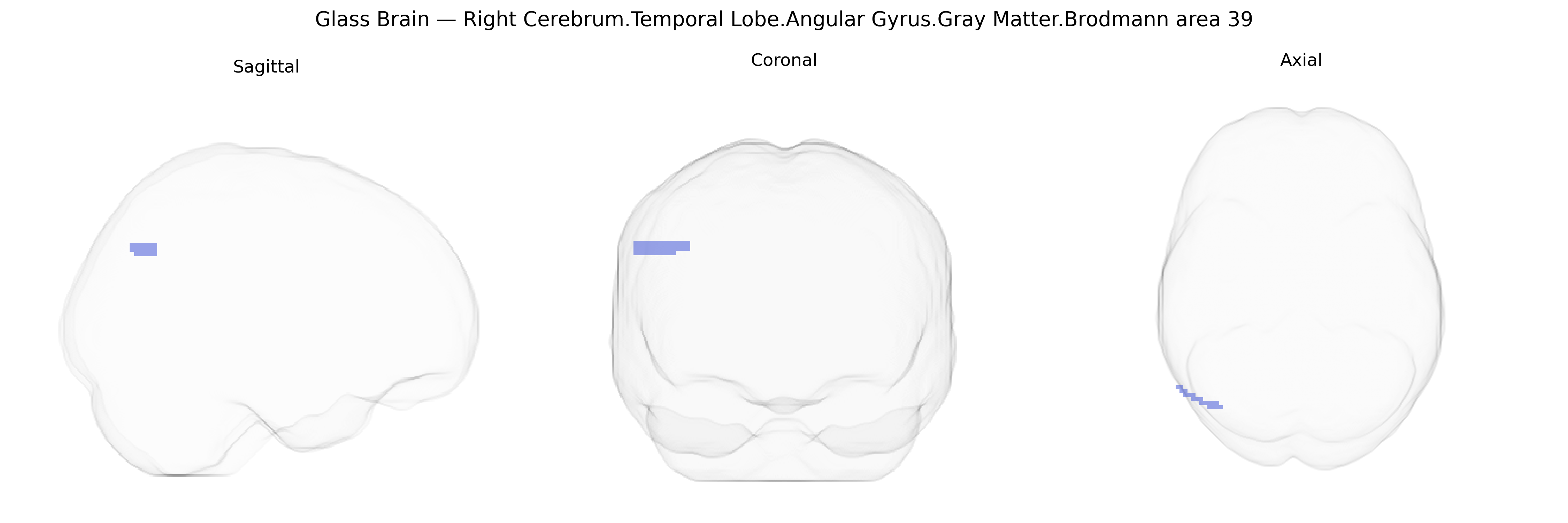
The bilateral Right Cerebrum.Temporal Lobe.Angular Gyrus.Gray Matter.Brodmann area 39 corresponds to cortical gray matter in the angular gyrus (Brodmann area 39), located at the junction of the temporal, parietal, and occipital lobes in the posterior inferior parietal region. This area is implicated in high-level associative functions, including language comprehension, semantic processing, reading, number processing, spatial cognition, and aspects of theory of mind, as well as integration of multisensory information. It serves as a key hub in the default mode and language networks, contributing to the integration of visual, auditory, and somatosensory inputs for complex symbolic and conceptual representations. There is no direct Wikipedia article for this exact Talairach label; a related structure is the Angular gyrus.
The bilateral right angular gyrus (Brodmann area 39) has been implicated in multiple imaging genetics and GWAS-derived endophenotype studies, largely via its roles in language, semantic processing, number cognition, and default mode network function. Variants in genes associated with synaptic plasticity and neurodevelopment—such as APOE (particularly ε4), CLU, PICALM, and BIN1—have been linked to Alzheimer’s disease–related atrophy and hypometabolism in temporoparietal regions including the angular gyrus, while schizophrenia- and bipolar disorder–risk loci (e.g., CACNA1C, ZNF804A) show associations with altered functional and structural connectivity in temporal–parietal networks that encompass BA39. Large-scale GWAS of cortical thickness and surface area (e.g., ENIGMA consortium) have identified loci in genes related to neuronal proliferation and migration that influence parietotemporal morphology, with angular gyrus gray matter measures serving as heritable intermediate phenotypes connected to general cognitive ability and educational attainment. Additionally, autism spectrum disorder and dyslexia genetics studies have reported that risk variants in genes such as CNTNAP2, DCDC2, and KIAA0319 are associated with disrupted activation and structural differences in temporoparietal language regions including the angular gyrus, and pain, empathy, and social cognition GWAS and candidate-gene work (involving OXTR and others) implicate this region within broader social–affective networks. Overall, genetic influences on neurodegeneration, neurodevelopmental risk, and cognitive traits converge on the right BA39 angular gyrus as part of distributed networks rather than as an isolated locus.
Overview generated by GPT-4o (2026).
Region ID: 959
Hemisphere: bilateral
Atlas: Talairach labels 2mm
Full Quality Version: Download MP4
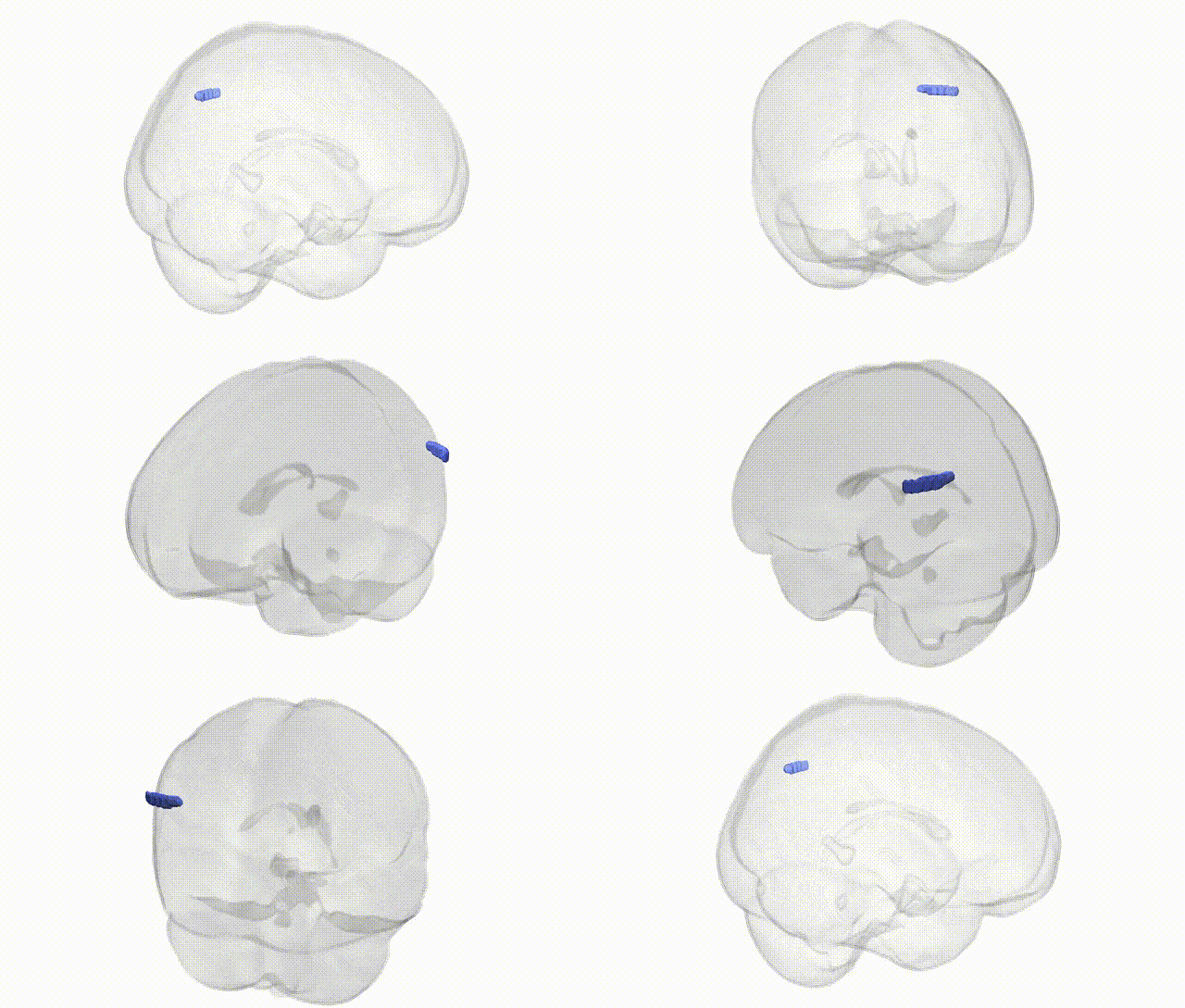
Full Quality Version: Download MP4
Wali Sidiqyar*, Gaurav Rudravaram*, Elyssa M. McMaster, Trent M. Schwartz, Adam M. Saunders, Kurt G. Schilling, Bennett A. Landman "Introducing SPINS: A Shared Public Visualization Library of Neuroanatomical Structures." Medical Imaging with Deep Learning- short paper
This resource is licensed under CC0 1.0 Universal (Public Domain).