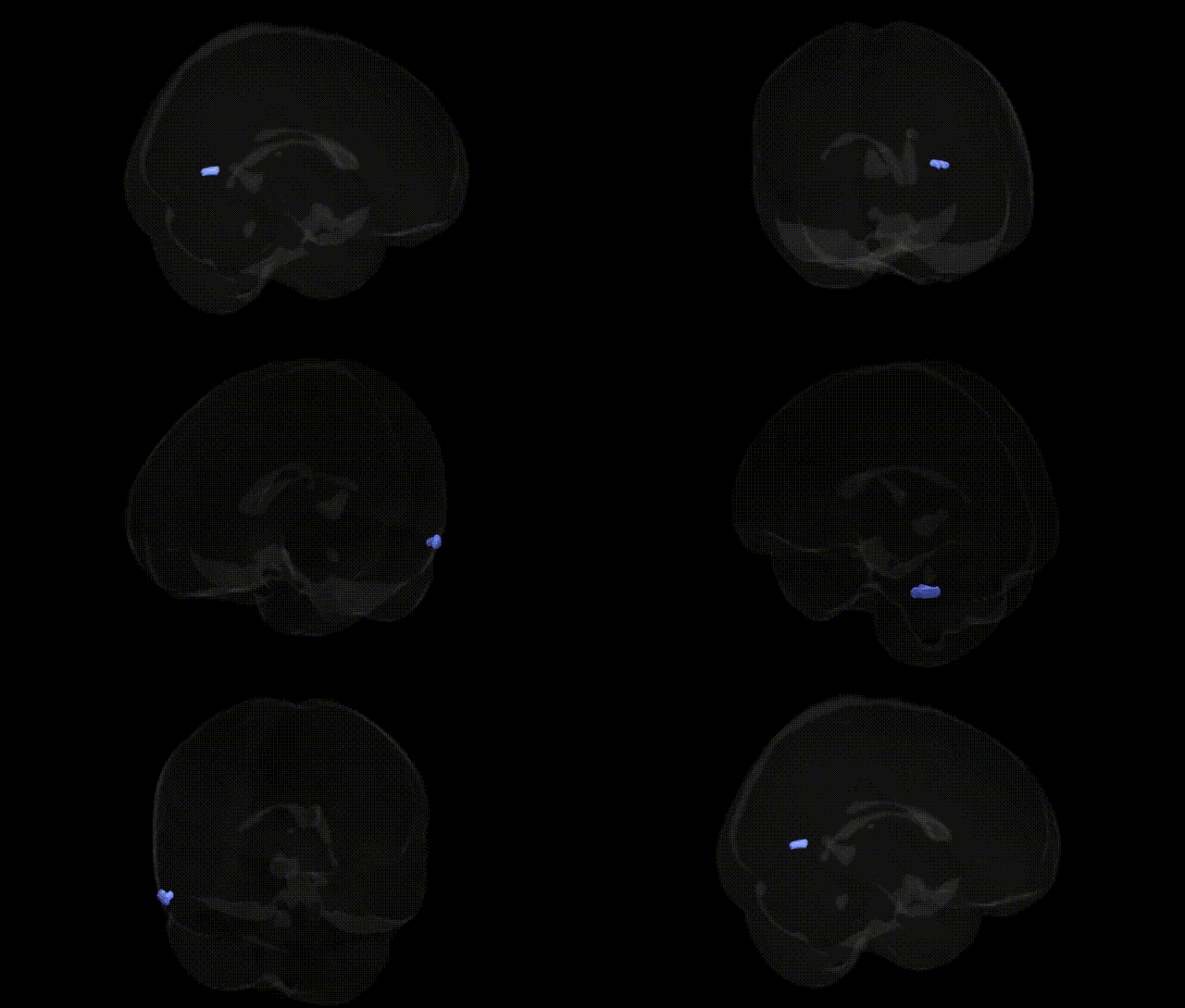
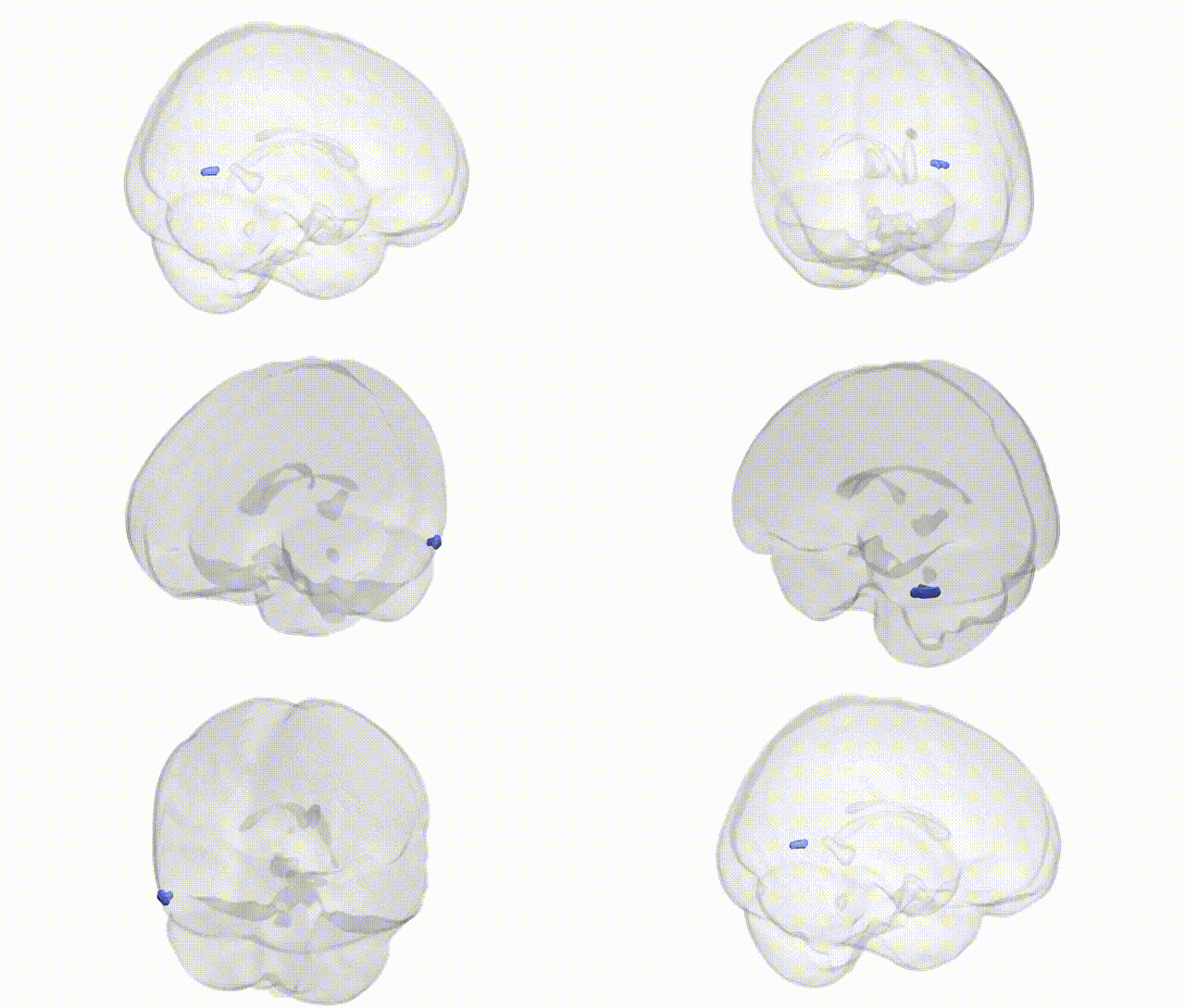
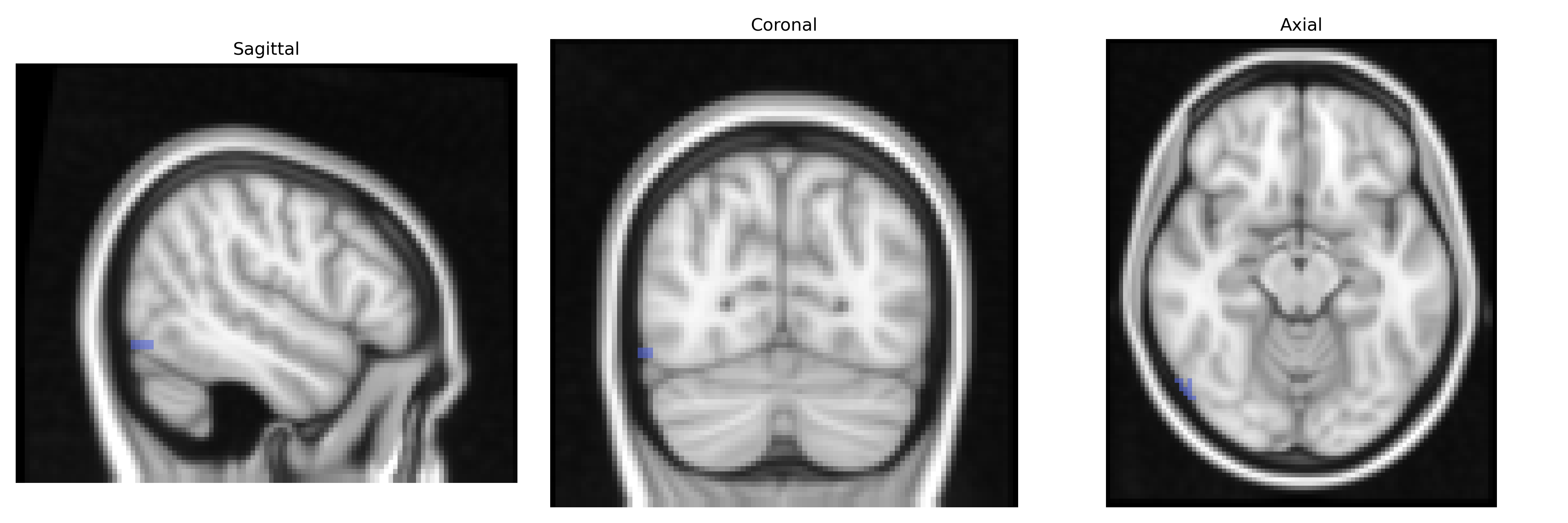
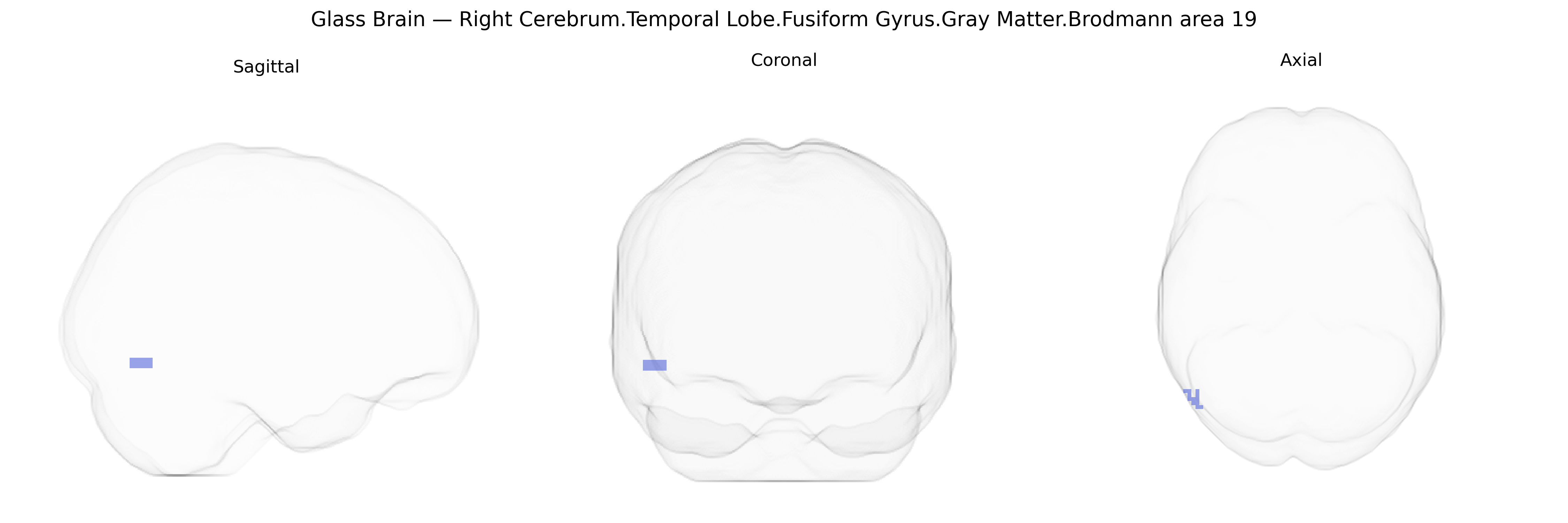
The bilateral Right Cerebrum.Temporal Lobe.Fusiform Gyrus.Gray Matter.Brodmann area 19 corresponds to a portion of the ventral temporal cortex involved in higher-order visual processing, particularly aspects of object and complex pattern recognition. Although Brodmann area 19 is classically defined in the occipital lobe as part of the associative visual cortex, Talairach-based parcellations can extend its label into adjacent temporal fusiform regions that contribute to integrating visual features into meaningful representations, including forms, textures, and potentially category-specific information. This region participates in the broader ventral visual stream, receiving inputs from primary and secondary visual areas and projecting to other temporal and parietal association cortices for multimodal integration. There is no direct link for this exact compound region label; a closely related structure is Fusiform gyrus.
The fusiform gyrus (often spanning BA19/BA37 in occipitotemporal cortex) has been implicated in genetic studies primarily through its role in visual processing, face and word recognition, and high-level perceptual integration, rather than through GWAS focused specifically on Talairach-defined BA19 gray matter volume. Twin and heritability studies show substantial genetic influence on fusiform structure and function, and imaging genetics has repeatedly linked fusiform activation and morphology to common variants in genes such as BDNF (e.g., Val66Met affecting cortical thickness and activation), CNTNAP2, and DISC1, as well as polygenic risk scores for schizophrenia, autism spectrum disorder, and major depression that are associated with fusiform volume or functional connectivity abnormalities. GWAS of brain imaging phenotypes (e.g., large UK Biobank-based studies) have identified multiple loci associated with temporal and occipitotemporal cortical thickness and surface area, including variants near genes involved in neurodevelopment and synaptic function (such as KIAA0586 and MAPT), though these findings generally refer to broader temporal/occipital regions and do not isolate bilateral right BA19 fusiform gray matter. Fusiform dysfunction linked to genetic risk has been reported in neurodevelopmental and neuropsychiatric conditions, including autism (social and face-processing deficits, with associations to synaptic and cell-adhesion genes), prosopagnosia (including rare familial forms implicating structural/functional fusiform anomalies), dyslexia (word-form area in left fusiform linked to genetic risk loci such as DCDC2 and KIAA0319), and schizophrenia (polygenic risk associated with fusiform volume and visual processing deficits). Overall, genetic associations to this specific Talairach region are indirect and mainly derive from broader fusiform/occipitotemporal imaging genetics and GWAS of cortical morphology and disease-related endophenotypes, rather than precise BA19-labeled GWAS targets.
Overview generated by GPT-4o (2026).
Region ID: 266
Hemisphere: bilateral
Atlas: Talairach labels 2mm
Full Quality Version: Download MP4
Full Quality Version: Download MP4
Wali Sidiqyar*, Gaurav Rudravaram*, Elyssa M. McMaster, Trent M. Schwartz, Adam M. Saunders, Kurt G. Schilling, Bennett A. Landman "Introducing SPINS: A Shared Public Visualization Library of Neuroanatomical Structures." Medical Imaging with Deep Learning- short paper
This resource is licensed under CC0 1.0 Universal (Public Domain).