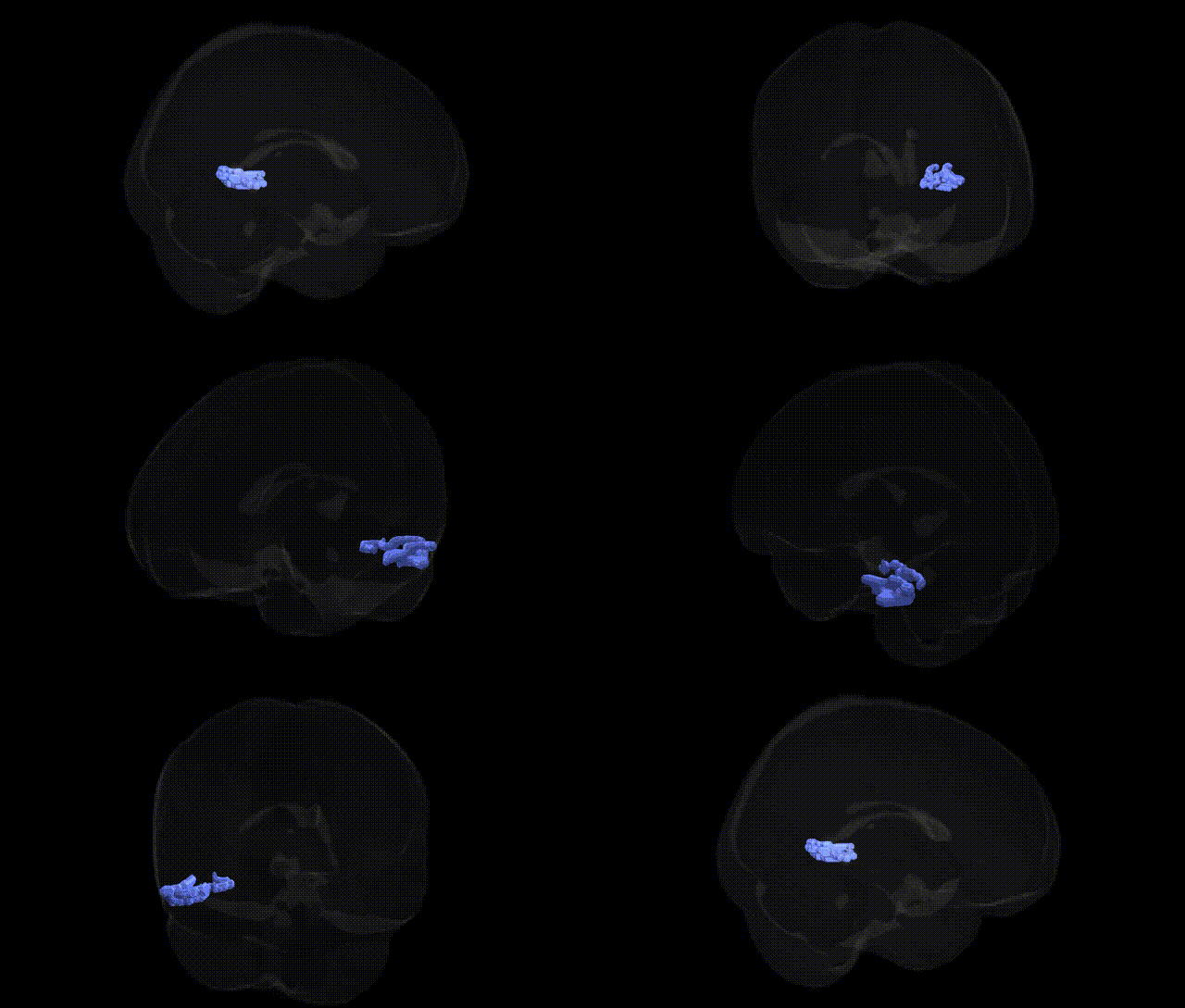
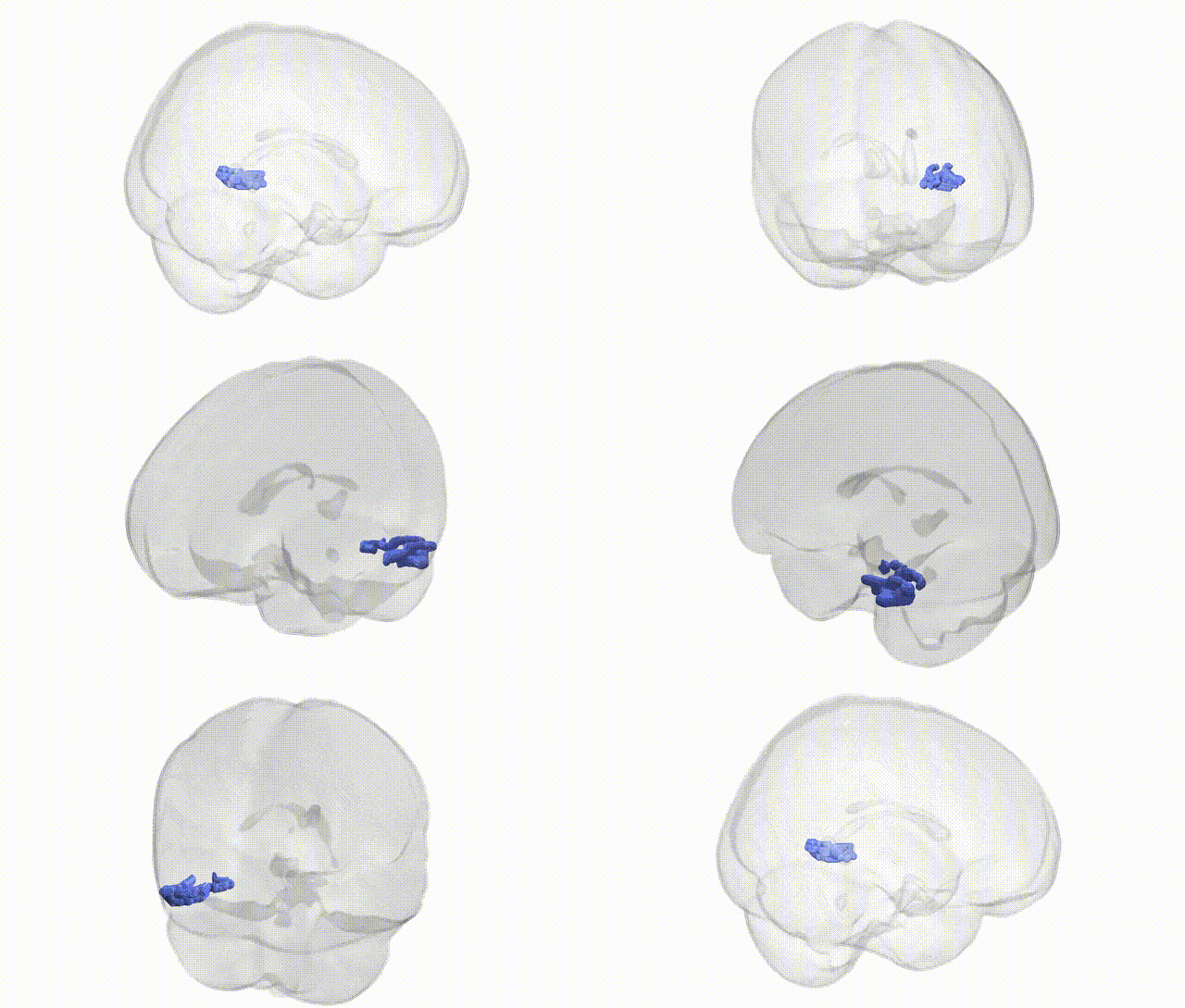
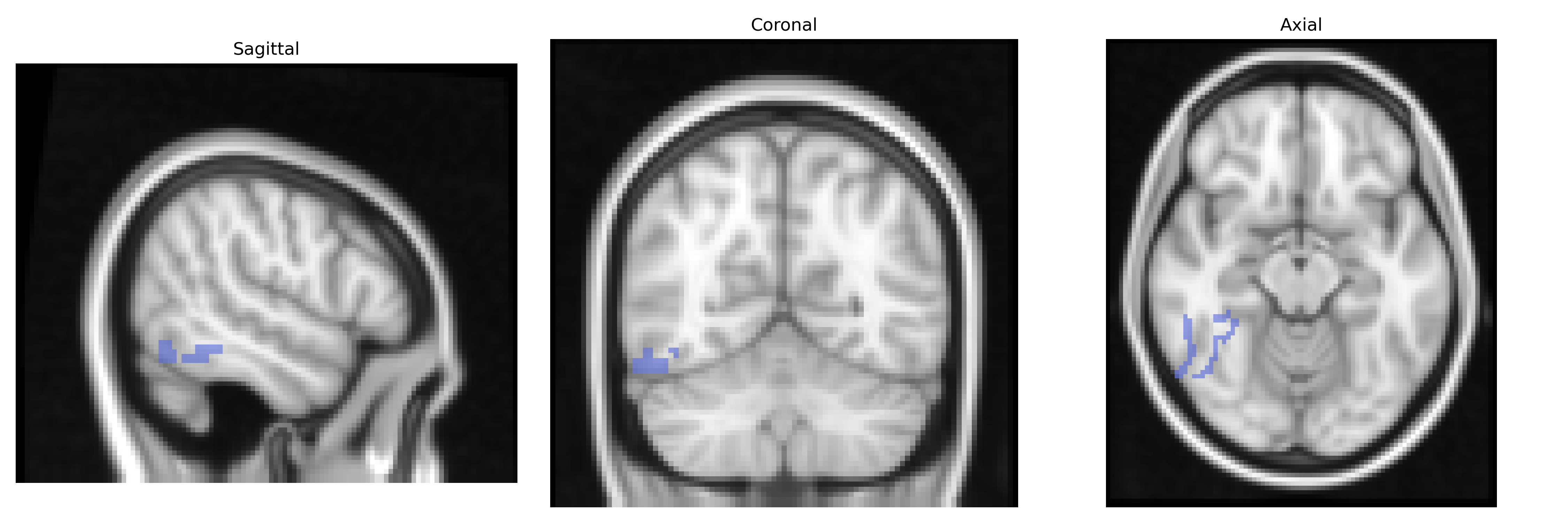
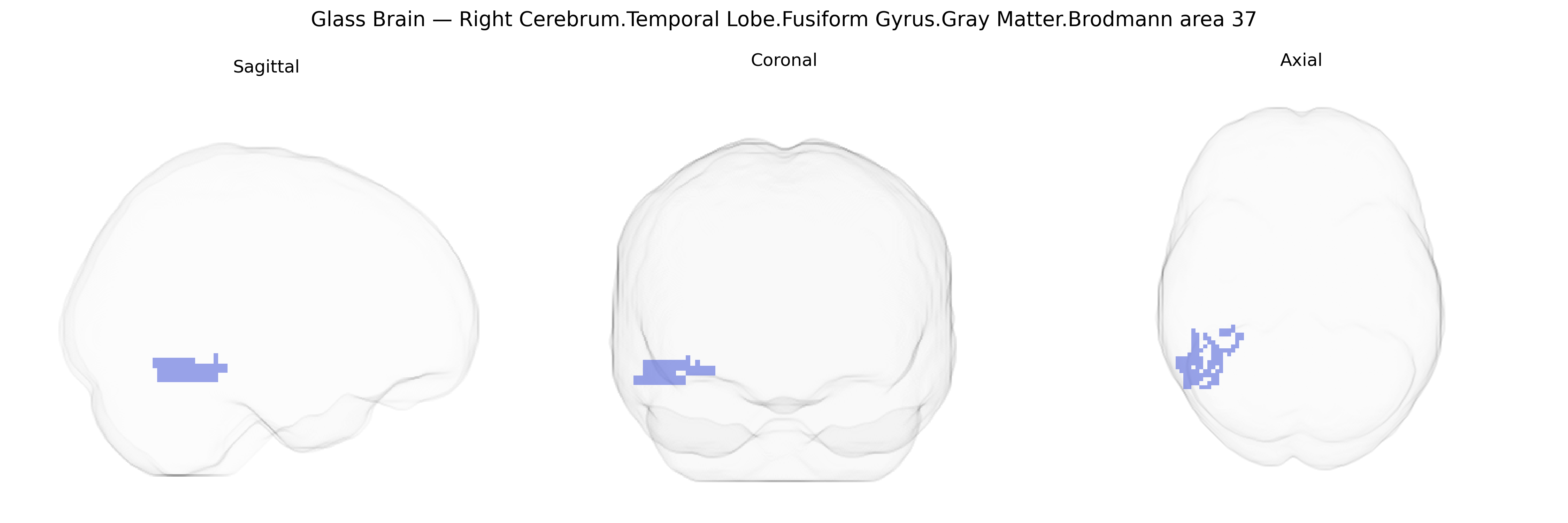
The bilateral Right Cerebrum Temporal Lobe Fusiform Gyrus Gray Matter Brodmann area 37 corresponds to a cytoarchitectonic region located in the posterior fusiform and adjacent inferior temporal cortex, primarily involved in high-level visual processing and multimodal integration. BA37 plays a key role in object and face recognition, visual word form processing, and the association of visual stimuli with semantic information, making it critical for functions such as reading, naming, and the recognition of complex patterns and categories. It is heavily interconnected with other temporal and occipitotemporal regions, including the ventral visual stream and language-related cortices, and lesions in this area can lead to deficits such as anomia, prosopagnosia, or impairments in visual word recognition. There is no direct Wikipedia article for “Brodmann area 37” as a standalone page; a closely related and encompassing structure is the Fusiform gyrus.
The bilateral right fusiform gyrus (Brodmann area 37) gray matter, as defined in the Talairach 2 mm atlas, has been repeatedly implicated in genetic studies of face and object recognition, social cognition, and neurodevelopmental and neuropsychiatric conditions. Twin and imaging–genetics studies show moderate heritability of fusiform gyrus volume, cortical thickness, and activation, with common variants in genes related to synaptic function and neurodevelopment—such as CNTNAP2, NRXN1, and SHANK3—frequently associated with altered fusiform structure or function, particularly in autism spectrum disorder, where reduced fusiform volume and hypoactivation during face processing are well documented. GWAS and large-scale imaging consortia (e.g., ENIGMA, UK Biobank) have identified polygenic influences on temporal and fusiform cortical morphology from loci including variants near genes such as HMGA2 and IGF1 (general brain size and cortical morphology), as well as distributed polygenic scores for schizophrenia, bipolar disorder, and major depression that correlate with temporal lobe and fusiform gray matter alterations. Additional genetic associations with this region arise in studies of prosopagnosia and social perception, suggesting a contribution of face-processing–related genes (e.g., OXTR and other social-behavior loci) to fusiform function, and in dyslexia and language-related traits, where temporal–occipital regions including BA37 show structural and functional differences that track with polygenic risk for reading and language difficulties, although specific locus-level GWAS hits for right BA37 itself remain sparse and largely embedded within broader temporal and occipital cortical measures.
Overview generated by GPT-4o (2026).
Region ID: 209
Hemisphere: bilateral
Atlas: Talairach labels 2mm
Full Quality Version: Download MP4
Full Quality Version: Download MP4
Wali Sidiqyar*, Gaurav Rudravaram*, Elyssa M. McMaster, Trent M. Schwartz, Adam M. Saunders, Kurt G. Schilling, Bennett A. Landman "Introducing SPINS: A Shared Public Visualization Library of Neuroanatomical Structures." Medical Imaging with Deep Learning- short paper
This resource is licensed under CC0 1.0 Universal (Public Domain).