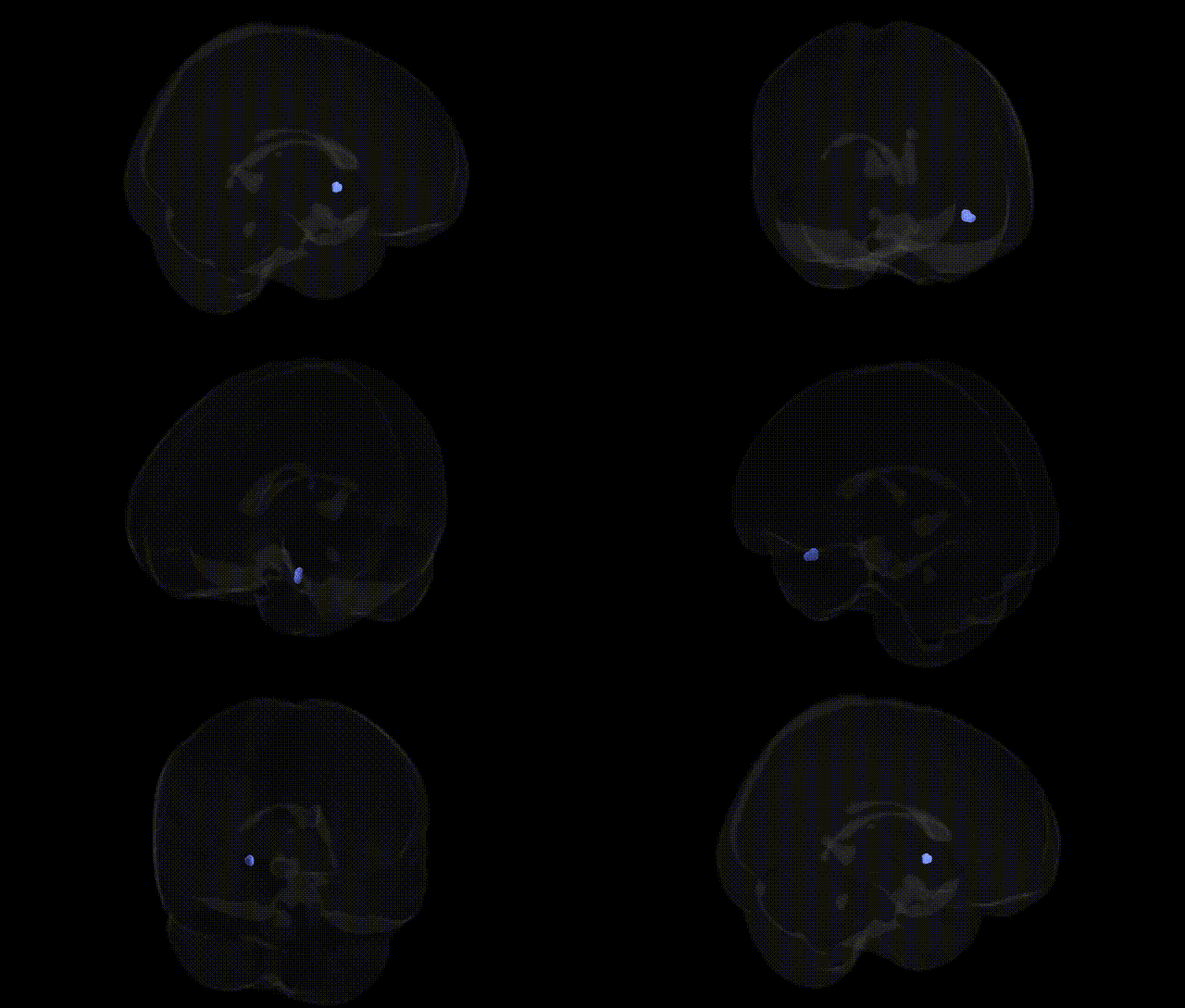
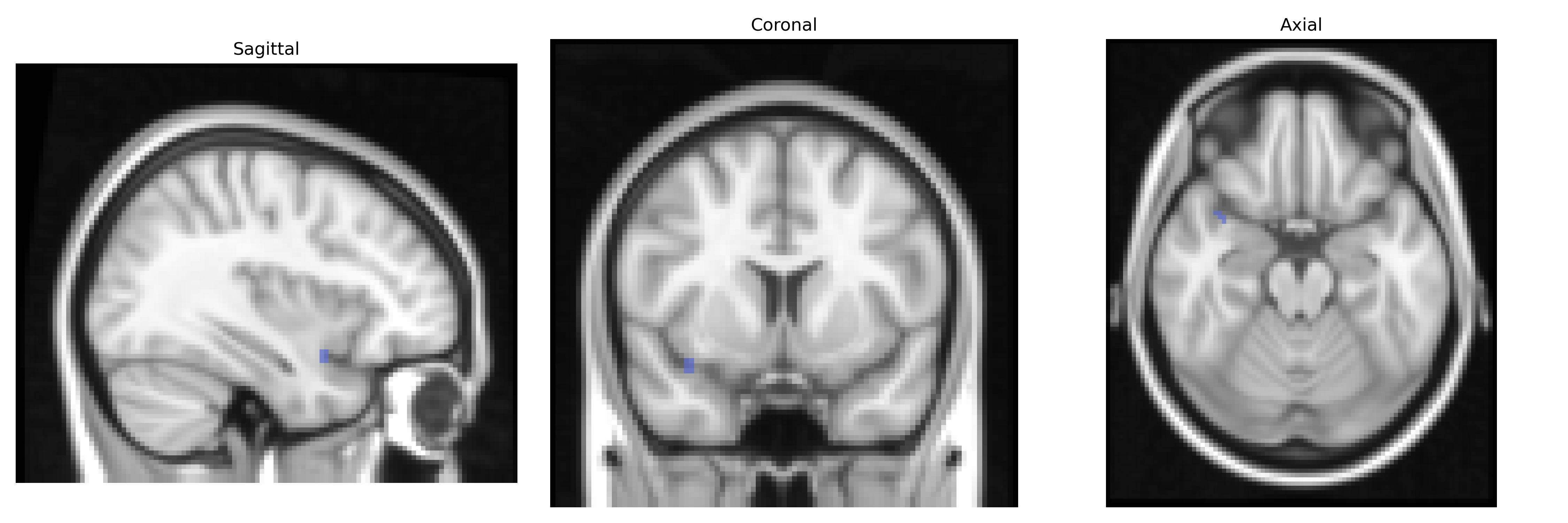
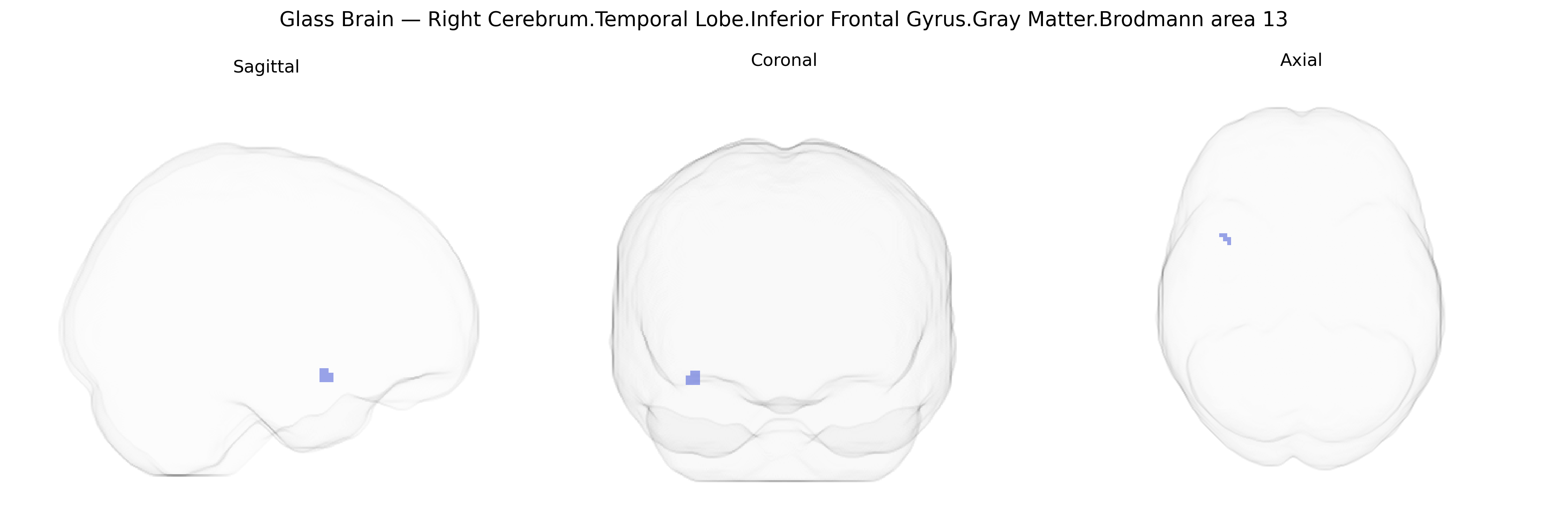
The bilateral Right Cerebrum.Temporal Lobe.Inferior Frontal Gyrus.Gray Matter.Brodmann area 13 region, as defined in the Talairach 2 mm atlas, corresponds to insular and adjacent frontal–temporal association cortex typically grouped within the orbitofrontal–insular complex. Brodmann area 13 is located deep within the lateral sulcus on the insular cortex and is involved in multimodal integration of visceral, emotional, gustatory, and somatosensory information, contributing to interoceptive awareness, affective processing, and aspects of decision-making related to bodily states. Although labeled here with an “inferior frontal gyrus” descriptor, the Talairach nomenclature reflects its proximity to orbitofrontal and anterior temporal structures rather than a strict gyral definition. There is no direct link for this specific Talairach composite label; a closely related structure with functional and anatomical overlap is the insular cortex: Insular cortex.
The bilateral Right Cerebrum.Temporal Lobe.Inferior Frontal Gyrus.Gray Matter.Brodmann area 13, corresponding approximately to parts of the insular and adjacent frontal-opercular/temporal-opercular cortex in the Talairach 2mm Atlas, has been implicated in several genetics-informed neuroimaging and GWAS findings, though most work targets broader insula/opercular or anterior temporal-frontal networks rather than BA13 specifically. Variants in genes related to synaptic function and neurodevelopment—such as CACNA1C, ANK3, and ZNF804A—have been associated with structural and functional alterations in insular/opercular regions involved in interoception, emotion, and salience processing, particularly in schizophrenia, bipolar disorder, and major depressive disorder. Large-scale GWAS of brain morphology (e.g., ENIGMA consortium studies) have identified polygenic influences on cortical thickness and surface area in insular and temporal regions overlapping BA13, with common variants near genes like KIAA0319, DLG2, and GRIN2A contributing to variability in these measures and to risk for neuropsychiatric traits. This region’s involvement in pain, addiction, and gustatory/interoceptive processing aligns with genetic findings in substance use and obesity-related traits, where alleles in dopaminergic (DRD2, OPRM1) and metabolic pathways (FTO, MC4R) show associations with altered activation or volume in nearby insular/frontal-opercular areas. In anxiety-related and post-traumatic stress phenotypes, risk variants in stress-response genes (FKBP5, CRHR1) and serotonin system genes (SLC6A4, HTR1A) have been linked to altered connectivity and reactivity of insular/anterior temporal-frontal circuits that include BA13. Overall, genetic associations for BA13 are best characterized at the level of larger insula–frontal–temporal networks, with converging evidence from GWAS and imaging genetics tying common risk alleles for mood, psychotic, pain, addiction, and metabolic disorders to structural and functional variation in this region.
Overview generated by GPT-4o (2026).
Region ID: 292
Hemisphere: bilateral
Atlas: Talairach labels 2mm
Full Quality Version: Download MP4
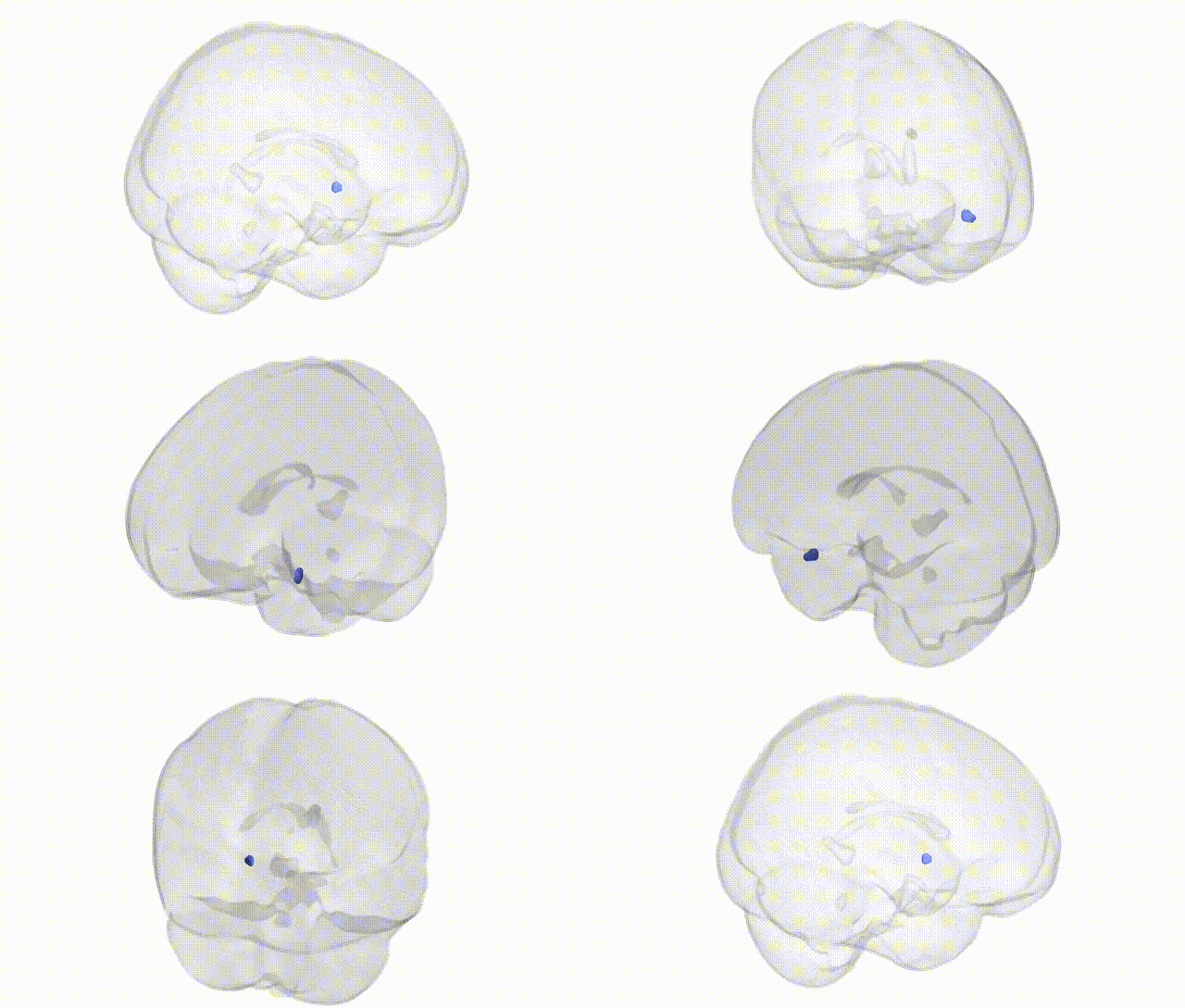
Full Quality Version: Download MP4
Wali Sidiqyar*, Gaurav Rudravaram*, Elyssa M. McMaster, Trent M. Schwartz, Adam M. Saunders, Kurt G. Schilling, Bennett A. Landman "Introducing SPINS: A Shared Public Visualization Library of Neuroanatomical Structures." Medical Imaging with Deep Learning- short paper
This resource is licensed under CC0 1.0 Universal (Public Domain).