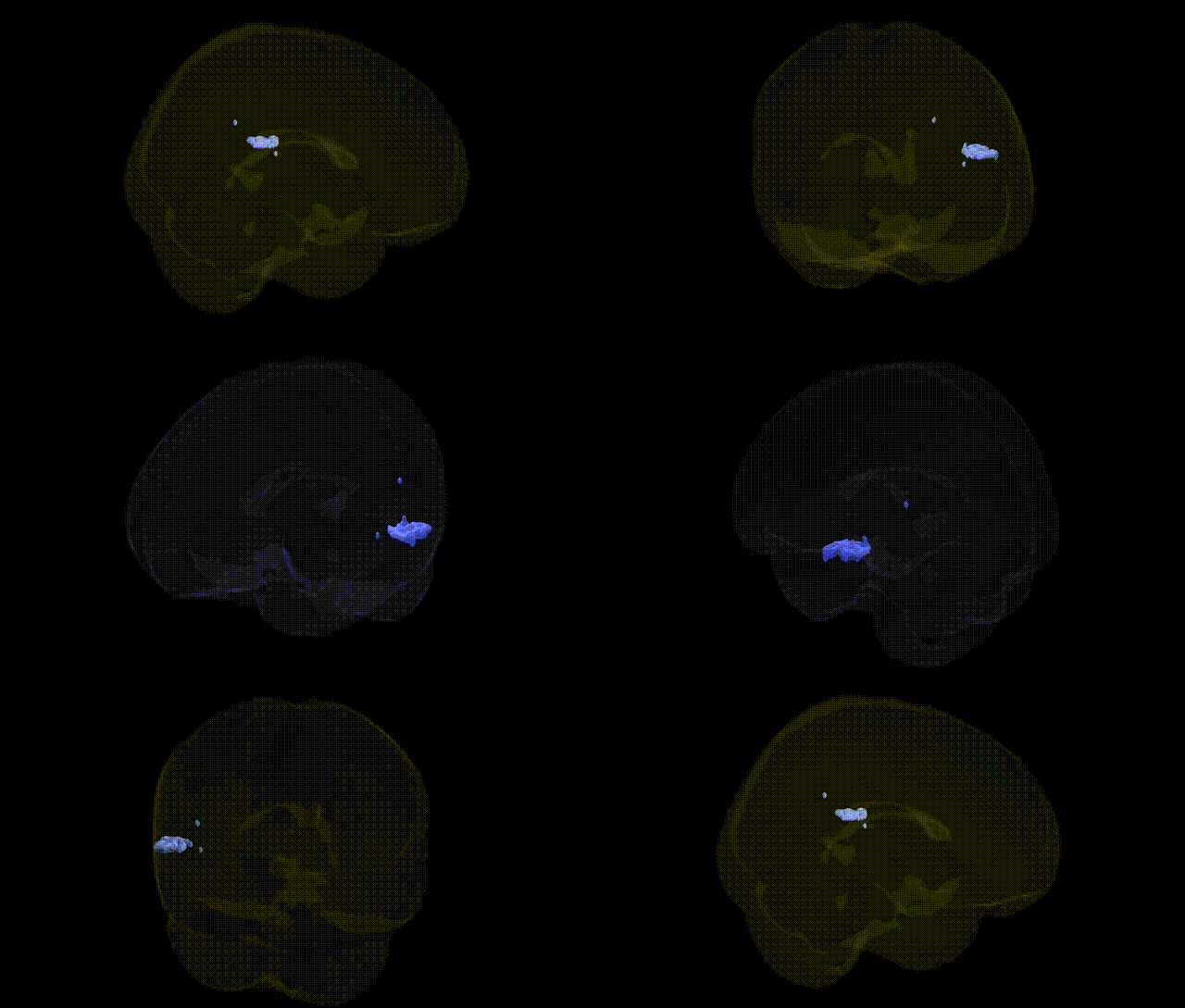
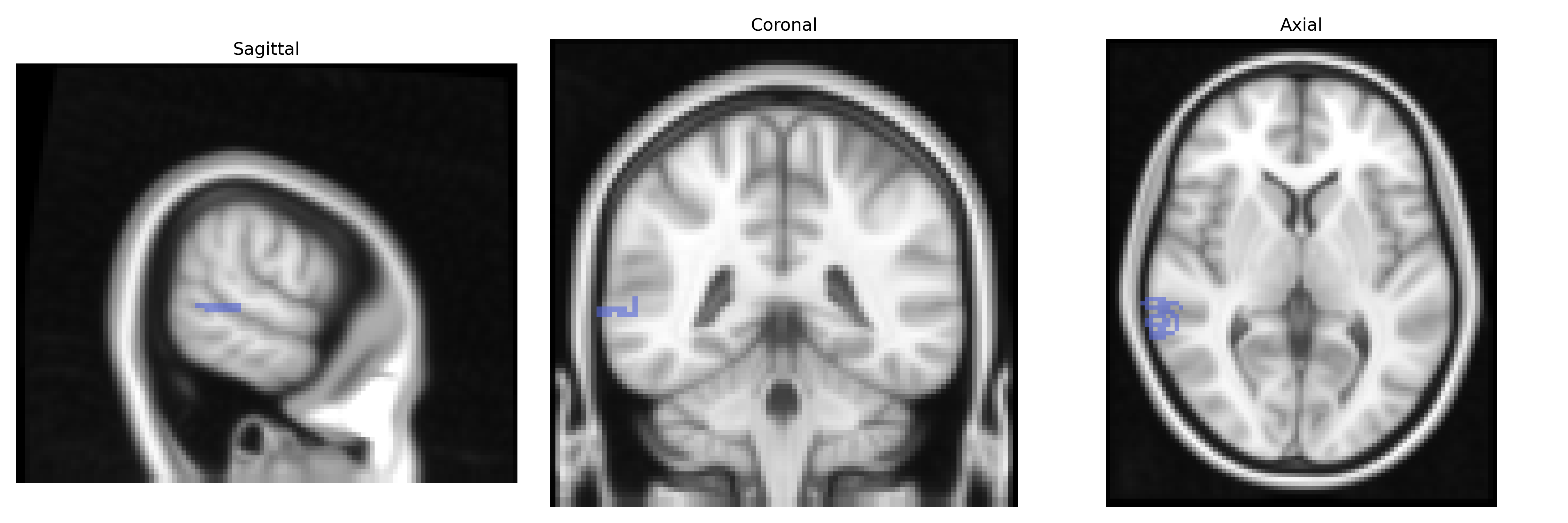
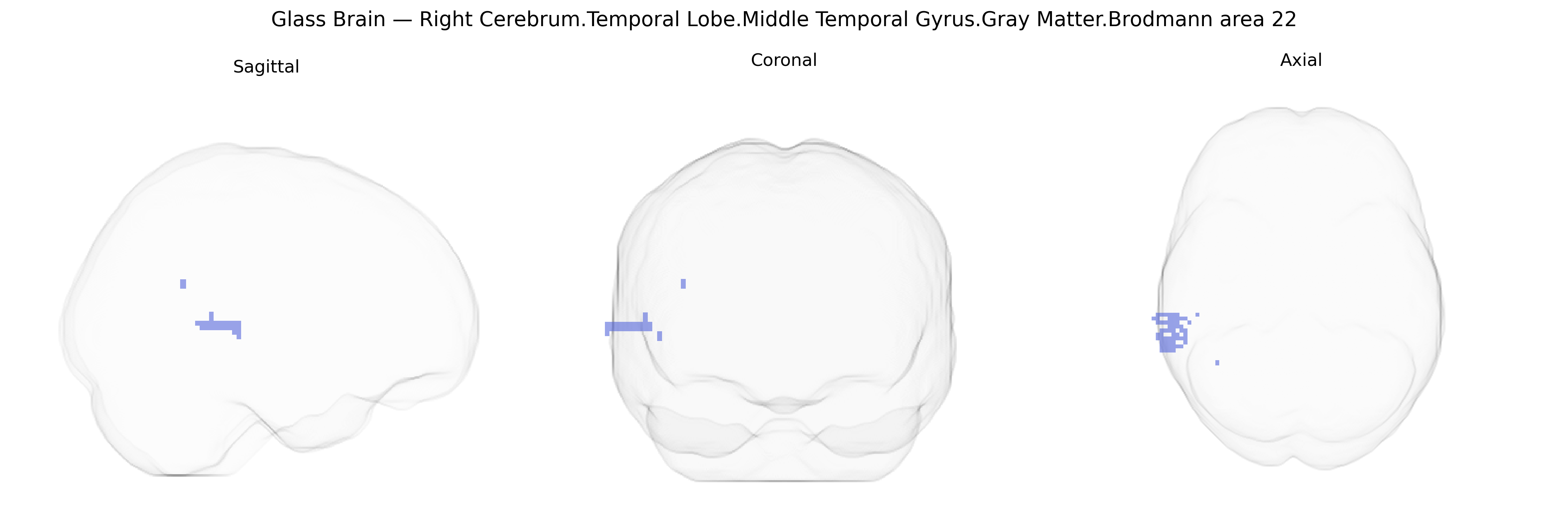
The bilateral Right Cerebrum.Temporal Lobe.Middle Temporal Gyrus.Gray Matter.Brodmann area 22 corresponds primarily to auditory association cortex situated on the lateral aspect of the temporal lobe, adjacent to the superior temporal gyrus and encompassing portions of the posterior temporal region implicated in language and higher-order auditory processing. Histologically, Brodmann area 22 is characterized by a granular neocortical architecture with well-developed layers II–IV, supporting complex integration of auditory inputs from primary auditory areas and multimodal cortical regions. Functionally, this area participates in speech comprehension, semantic processing, and the discrimination of complex acoustic patterns, with the dominant (usually left) hemisphere contributing centrally to receptive language functions, while the right hemisphere is more involved in prosody and aspects of music and non-verbal auditory perception. There is no single dedicated Wikipedia article for “Right Cerebrum.Temporal Lobe.Middle Temporal Gyrus.Brodmann area 22”; a closely related structure is Brodmann area 22.
The bilateral right middle temporal gyrus gray matter in Brodmann area 22, a canonical language and social cognition region, has been implicated in multiple genetic and GWAS-based findings, primarily through structural and functional MRI endophenotypes and disorder-related studies rather than single-region–specific genome-wide scans. Large imaging-genetics consortia (e.g., ENIGMA) have identified common variants near genes such as KIAA0586, DCDC2, and other neurodevelopmental loci that influence temporal lobe cortical thickness and surface area, with downstream effects on BA22 structure and connectivity. BA22 abnormalities are repeatedly reported in schizophrenia, with risk variants in genes including ZNF804A, CACNA1C, and GRM3 associated with altered temporal lobe activation and gray matter volume during language and auditory processing tasks. In autism spectrum disorder, common and rare variants affecting synaptic genes (e.g., NRXN1, SHANK3), as well as polygenic risk scores, have been linked to atypical temporal cortex development and reduced specialization of BA22 for social communication. GWAS of reading and language-related traits, including developmental language disorder and dyslexia, have implicated loci such as CNTNAP2 and FOXP2-regulated networks, which show altered connectivity and cortical morphology in BA22 and adjacent superior/middle temporal regions. Additionally, GWAS of general cognitive ability and educational attainment highlight polygenic influences on temporal lobe gray matter and functional coupling of BA22 with frontoparietal networks, suggesting that this region’s structure and function partly mediate genetically driven variation in language, verbal IQ, and social cognitive phenotypes.
Overview generated by GPT-4o (2026).
Region ID: 460
Hemisphere: bilateral
Atlas: Talairach labels 2mm
Full Quality Version: Download MP4
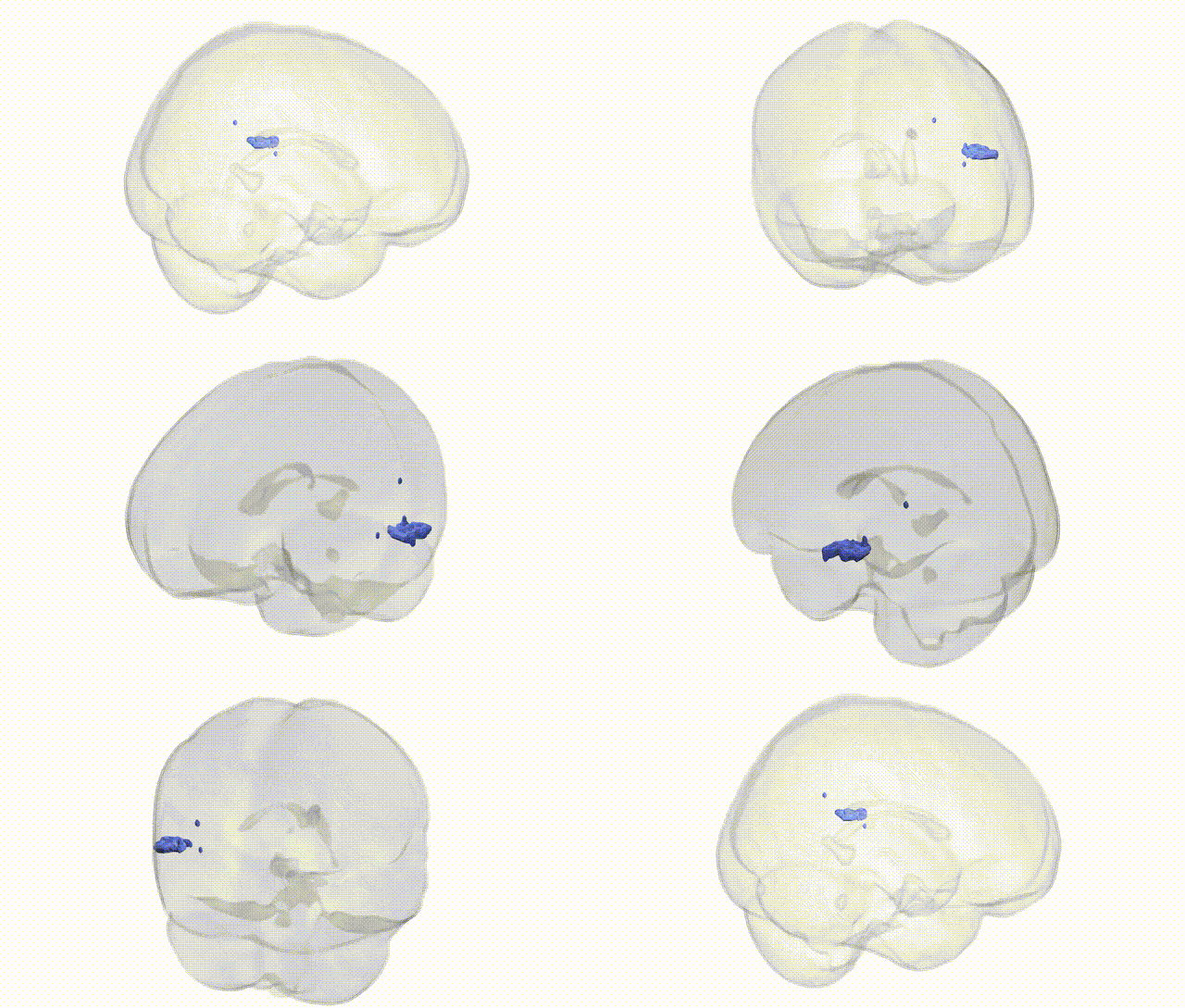
Full Quality Version: Download MP4
Wali Sidiqyar*, Gaurav Rudravaram*, Elyssa M. McMaster, Trent M. Schwartz, Adam M. Saunders, Kurt G. Schilling, Bennett A. Landman "Introducing SPINS: A Shared Public Visualization Library of Neuroanatomical Structures." Medical Imaging with Deep Learning- short paper
This resource is licensed under CC0 1.0 Universal (Public Domain).