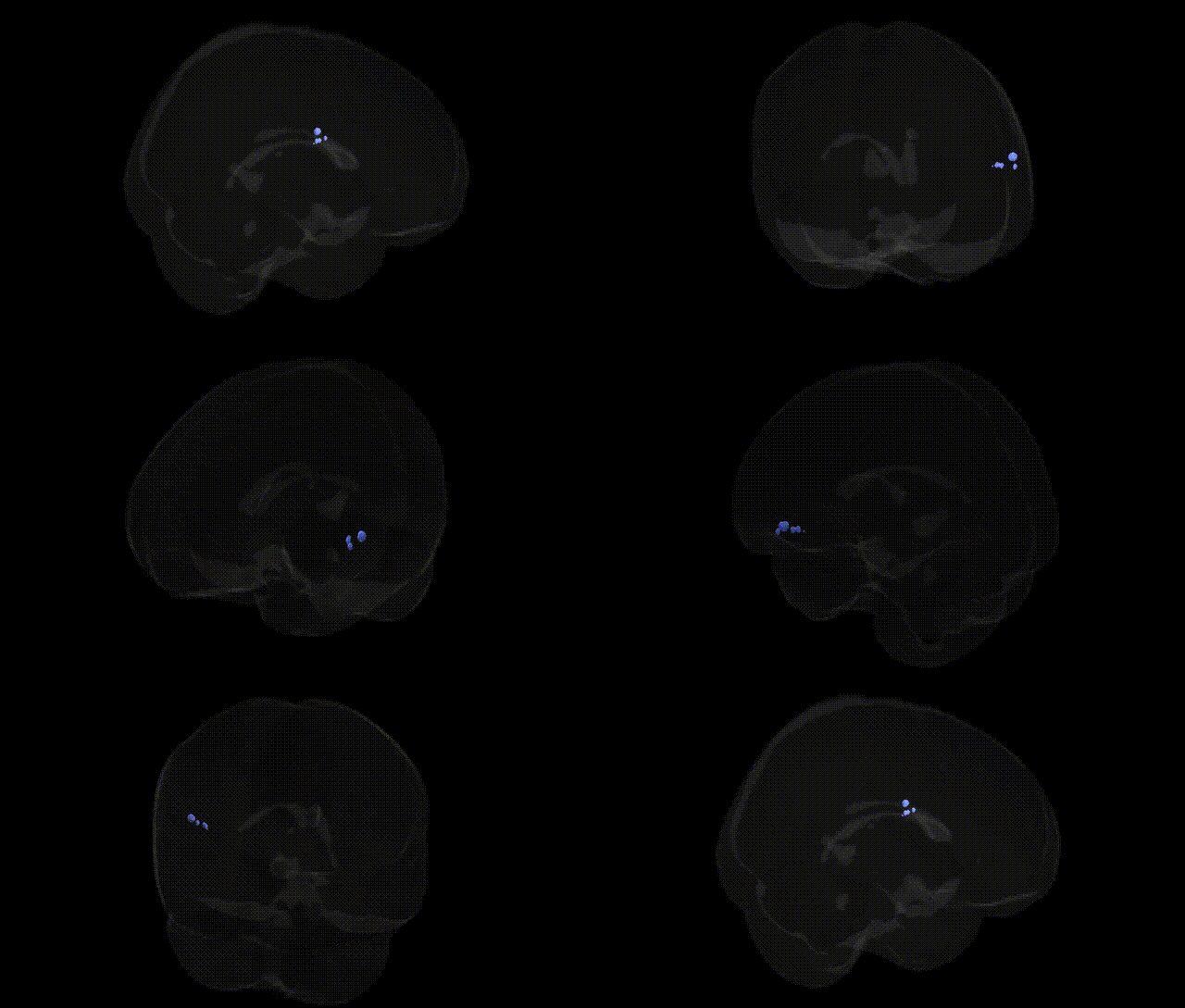
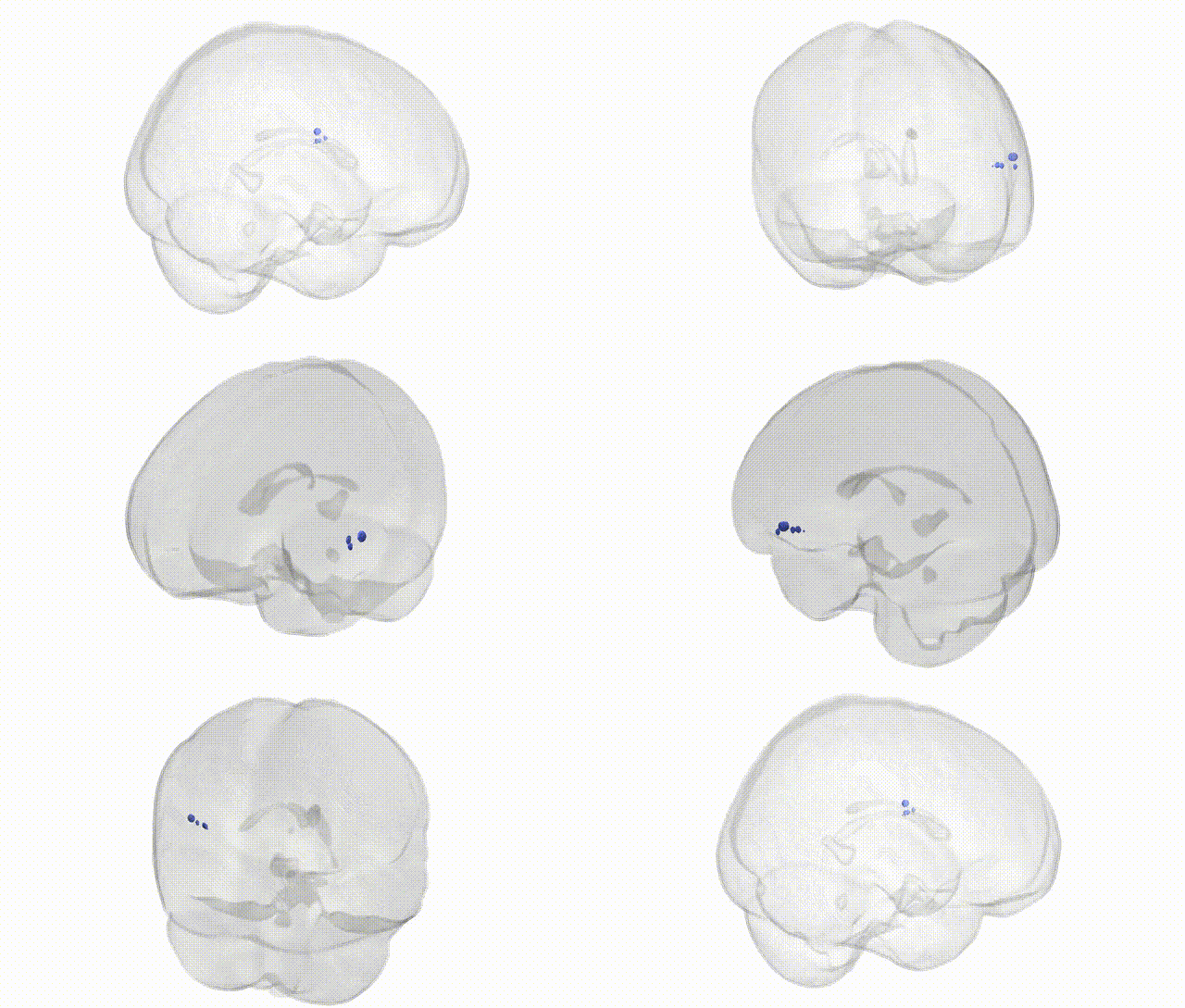
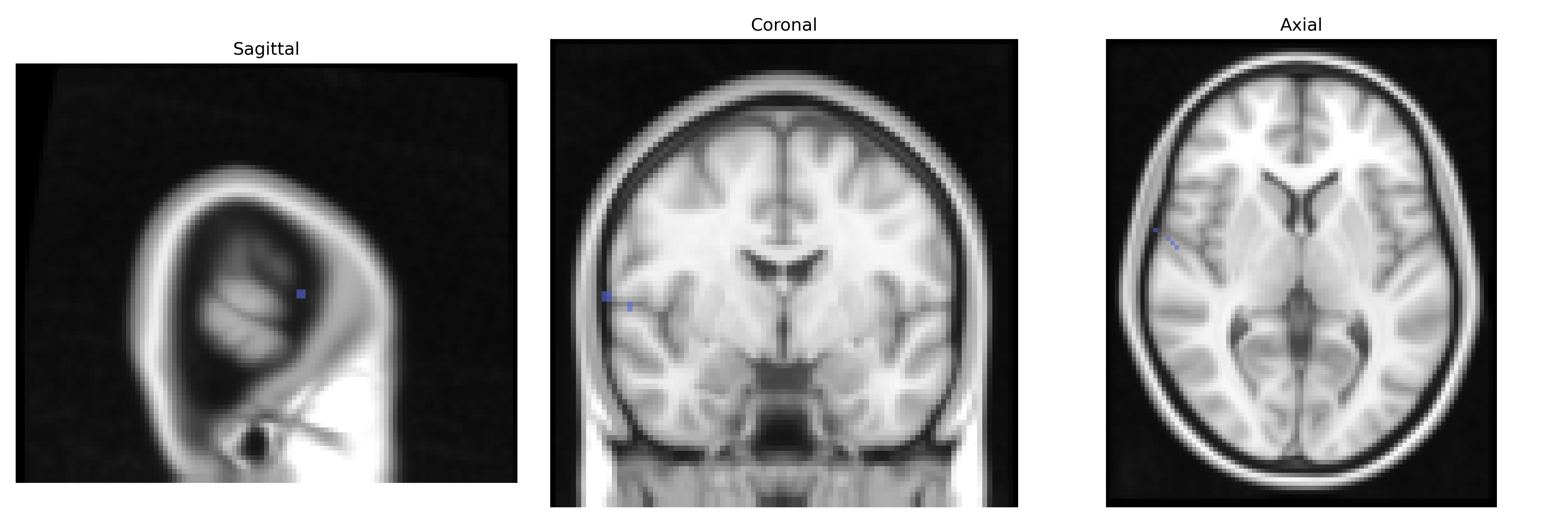
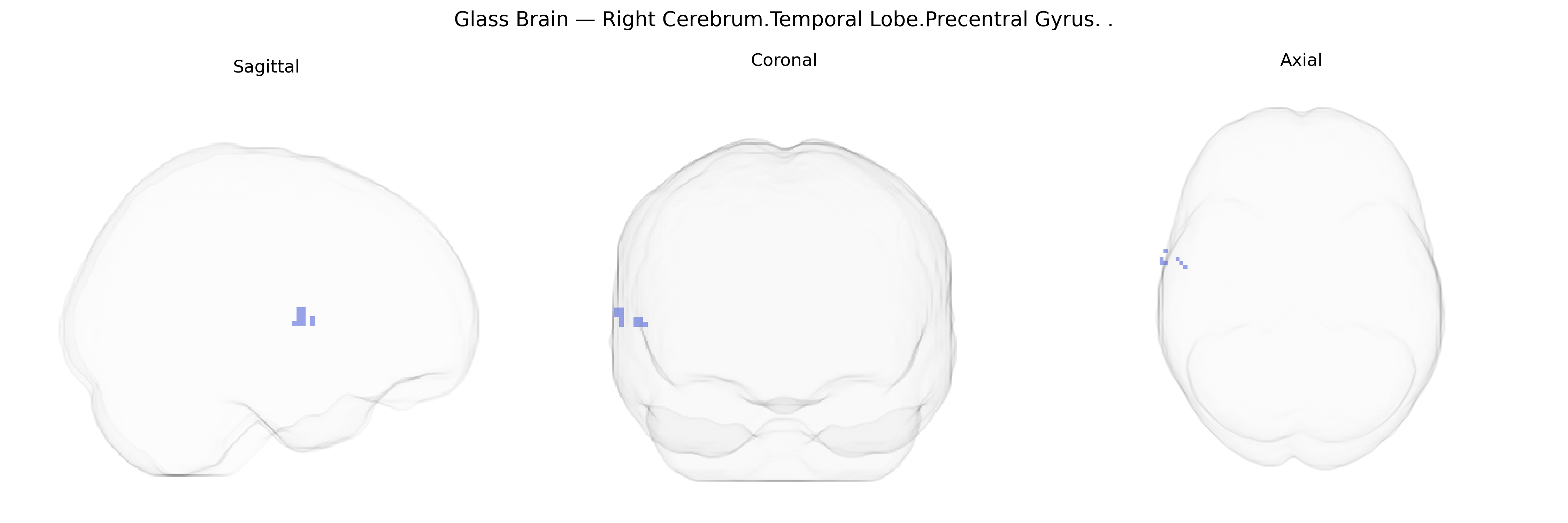
The bilateral Right Cerebrum.Temporal Lobe.Precentral Gyrus, as labeled in the Talairach 2 mm atlas, reflects a composite or bordering region that combines elements of the temporal lobe with the precentral gyrus of the frontal lobe, likely corresponding to an area near the fronto-temporal junction and adjacent to primary motor cortex. The precentral gyrus is classically identified as the primary motor cortex (Brodmann area 4), responsible for voluntary motor control, somatotopically organized with body parts represented along its rostro-caudal and medio-lateral extent. Functionally, this region contributes to the planning and execution of precise, contralateral movements, including those involving the face, upper limb, and trunk, while its proximity to temporal lobe structures situates it near circuits involved in multimodal integration, language, and sensorimotor processing. There is no direct Wikipedia link for the combined Talairach label; a closely related structure is the precentral gyrus itself: Precentral gyrus.
The “Right Cerebrum.Temporal Lobe.Precentral Gyrus” label in the Talairach 2 mm atlas partly reflects a parcellation artifact, as the precentral gyrus is classically frontal rather than temporal; nevertheless, genetic and GWAS-related work on the precentral region (primary motor cortex and adjacent premotor areas) has repeatedly implicated it in motor, cognitive, and neuropsychiatric phenotypes. Large imaging genetics consortia (e.g., ENIGMA, UK Biobank) have identified polygenic influences on cortical thickness and surface area of motor/precentral territories, with variants near genes involved in synaptic function and neurodevelopment (such as BDNF, CNTNAP2, and various glutamatergic and axon-guidance genes) contributing to inter-individual variation. GWAS of motor skill, fine motor coordination, and general physical activity consistently show enrichment of associated variants in regulatory elements active in motor cortex, while structural and functional alterations of precentral regions have been tied, via genetic and polygenic risk approaches, to movement disorders including Parkinson’s disease, dystonia, and Tourette syndrome, as well as to amyotrophic lateral sclerosis, where risk loci (for example in C9orf72, SOD1, TARDBP, FUS) are linked to degeneration and functional disruption of corticospinal motor neurons originating in the precentral gyrus. Neurodevelopmental and psychiatric GWAS also show precentral involvement: polygenic risk for ADHD and autism spectrum disorder has been associated with atypical activation and morphology of precentral/motor regions, and schizophrenia and bipolar disorder risk scores modestly correlate with distributed cortical changes that include the precentral cortex. More broadly, brain-wide GWAS of task-based and resting-state fMRI have revealed heritable patterns of sensorimotor network connectivity involving the precentral gyrus, indicating that many common variants with small effects collectively shape the structure and function of this motor region, and through it, susceptibility to a range of motor, cognitive, and psychiatric traits.
Overview generated by GPT-4o (2026).
Region ID: 681
Hemisphere: bilateral
Atlas: Talairach labels 2mm
Full Quality Version: Download MP4
Full Quality Version: Download MP4
Wali Sidiqyar*, Gaurav Rudravaram*, Elyssa M. McMaster, Trent M. Schwartz, Adam M. Saunders, Kurt G. Schilling, Bennett A. Landman "Introducing SPINS: A Shared Public Visualization Library of Neuroanatomical Structures." Medical Imaging with Deep Learning- short paper
This resource is licensed under CC0 1.0 Universal (Public Domain).