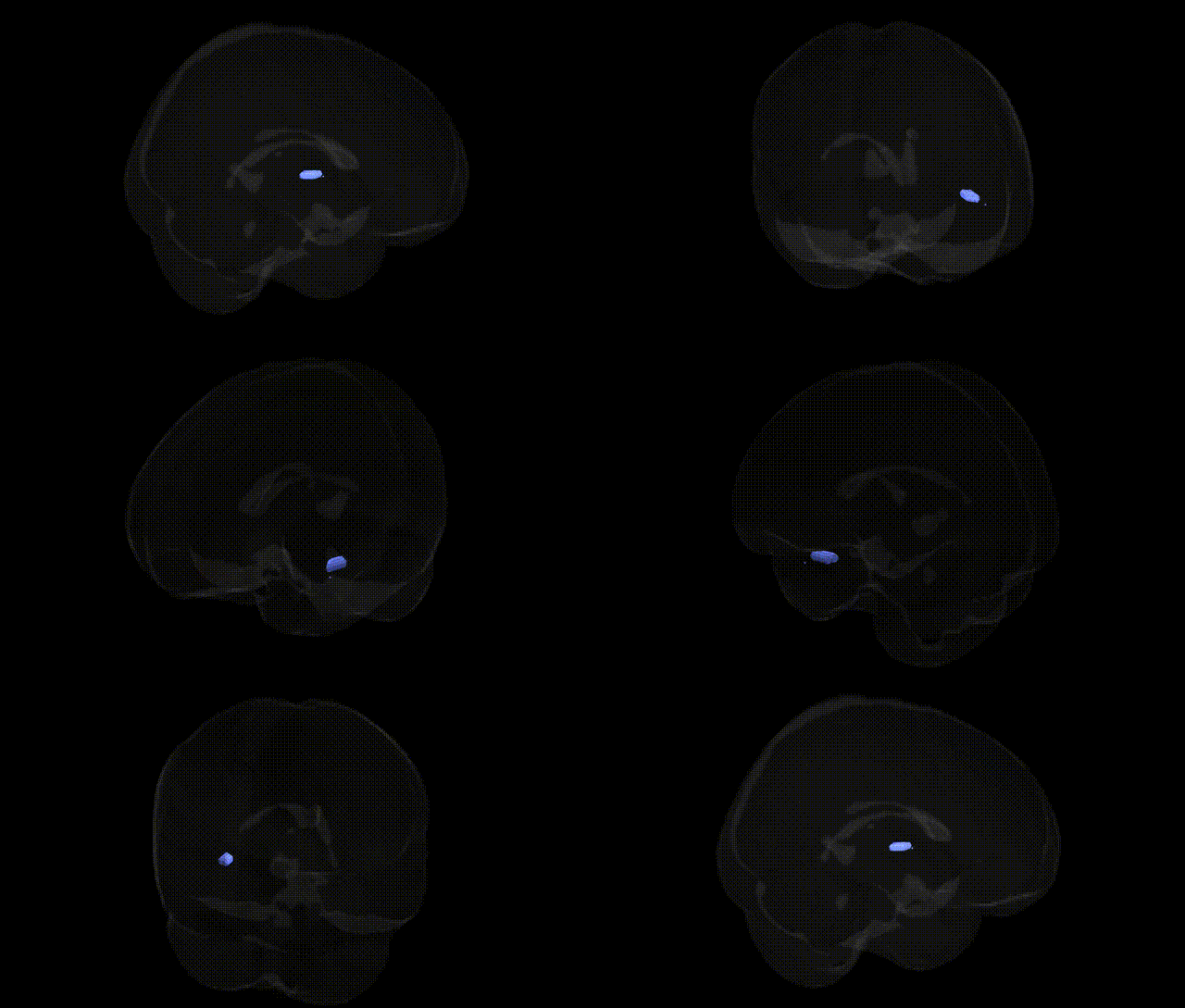
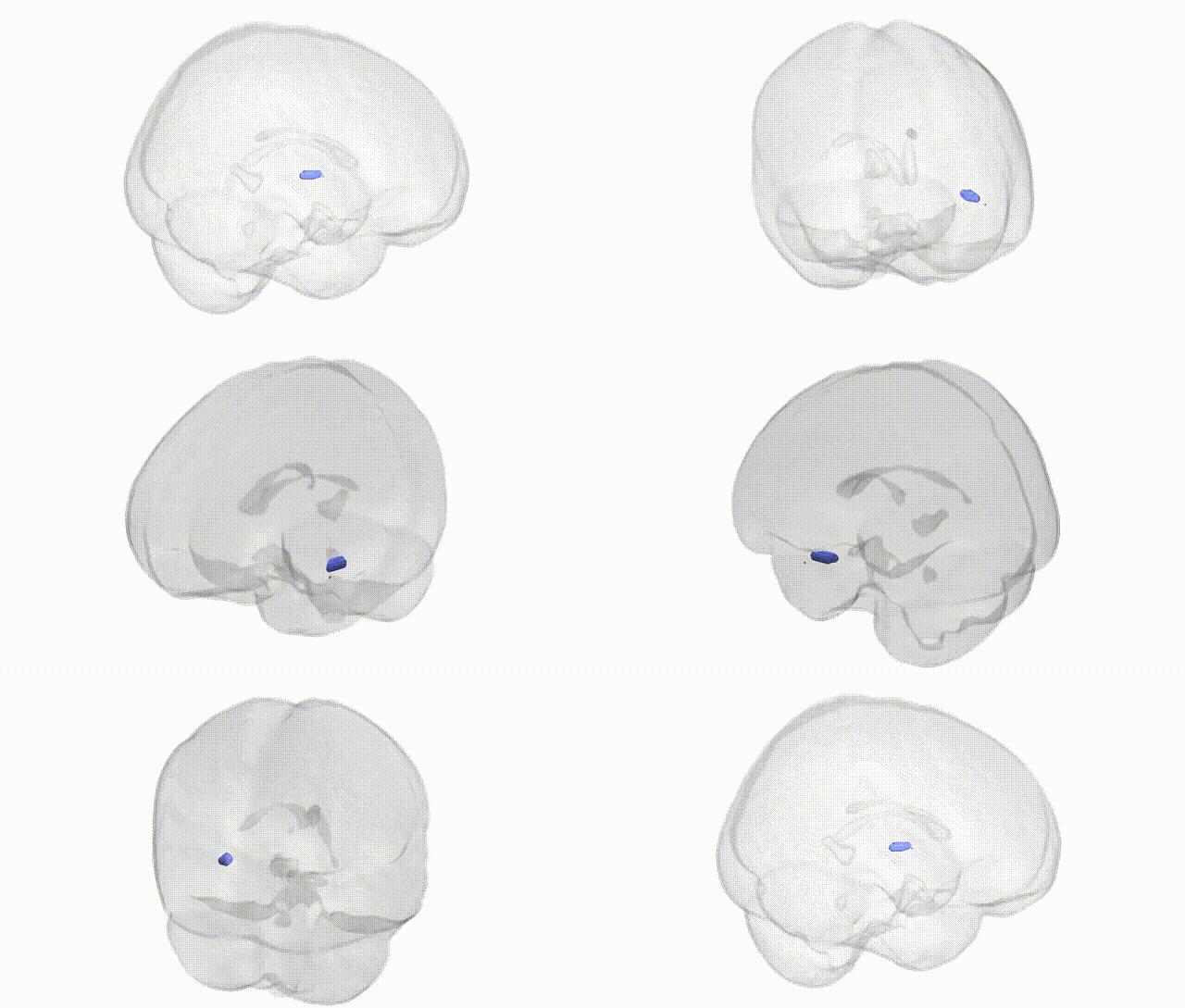
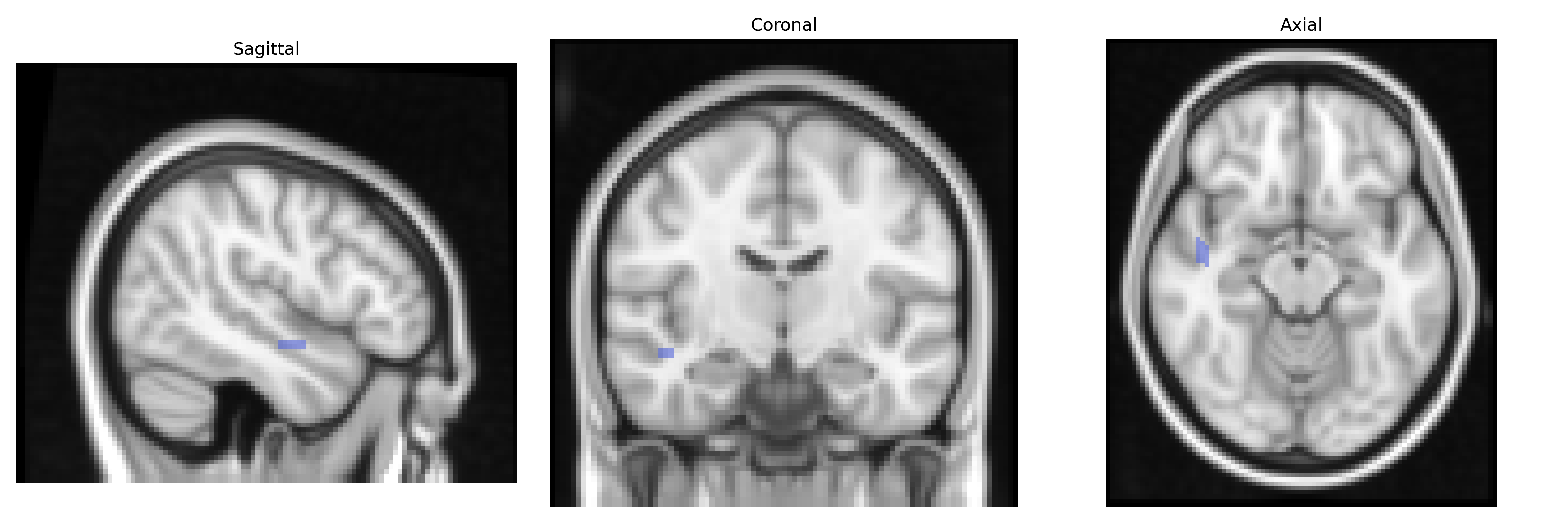
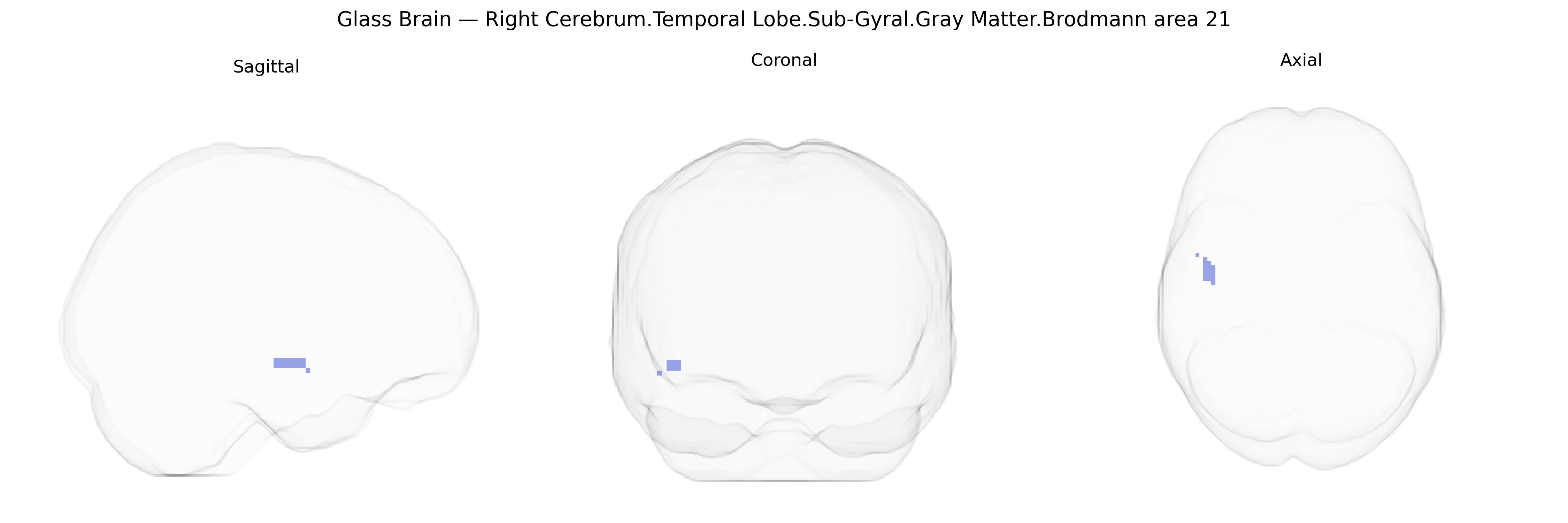
The bilateral Right Cerebrum.Temporal Lobe.Sub-Gyral.Gray Matter.Brodmann area 21 corresponds to association cortex within the middle temporal gyrus of the right temporal lobe, situated beneath the cortical gyri (sub-gyral gray matter) and extending across both hemispheres in the Talairach 2 mm framework. Brodmann area 21 is primarily involved in higher-order auditory and language processing, semantic integration, and aspects of visual object recognition, and it participates in multimodal association networks linking auditory, visual, and limbic regions. Functionally, this area contributes to comprehension of spoken and written language, interpretation of complex sounds, and integration of contextual meaning, with right-hemisphere portions additionally implicated in prosody, social and emotional aspects of communication, and certain facets of autobiographical memory. There is no direct Wikipedia article for this full Talairach label; a closely related structure is the middle temporal gyrus: Middle temporal gyrus.
The bilateral Right Cerebrum Temporal Lobe Sub-Gyral Gray Matter Brodmann area 21 (BA21), a key component of the middle temporal gyrus involved in language, semantic processing, and social cognition, has been implicated in multiple genetic and GWAS-based findings through its structure and function rather than via region-specific single-gene associations. Imaging genetics studies and large-scale GWAS of cortical thickness and surface area consistently show that temporal lobe regions encompassing BA21 are influenced by polygenic variation in neurodevelopmental and synaptic genes, including loci near microtubule-related genes (e.g., MAPT region on 17q21), glutamatergic and GABAergic signaling genes, and genes regulating neuronal migration and axon guidance. BA21 volume and cortical thickness have been repeatedly associated with schizophrenia- and bipolar-disorder risk variants in genome-wide studies of brain morphology, and reduced gray matter in this area is a robust imaging phenotype in schizophrenia and major depression, which partly tracks polygenic risk scores for these disorders. Autism spectrum disorder and social cognition GWAS have also linked polygenic risk to alterations in temporal lobe regions covering BA21, consistent with its role in language and theory-of-mind processing, while Alzheimer’s disease risk loci (e.g., APOE and other GWAS hits) are associated with atrophy patterns that include the lateral temporal cortex. In addition, GWAS of cognitive traits such as educational attainment, general intelligence, and reading/language ability show enrichment of associated variants in networks that heavily recruit BA21, and polygenic influences on resting-state connectivity within language and default-mode networks frequently involve this region, underscoring that genetic effects on BA21 are highly polygenic and network-based rather than driven by single, region-specific genes.
Overview generated by GPT-4o (2026).
Region ID: 275
Hemisphere: bilateral
Atlas: Talairach labels 2mm
Full Quality Version: Download MP4
Full Quality Version: Download MP4
Wali Sidiqyar*, Gaurav Rudravaram*, Elyssa M. McMaster, Trent M. Schwartz, Adam M. Saunders, Kurt G. Schilling, Bennett A. Landman "Introducing SPINS: A Shared Public Visualization Library of Neuroanatomical Structures." Medical Imaging with Deep Learning- short paper
This resource is licensed under CC0 1.0 Universal (Public Domain).