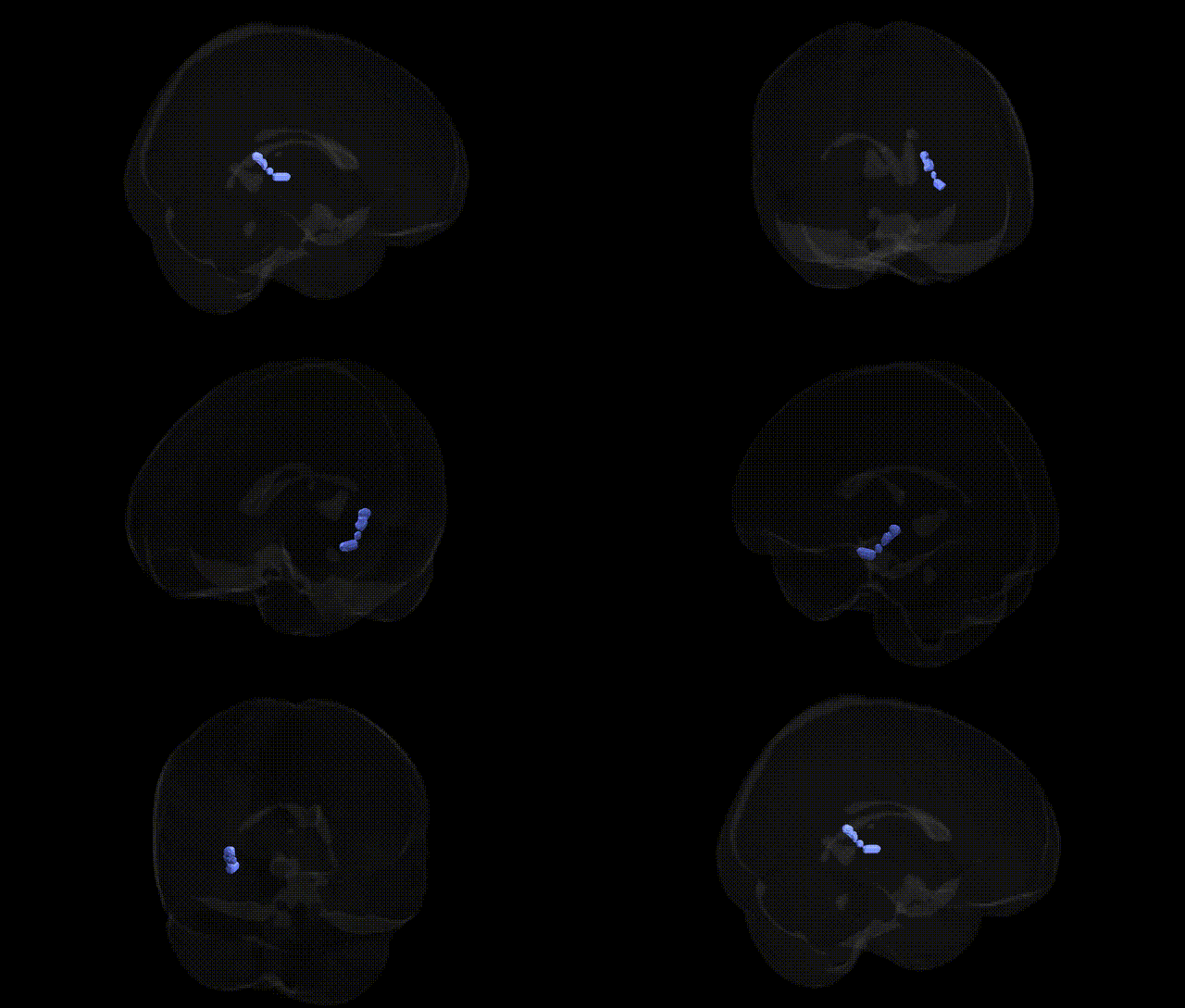
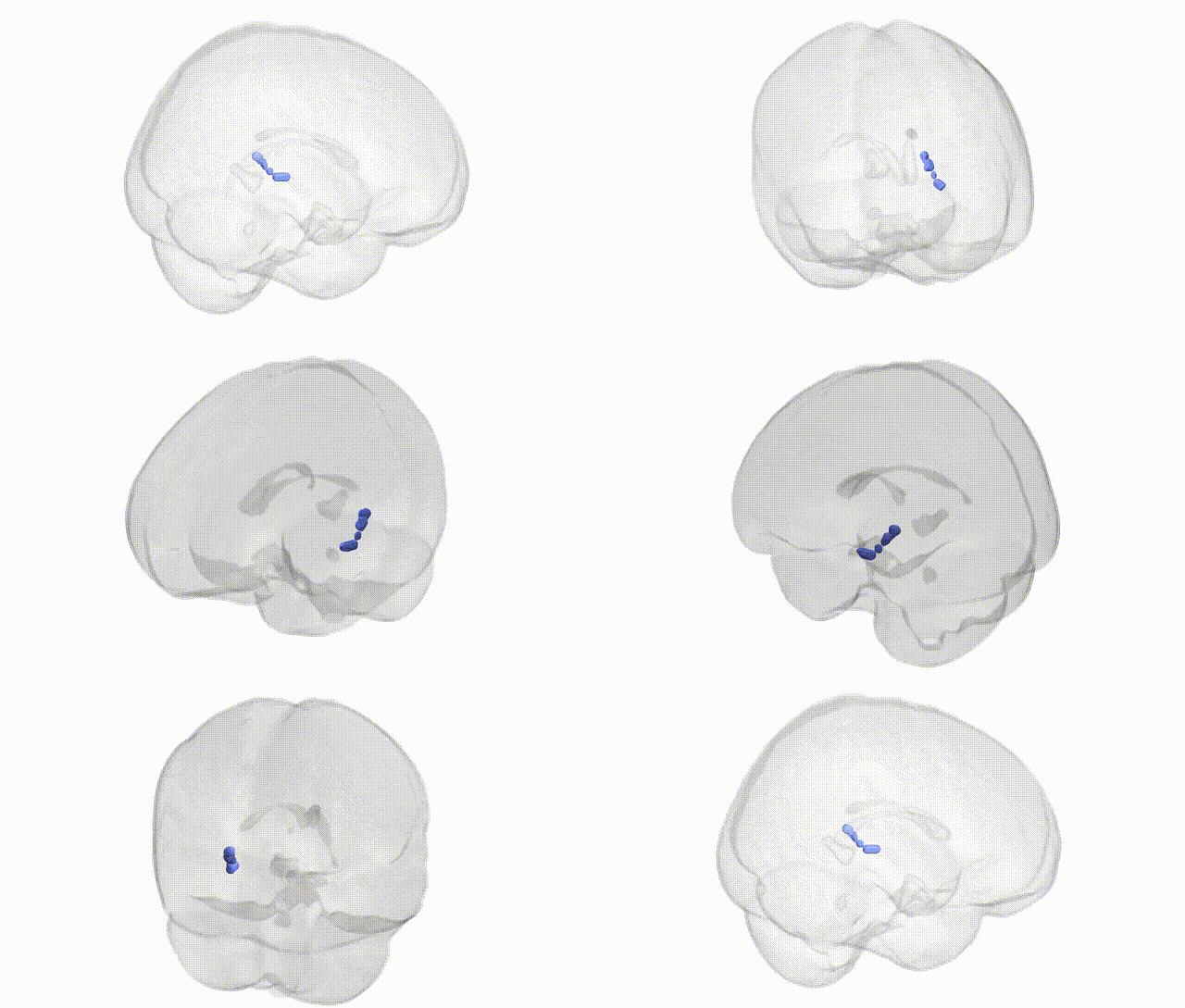
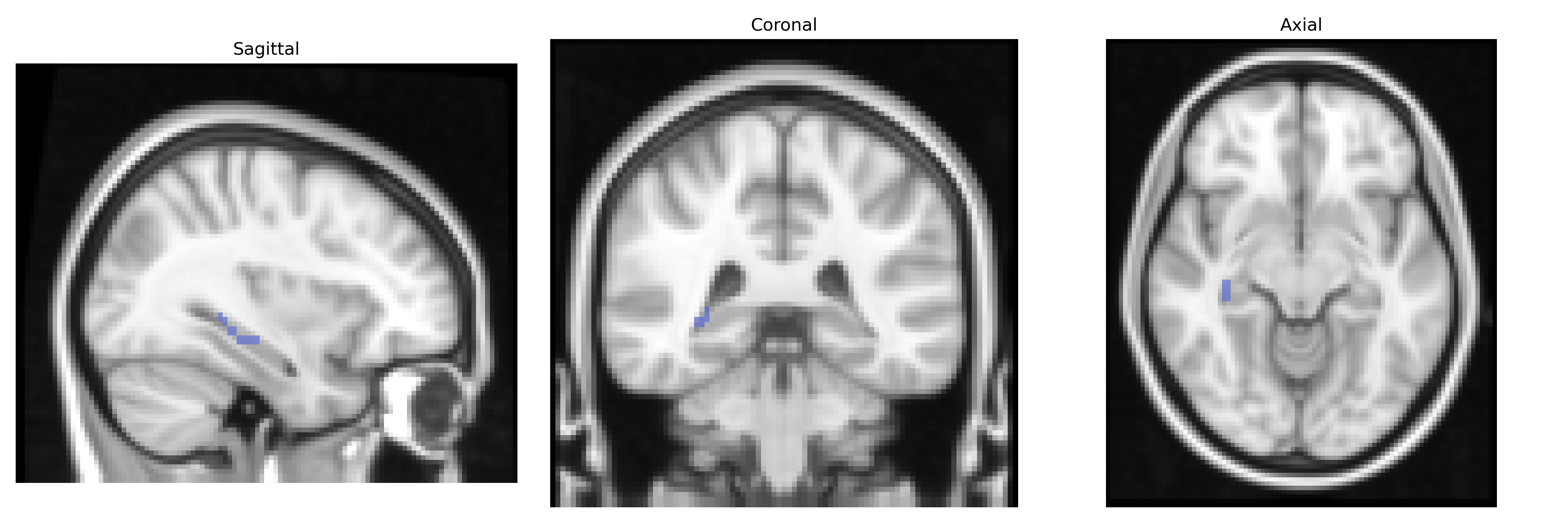
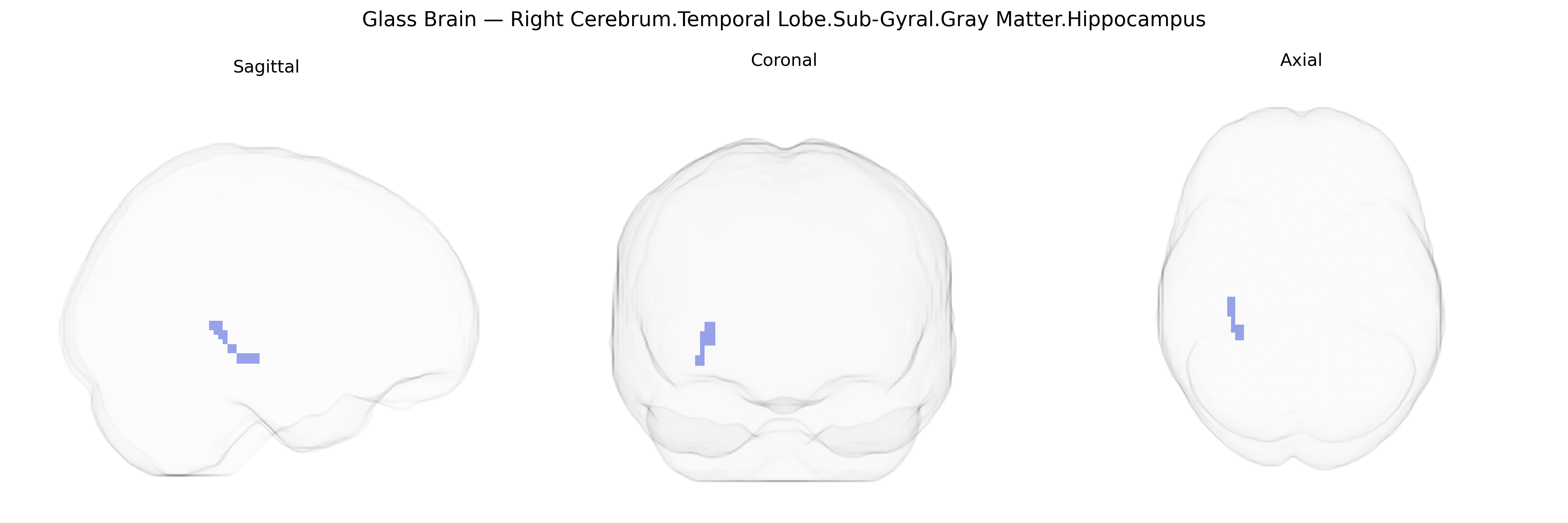
The bilateral Right Cerebrum.Temporal Lobe.Sub-Gyral.Gray Matter.Hippocampus corresponds to the hippocampal formation located within the medial temporal lobe, lying deep to the temporal gyri in the sub-gyral gray matter. This structure is critically involved in the encoding, consolidation, and retrieval of declarative (episodic and autobiographical) memories, as well as spatial navigation and contextual processing. It interacts extensively with the entorhinal cortex, parahippocampal gyrus, and prefrontal regions as part of memory and limbic networks, and is highly sensitive to metabolic and ischemic insults. Bilateral hippocampal integrity is essential for normal memory function, and its atrophy or dysfunction is a hallmark of several neurological and psychiatric disorders, including Alzheimer’s disease and temporal lobe epilepsy. Hippocampus
The bilateral right hippocampal sub-gyral gray matter within the temporal lobe (as defined in the Talairach 2 mm atlas) is a key structure repeatedly implicated in genetic studies of neuropsychiatric and neurodegenerative traits. Large GWAS of hippocampal volume and subfield morphology have identified common variants in and around genes such as APOE, TOMM40, and BIN1 (Alzheimer’s disease risk), SLC4A7, DPP4, and HMGA2, among others, that influence hippocampal size and microstructure, with several loci overlapping those for general cognitive ability and educational attainment. Polygenic risk scores for Alzheimer’s disease, schizophrenia, major depressive disorder, bipolar disorder, and PTSD show significant associations with reduced hippocampal volume or altered right hippocampal connectivity, particularly in CA1 and subiculum-related subregions, supporting a shared genetic architecture for episodic memory dysfunction and stress-related pathology. Variants in BDNF (notably Val66Met), FKBP5, and GR-related pathways (NR3C1) have been linked to stress responsivity and hippocampal plasticity, with imaging genetics studies demonstrating genotype-dependent differences in right hippocampal activation during memory and emotional processing tasks. In addition, GWAS of traits such as anxiety, neuroticism, and resilience highlight loci that modulate hippocampal structure and function, and rare variant and copy-number studies (for example involving 22q11.2 deletions) connect hippocampal abnormalities to schizophrenia and developmental cognitive impairments. Collectively, these findings indicate that the genetic architecture of right temporal sub-gyral hippocampal gray matter intersects strongly with pathways for synaptic plasticity, lipid metabolism, neuroinflammation, and HPA-axis regulation, underpinning susceptibility to Alzheimer’s disease, mood and psychotic disorders, and individual differences in memory and emotional processing.
Overview generated by GPT-4o (2026).
Region ID: 338
Hemisphere: bilateral
Atlas: Talairach labels 2mm
Full Quality Version: Download MP4
Full Quality Version: Download MP4
Wali Sidiqyar*, Gaurav Rudravaram*, Elyssa M. McMaster, Trent M. Schwartz, Adam M. Saunders, Kurt G. Schilling, Bennett A. Landman "Introducing SPINS: A Shared Public Visualization Library of Neuroanatomical Structures." Medical Imaging with Deep Learning- short paper
This resource is licensed under CC0 1.0 Universal (Public Domain).