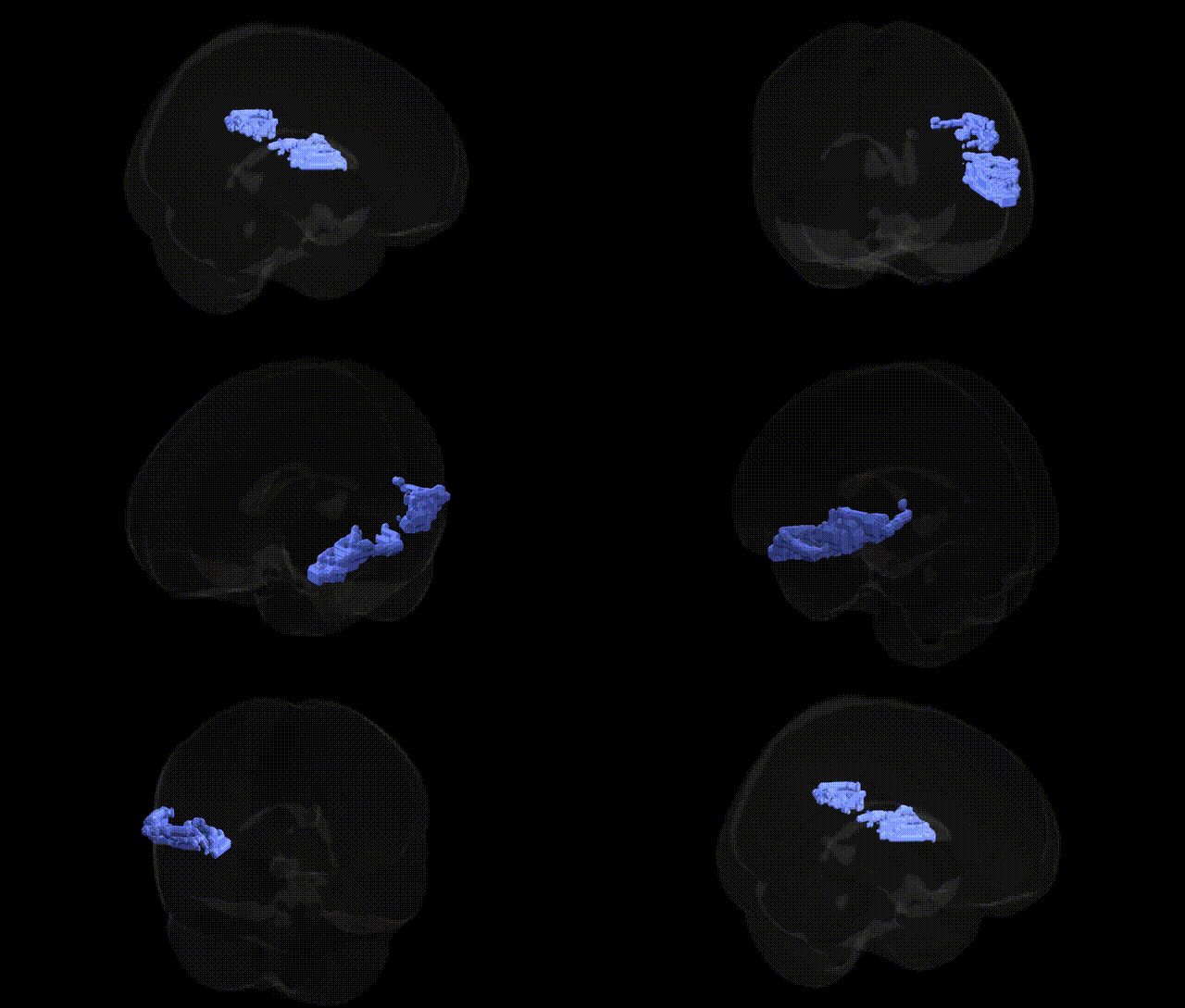
The bilateral Right Cerebrum.Temporal Lobe.Superior Temporal Gyrus.Gray Matter.Brodmann area 22 corresponds primarily to auditory association cortex involved in higher-order processing of complex sounds, speech perception, and aspects of language comprehension. Located on the superior temporal gyrus of the lateral temporal lobe, Brodmann area 22 integrates auditory inputs from primary auditory areas and connects extensively with frontal and parietal language networks, contributing to phonological processing, semantic interpretation, and recognition of vocal signals. In the dominant (usually left) hemisphere this region overlaps with Wernicke’s area and is crucial for understanding spoken language, while in the right hemisphere it is more strongly implicated in processing prosody, affective tone, and other nonverbal aspects of auditory communication. There is no single Wikipedia article for the full Talairach label; a closely related structure is Brodmann area 22.
The bilateral right superior temporal gyrus (STG), Brodmann area 22, is a core auditory and language-related region whose structure and function show substantial heritability and have been repeatedly implicated in genetic studies of psychiatric and neurodevelopmental disorders. GWAS of cortical thickness and surface area have identified common variants near genes involved in neurodevelopment and synaptic function (e.g., MIR137, GRIN2A, DCC, and several loci in calcium-channel and glutamatergic pathways) that associate with temporal lobe morphology, including BA22, although findings are typically reported at the level of broader temporal regions rather than this parcel alone. Structural and functional abnormalities of right STG are robustly associated with schizophrenia, and polygenic risk scores as well as specific loci such as ZNF804A, CACNA1C, and NRG1 have been linked to altered STG volume, cortical thickness, or activation during auditory and language tasks; similar but weaker associations have been reported in bipolar disorder and major depression. Variants in FOXP2, CNTNAP2, and related language-network genes show associations with temporal lobe activation patterns and gray matter in STG during speech and phonological processing, and rare mutations in GRIN2A, SRPX2, and other synaptic genes have been associated with epilepsy-aphasia syndromes and speech/language impairments involving BA22. Autism spectrum disorder risk genes (e.g., SHANK3, NRXN1, and CHD8) have been linked to atypical superior temporal response to social and auditory stimuli, as well as macro- or microstructural deviations in temporal cortex. Large-scale imaging genetics consortia (e.g., ENIGMA) support a highly polygenic architecture in which numerous small-effect variants collectively influence gray matter volume and cortical metrics in superior temporal regions, with overlapping genetic factors contributing to susceptibility for psychosis, language-related disorders, and social cognition traits that depend heavily on the integrity of BA22.
Overview generated by GPT-4o (2026).
Region ID: 446
Hemisphere: bilateral
Atlas: Talairach labels 2mm
Full Quality Version: Download MP4
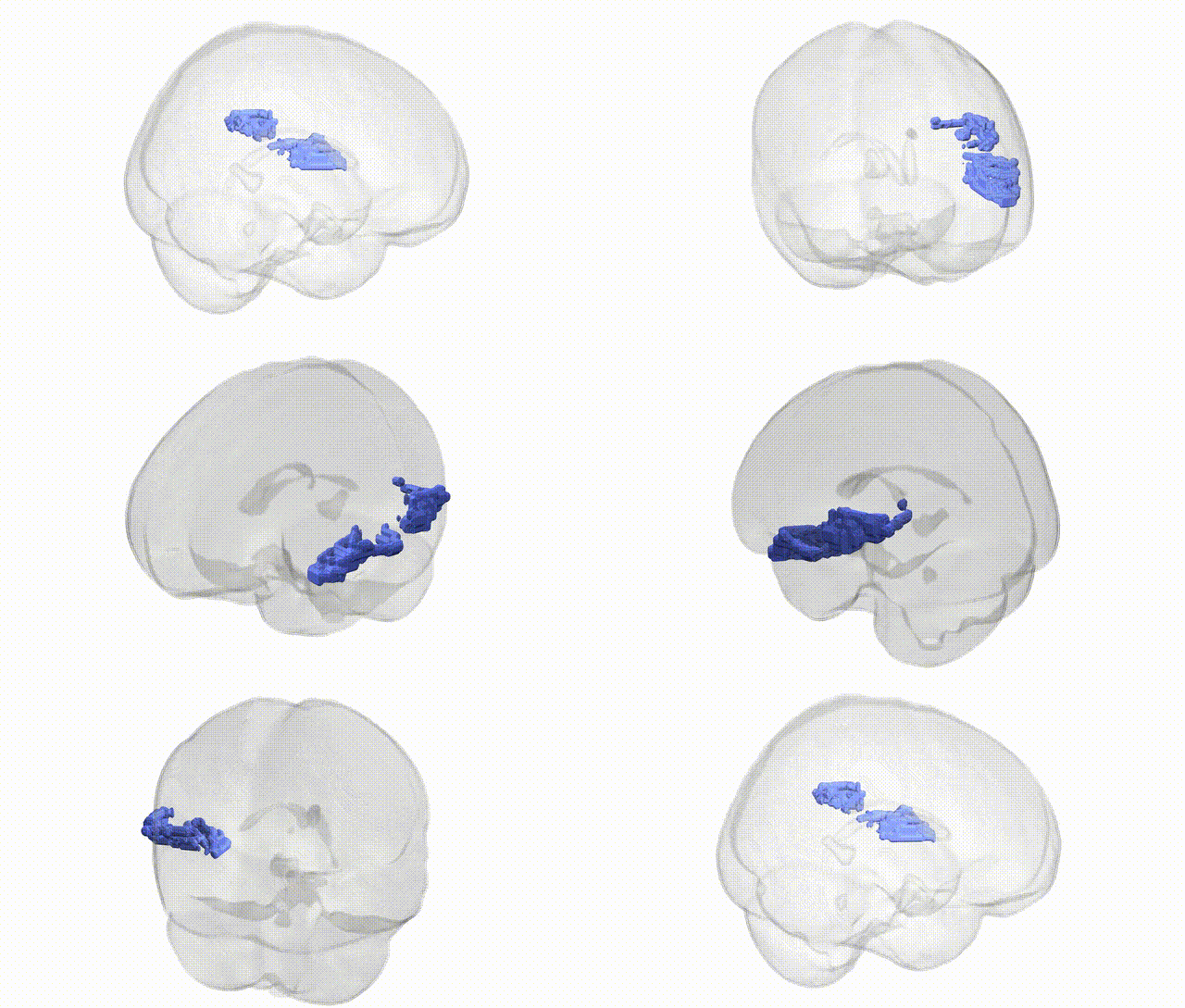
Full Quality Version: Download MP4
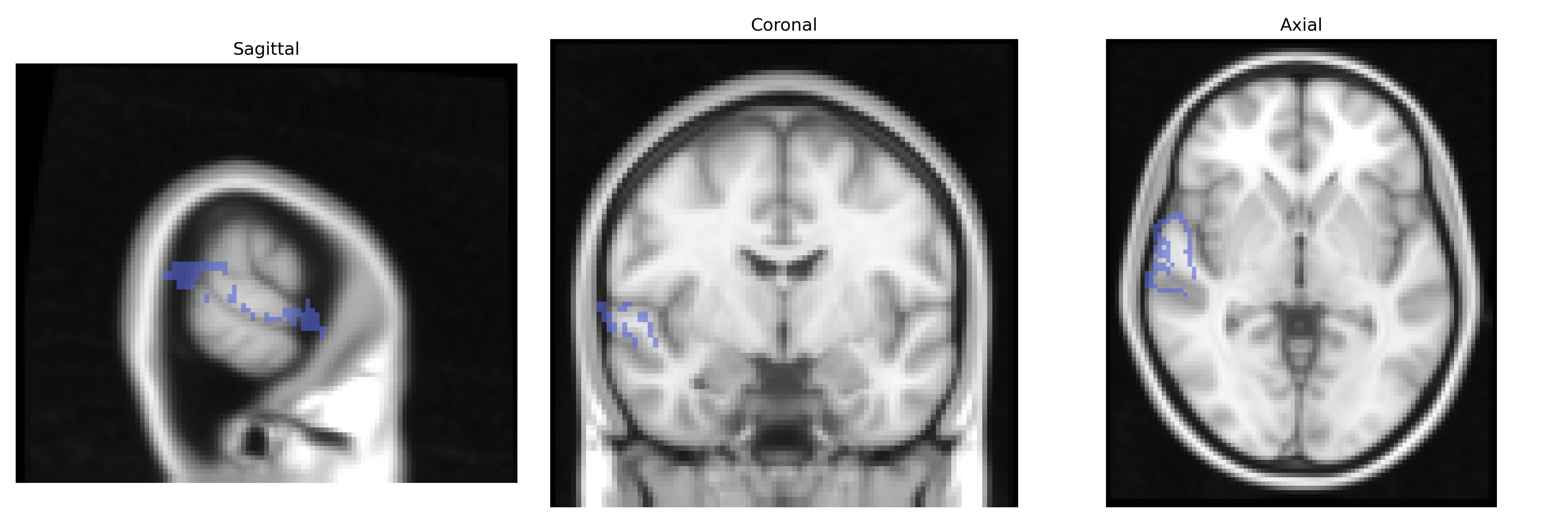
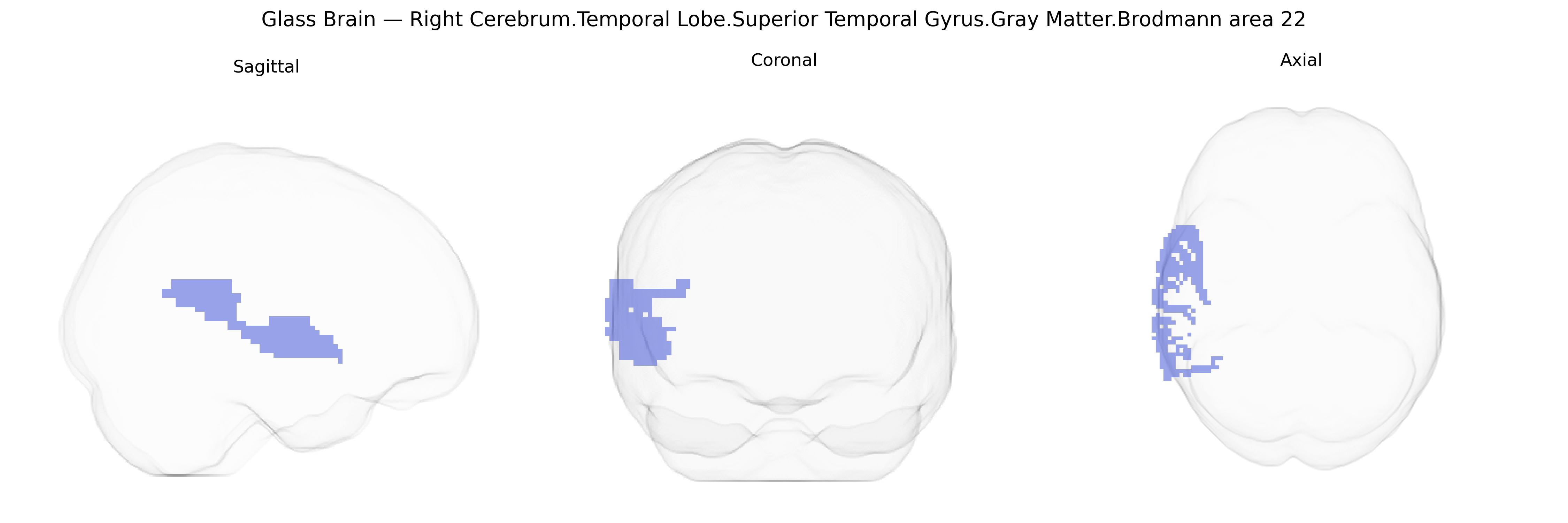
Wali Sidiqyar*, Gaurav Rudravaram*, Elyssa M. McMaster, Trent M. Schwartz, Adam M. Saunders, Kurt G. Schilling, Bennett A. Landman "Introducing SPINS: A Shared Public Visualization Library of Neuroanatomical Structures." Medical Imaging with Deep Learning- short paper
This resource is licensed under CC0 1.0 Universal (Public Domain).