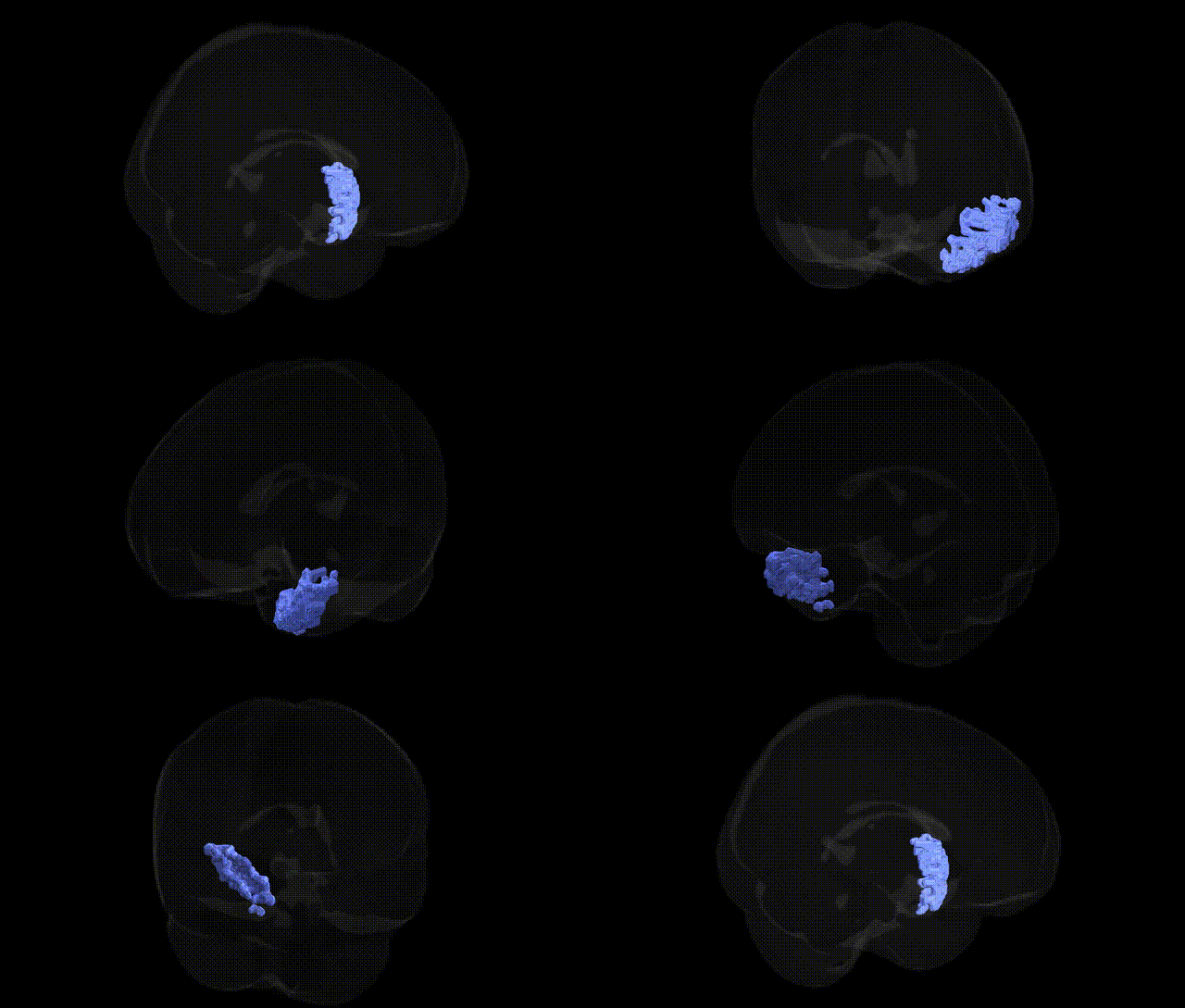
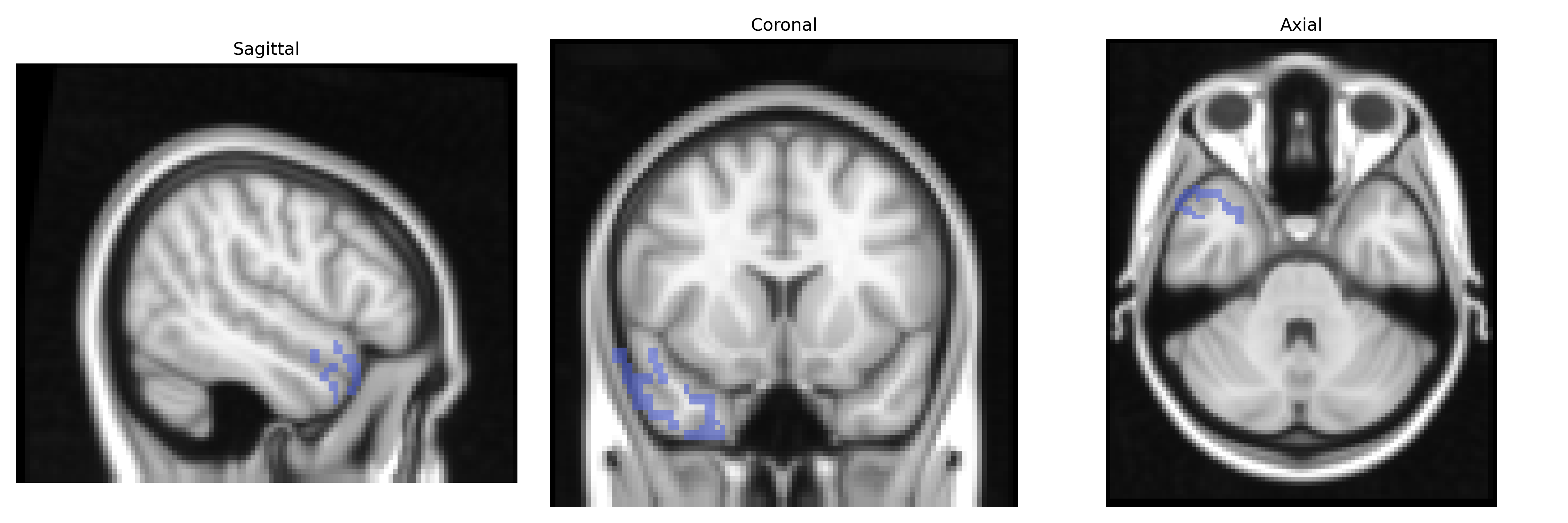
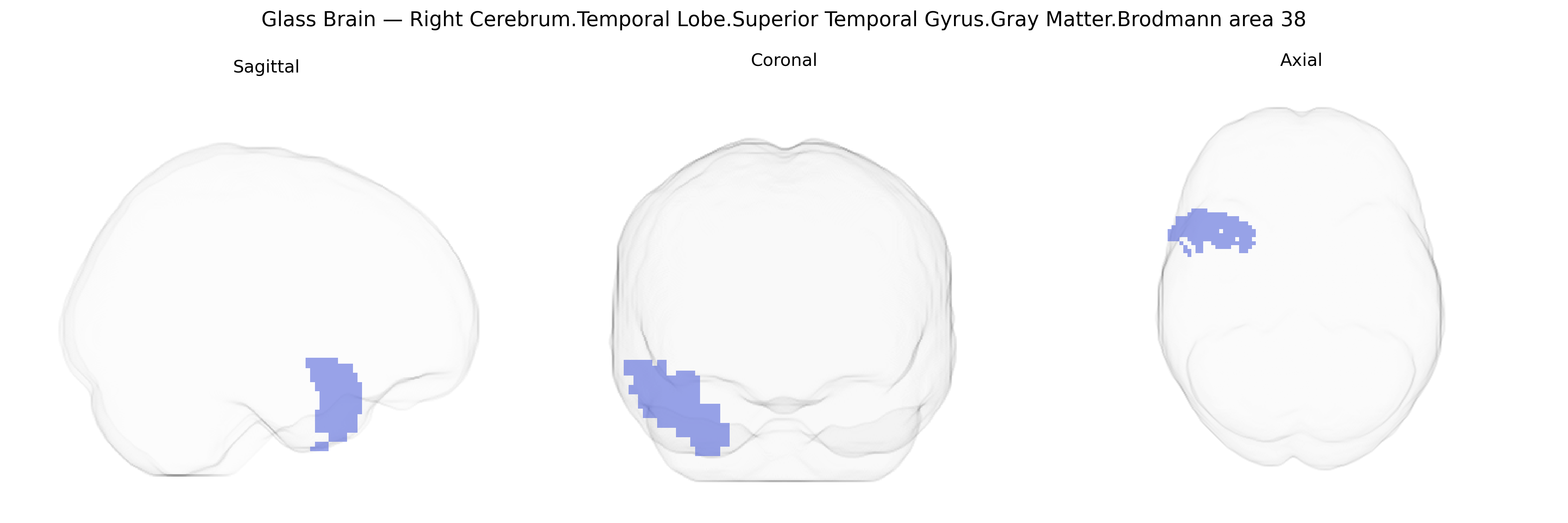
The bilateral right cerebrum temporal lobe superior temporal gyrus gray matter Brodmann area 38 corresponds to the temporopolar cortex, located at the most anterior portion of the temporal lobe along the superior temporal gyrus. This region is strongly connected with limbic and prefrontal structures and is implicated in high-order associative and integrative functions, including social and emotional processing, semantic memory, and aspects of language and narrative comprehension. Brodmann area 38 participates in multimodal integration of auditory, visual, and emotional stimuli and has been associated with processing personal relevance and social context, as well as contributing to the neural substrates of complex behavior and affect. There is no direct Wikipedia article for Brodmann area 38, but it is part of the temporal lobe: Temporal lobe.
The bilateral right superior temporal gyrus (STG) gray matter in Brodmann area 38, an anterior temporal/temporal pole region, is repeatedly implicated in genetic studies of language, social cognition, and psychiatric risk, though most GWAS and imaging-genetics work focus on broader STG or temporal lobe measures rather than Talairach atlas–specific parcels. Variants in genes such as FOXP2, CNTNAP2, and DCDC2 have been associated with STG structure and function in relation to speech and language impairments, developmental language disorder, and dyslexia, while schizophrenia, bipolar disorder, and major depression GWAS highlight loci (e.g., CACNA1C, GRM3, DRD2, ZNF804A) that show downstream effects on temporal cortex volume, cortical thickness, or activation patterns including anterior STG. Autism spectrum disorder risk genes (e.g., SHANK3, NRXN1) and polygenic risk scores for ASD and social communication traits have been linked to altered temporal pole/STG anatomy and connectivity, consistent with the region’s role in theory of mind, semantic and social-emotional processing. Large neuroimaging GWAS consortia (ENIGMA, UK Biobank) report heritable variation in temporal lobe gray matter with numerous common variants influencing superior temporal and temporal pole volumes or cortical thickness, and polygenic scores for educational attainment, intelligence, and cognitive performance correlate with structural differences in lateral temporal regions that encompass BA38. Additionally, GWAS of neuroticism, extraversion, and other personality traits, as well as of auditory hallucinations and musical aptitude, have identified genetic factors whose brain-structural correlates include anterior and superior temporal cortices, supporting a genetically influenced role of BA38/STG in language, social cognition, affective processing, and psychosis-related phenomena, although fine-grained parcel-level genetic associations for this specific Talairach-defined region remain limited.
Overview generated by GPT-4o (2026).
Region ID: 41
Hemisphere: bilateral
Atlas: Talairach labels 2mm
Full Quality Version: Download MP4
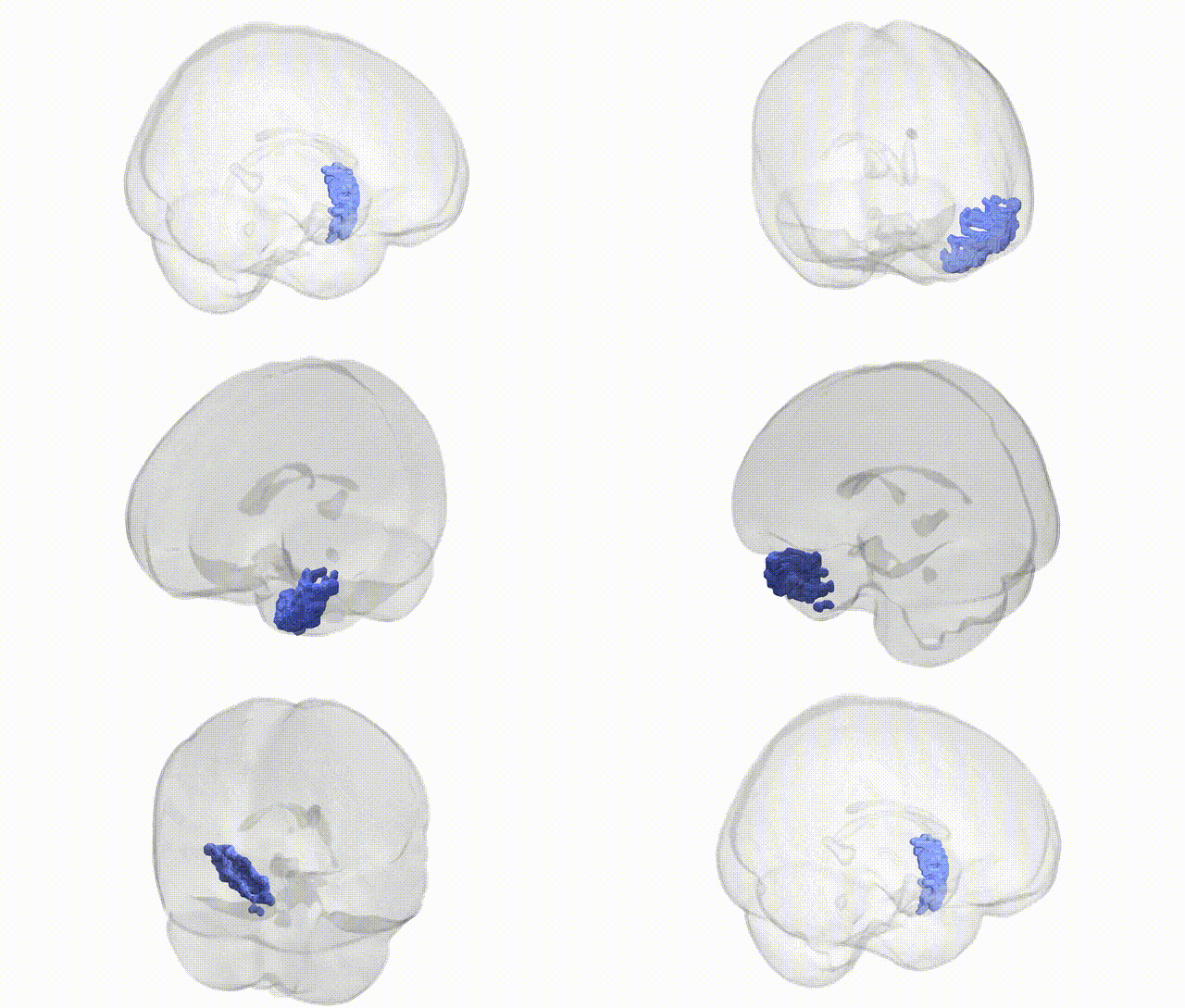
Full Quality Version: Download MP4
Wali Sidiqyar*, Gaurav Rudravaram*, Elyssa M. McMaster, Trent M. Schwartz, Adam M. Saunders, Kurt G. Schilling, Bennett A. Landman "Introducing SPINS: A Shared Public Visualization Library of Neuroanatomical Structures." Medical Imaging with Deep Learning- short paper
This resource is licensed under CC0 1.0 Universal (Public Domain).