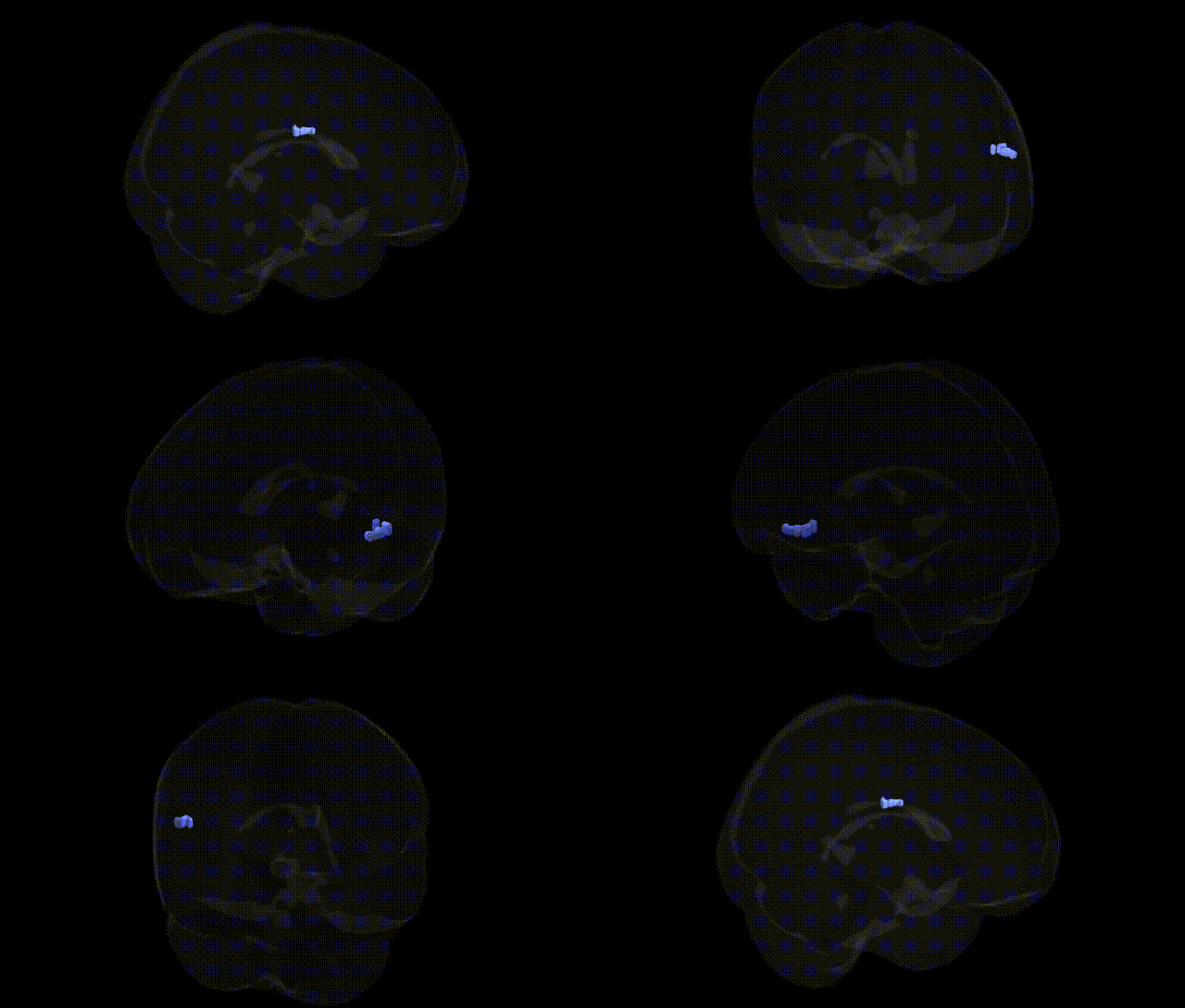
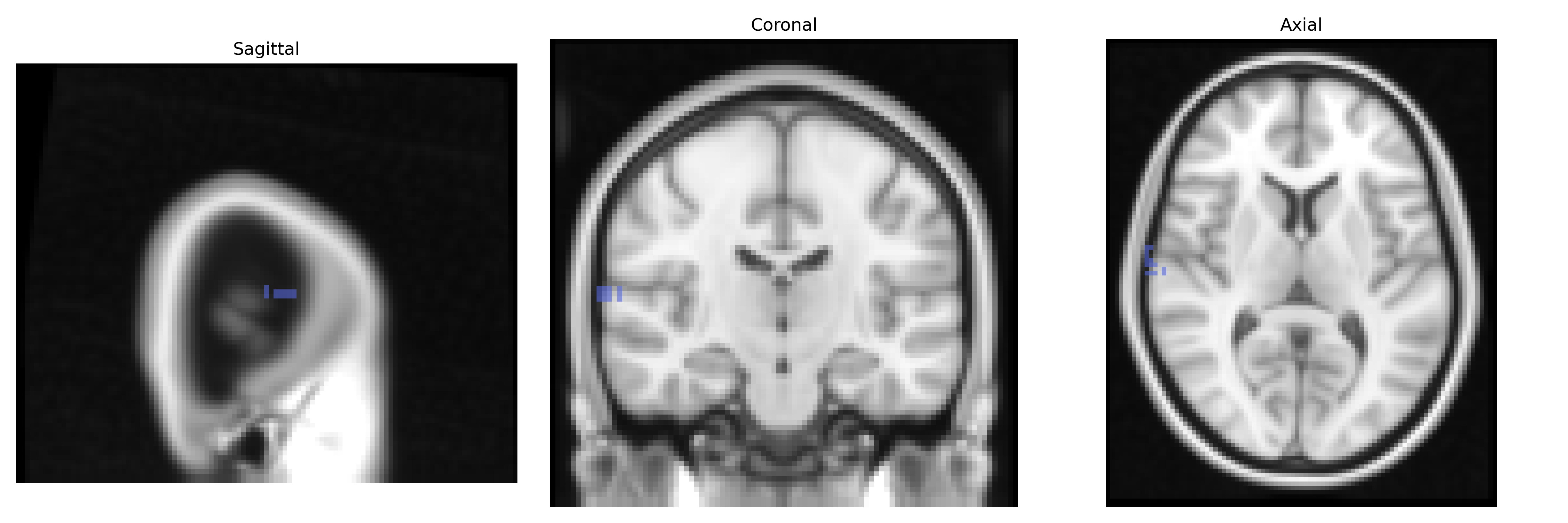
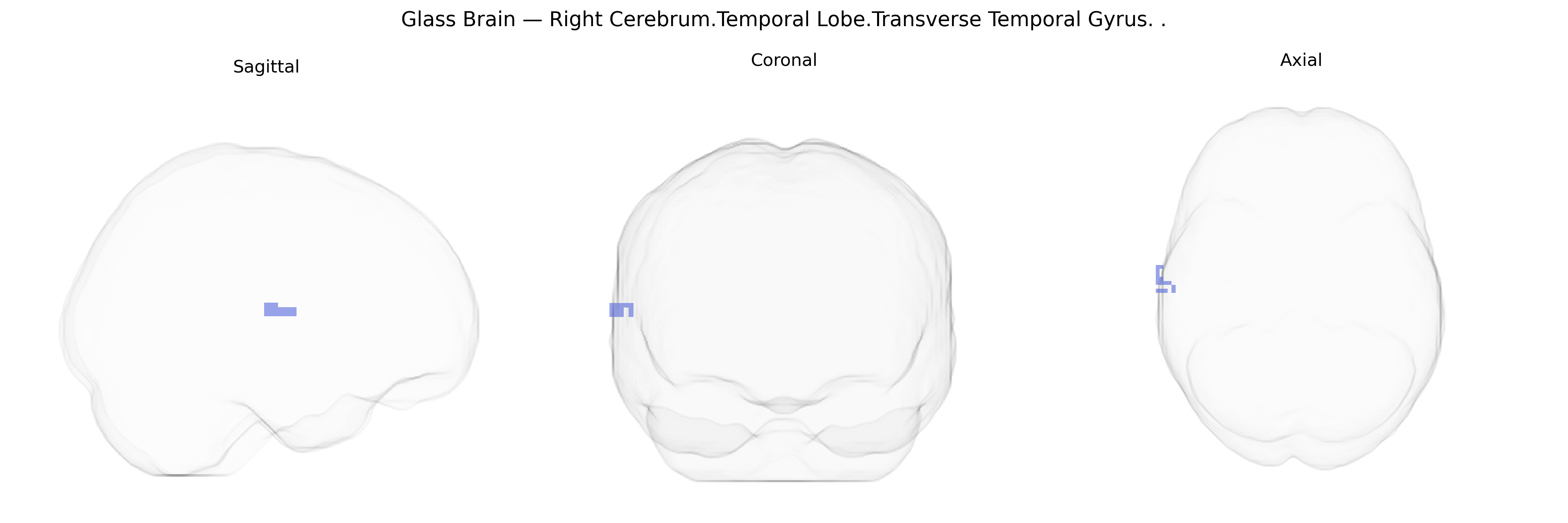
The bilateral Right Cerebrum.Temporal Lobe.Transverse Temporal Gyrus corresponds primarily to Heschl’s gyrus, the core region of primary auditory cortex situated on the superior surface of the temporal lobe within the lateral (Sylvian) fissure. This area receives dense input from the medial geniculate nucleus of the thalamus and is organized tonotopically, with neurons selectively responsive to specific sound frequencies. Functionally, it is critical for early cortical processing of acoustic information, including sound intensity, frequency, and temporal patterns, and contributes to the neural basis of speech and music perception by providing transformed auditory representations to adjacent secondary and association auditory cortices. There is no direct link for “Transverse Temporal Gyrus”; a closely related structure is Heschl’s gyrus.
The bilateral right transverse temporal gyrus (Heschl’s gyrus) is a primary auditory cortex region whose structure and function show heritable variation and have been implicated in multiple genetic and GWAS findings, particularly those related to auditory processing and language. Twin and imaging-genetic studies indicate moderate to high heritability of cortical thickness and surface area in this region, with variants in genes affecting neurodevelopment, synaptic function, and axon guidance (e.g., CNTNAP2, FOXP2-related networks, and other language-associated loci) contributing to individual differences in auditory and speech processing. GWAS on cortical morphology have linked common variants near genes involved in neuronal proliferation and migration (such as ASPM and microtubule-related genes) to structural measures of temporal lobe auditory areas, though findings are often reported for larger temporal lobe parcels rather than the transverse temporal gyrus specifically. Genetic studies in schizophrenia, autism spectrum disorder, and dyslexia have associated risk loci with altered gray matter volume or cortical thickness in auditory and language-related temporal regions that include Heschl’s gyrus, suggesting a shared vulnerability pathway through aberrant auditory cortex development and connectivity. Additionally, GWAS of tinnitus, musical aptitude, and speech-in-noise perception have implicated variants in ion channel, synaptic, and inner ear-related genes that correlate with activity and morphology in the transverse temporal gyrus, supporting a role for genetic influences on auditory cortex function in both clinical and normal-range auditory traits, although precise gene–region mappings at the level of the Talairach 2 mm label remain relatively coarse and evolving.
Overview generated by GPT-4o (2026).
Region ID: 730
Hemisphere: bilateral
Atlas: Talairach labels 2mm
Full Quality Version: Download MP4
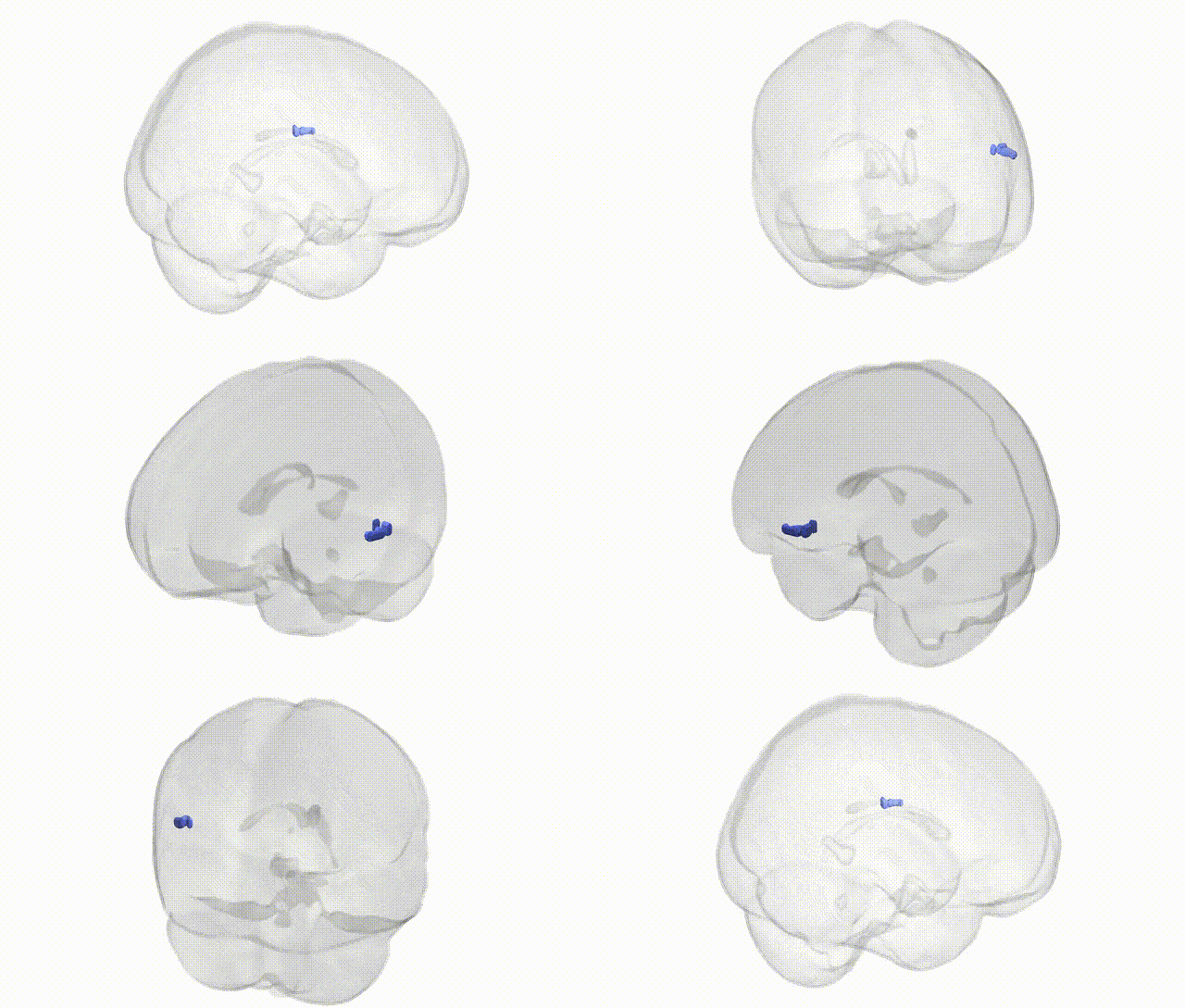
Full Quality Version: Download MP4
Wali Sidiqyar*, Gaurav Rudravaram*, Elyssa M. McMaster, Trent M. Schwartz, Adam M. Saunders, Kurt G. Schilling, Bennett A. Landman "Introducing SPINS: A Shared Public Visualization Library of Neuroanatomical Structures." Medical Imaging with Deep Learning- short paper
This resource is licensed under CC0 1.0 Universal (Public Domain).