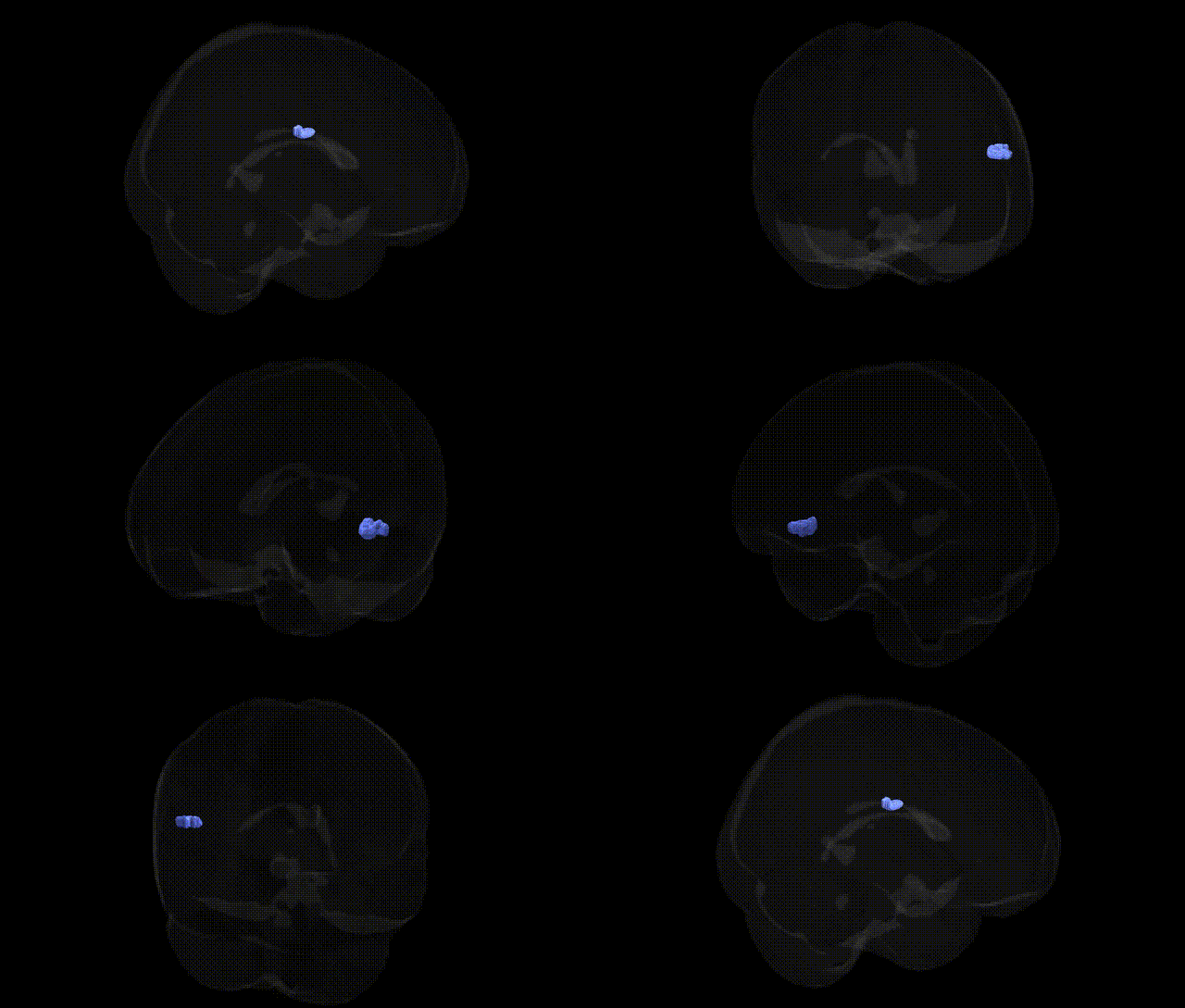
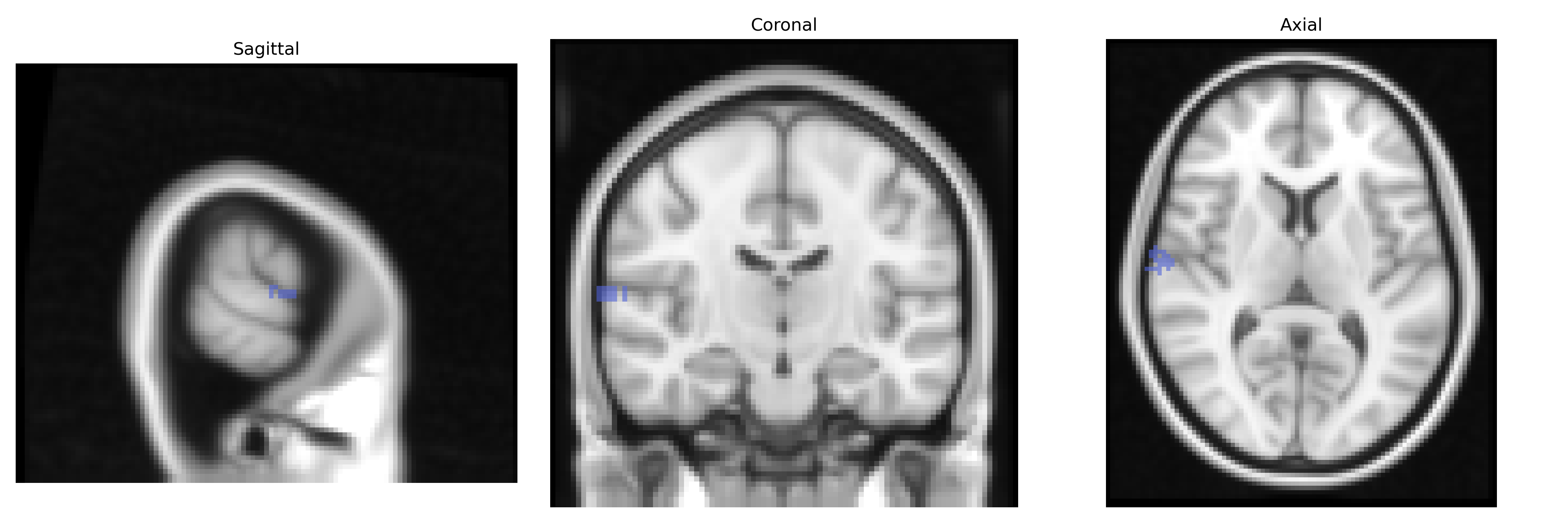
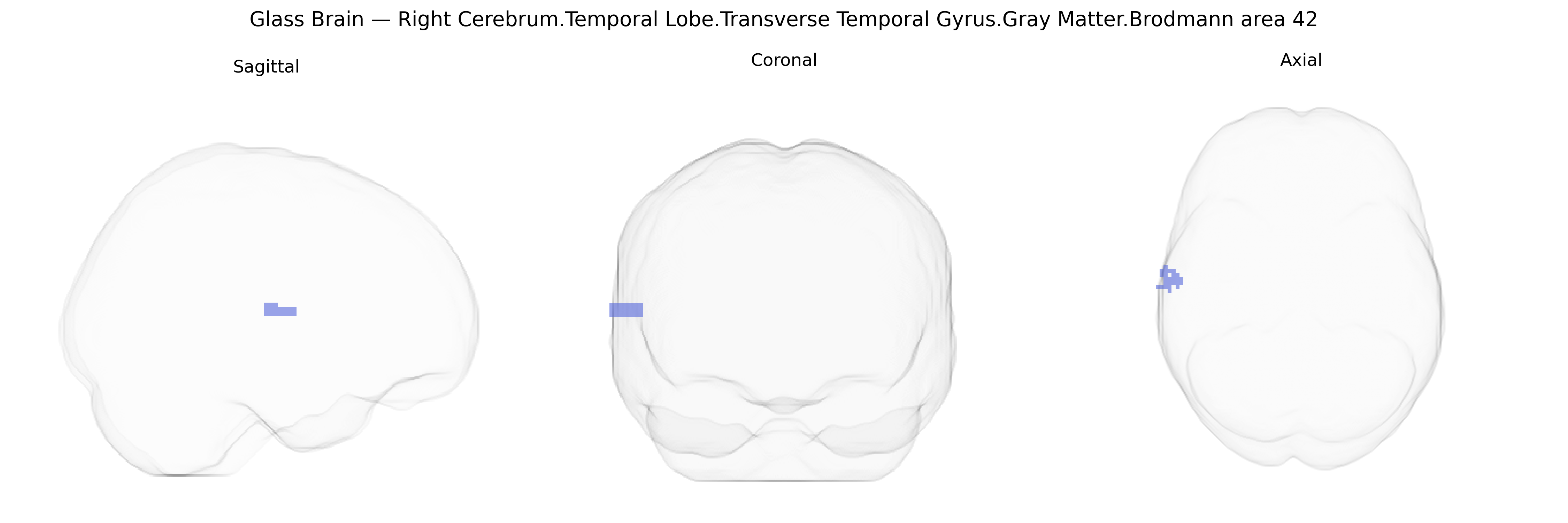
The bilateral Right Cerebrum Temporal Lobe Transverse Temporal Gyrus Gray Matter Brodmann area 42 corresponds to a portion of the secondary auditory cortex located on the superior surface of the temporal lobe within Heschl’s gyrus. Brodmann area 42 is involved in higher-order auditory processing, including analysis of complex sounds, temporal patterns, and aspects of speech perception, and works in close functional integration with Brodmann area 41 (primary auditory cortex) and adjacent superior temporal regions. Neuronal populations in this region receive input from the medial geniculate nucleus of the thalamus and project to wider temporal and frontal cortical networks supporting auditory recognition and language-related functions. A closely related structure is Brodmann area 42.
The bilateral right transverse temporal gyrus (Brodmann area 42), a core auditory association region, has been implicated in genetic studies primarily through its role in auditory processing, language, and neuropsychiatric phenotypes rather than through region-specific GWAS hits. Structural and functional variation in BA42 falls within heritable cortical thickness and surface area measures identified by large neuroimaging GWAS (e.g., ENIGMA and UK Biobank), where common variants near genes involved in neurodevelopment and synaptic function (such as PACRG, KCNK2, PAX6, and others) influence temporal lobe morphology and auditory cortex metrics. Genetic risk for schizophrenia and bipolar disorder, including polygenic scores and loci in genes like GRIN2A, CACNA1C, and ZNF804A, has been associated with altered activation and gray matter volume in superior and transverse temporal regions during auditory and language tasks, paralleling the well-known link between temporal lobe abnormalities and psychosis. Variants affecting language and reading abilities (FOXP2 pathway genes, CNTNAP2, DCDC2, KIAA0319) and autism spectrum disorder genes (e.g., CNTNAP2, SHANK3-related networks) have also been connected to atypical temporal lobe structure or auditory processing, which includes BA42 in imaging analyses. In addition, GWAS and candidate gene studies of tinnitus and auditory perception point to genes such as GDNF, KCNQ4, and other cochlear/auditory pathway loci whose downstream effects are reflected in functional changes of the transverse temporal gyrus. Overall, genetic associations involving BA42 derive mainly from broader temporal lobe and auditory cortex imaging-genetics, polygenic risk, and trait studies rather than from single-locus GWAS specifically targeting this Talairach-defined region.
Overview generated by GPT-4o (2026).
Region ID: 727
Hemisphere: bilateral
Atlas: Talairach labels 2mm
Full Quality Version: Download MP4
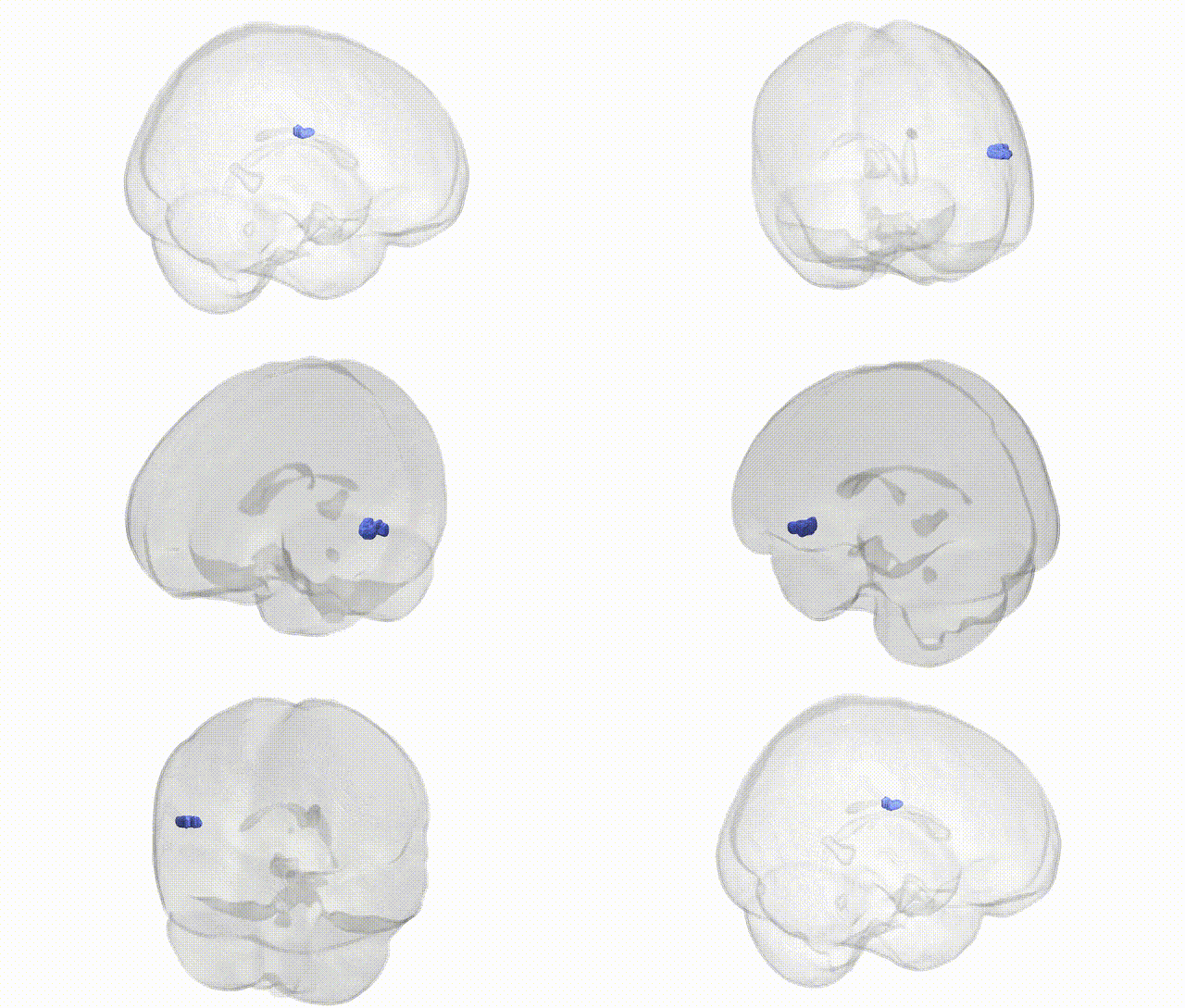
Full Quality Version: Download MP4
Wali Sidiqyar*, Gaurav Rudravaram*, Elyssa M. McMaster, Trent M. Schwartz, Adam M. Saunders, Kurt G. Schilling, Bennett A. Landman "Introducing SPINS: A Shared Public Visualization Library of Neuroanatomical Structures." Medical Imaging with Deep Learning- short paper
This resource is licensed under CC0 1.0 Universal (Public Domain).