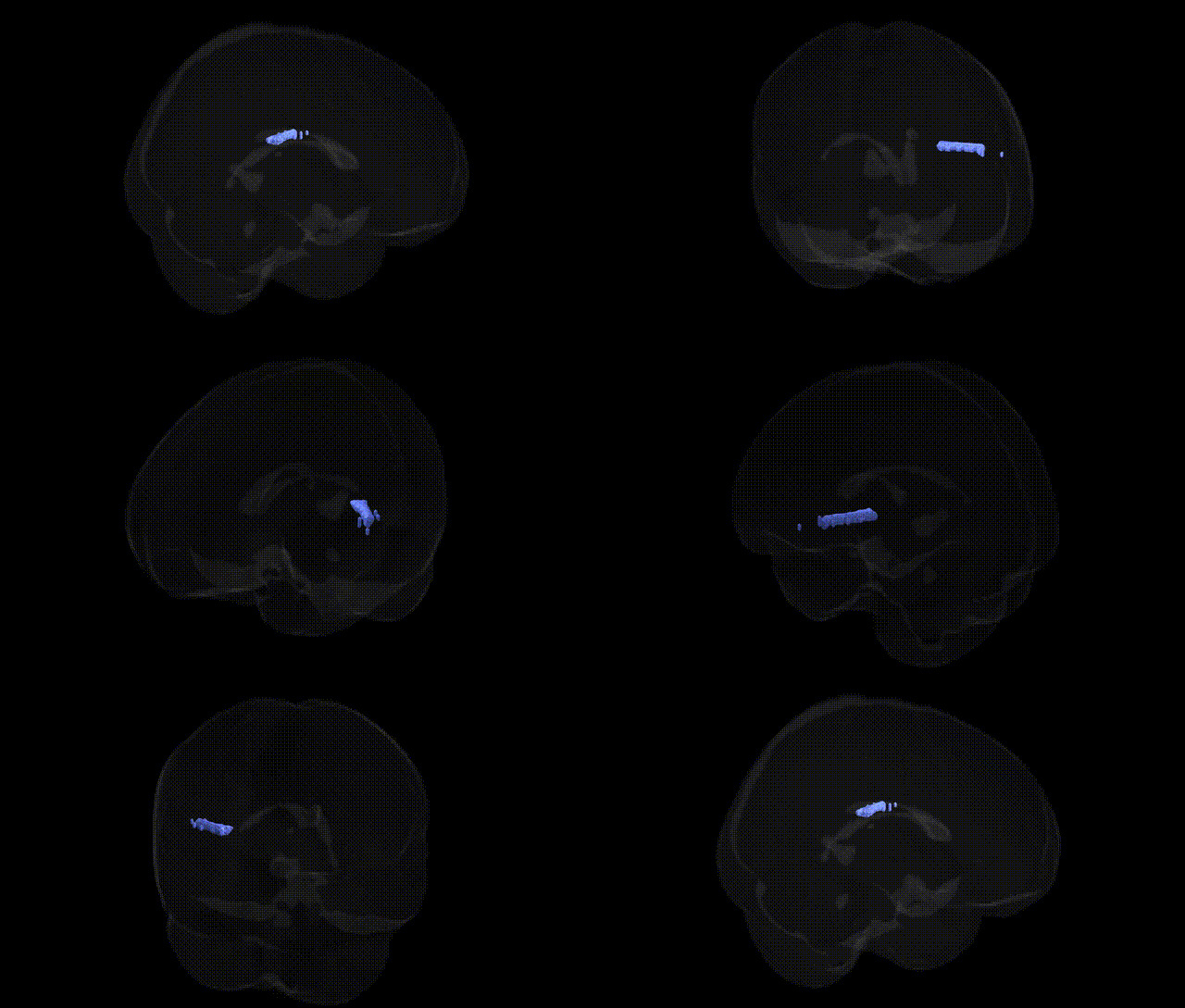
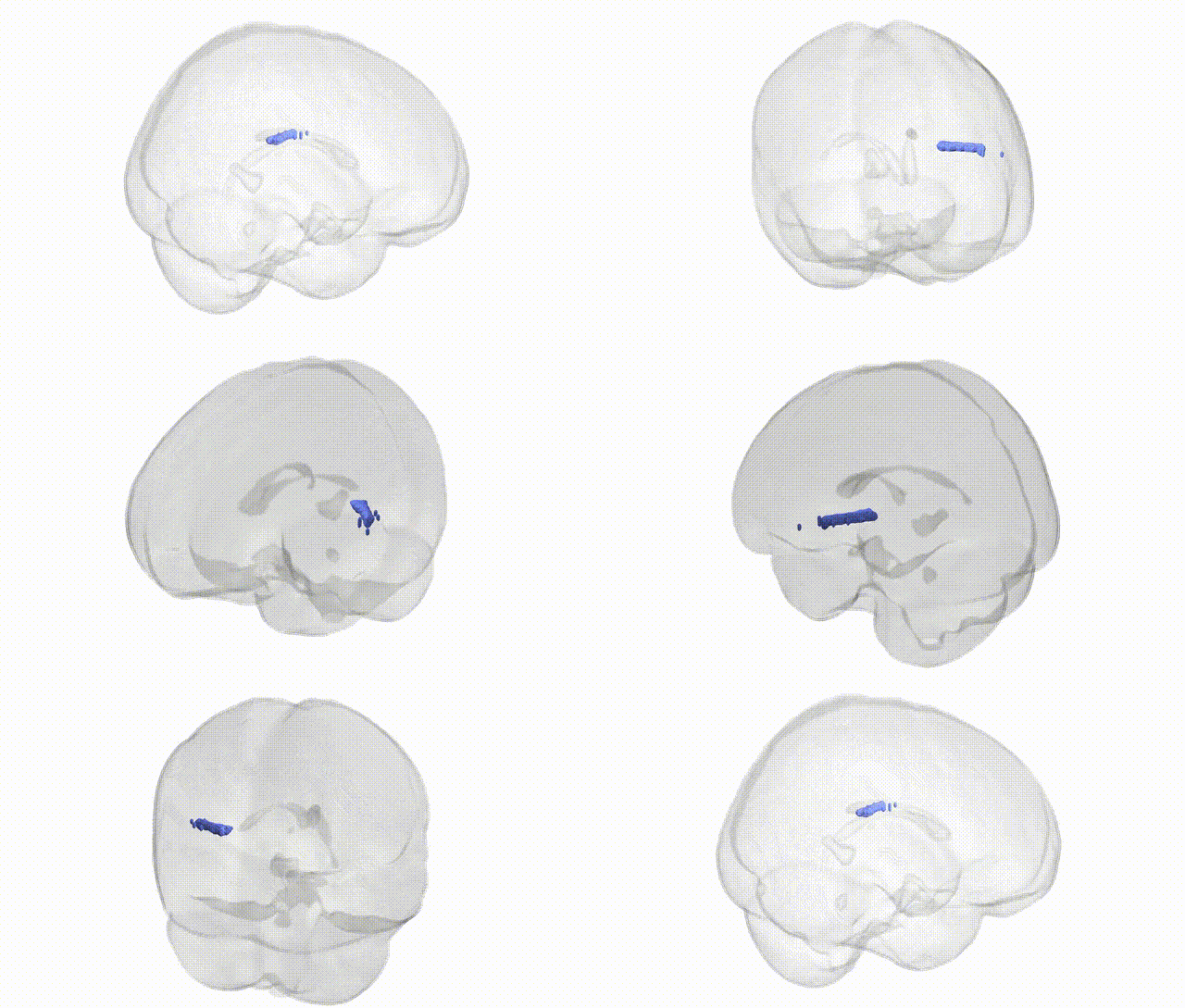
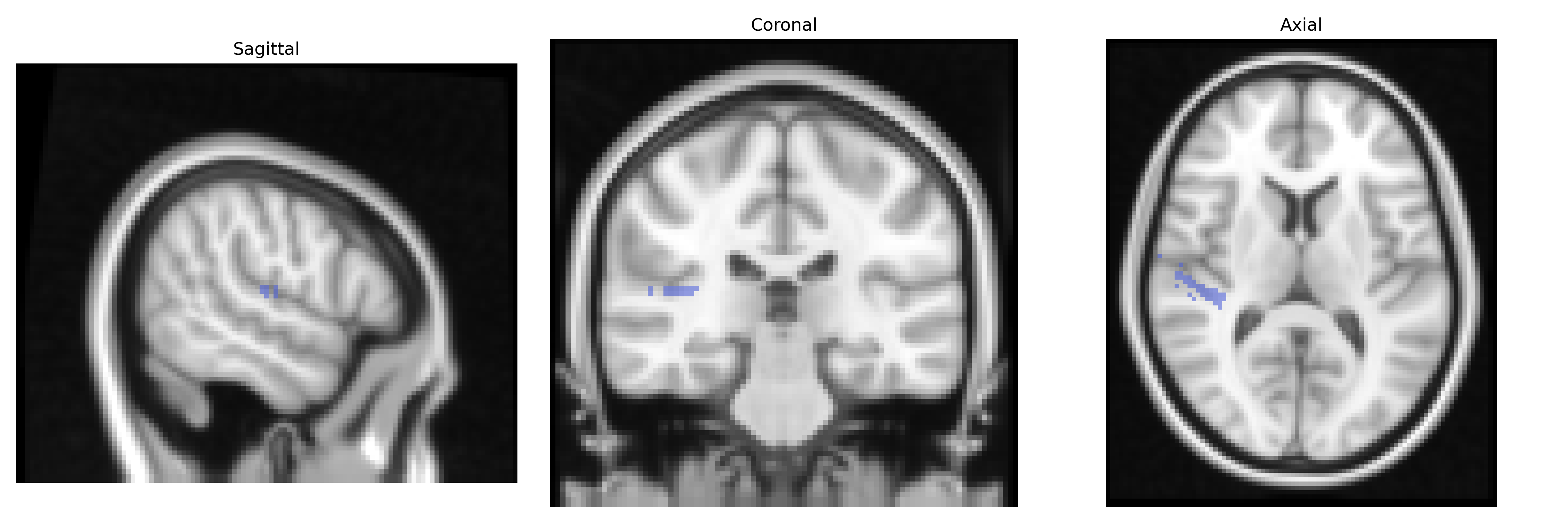
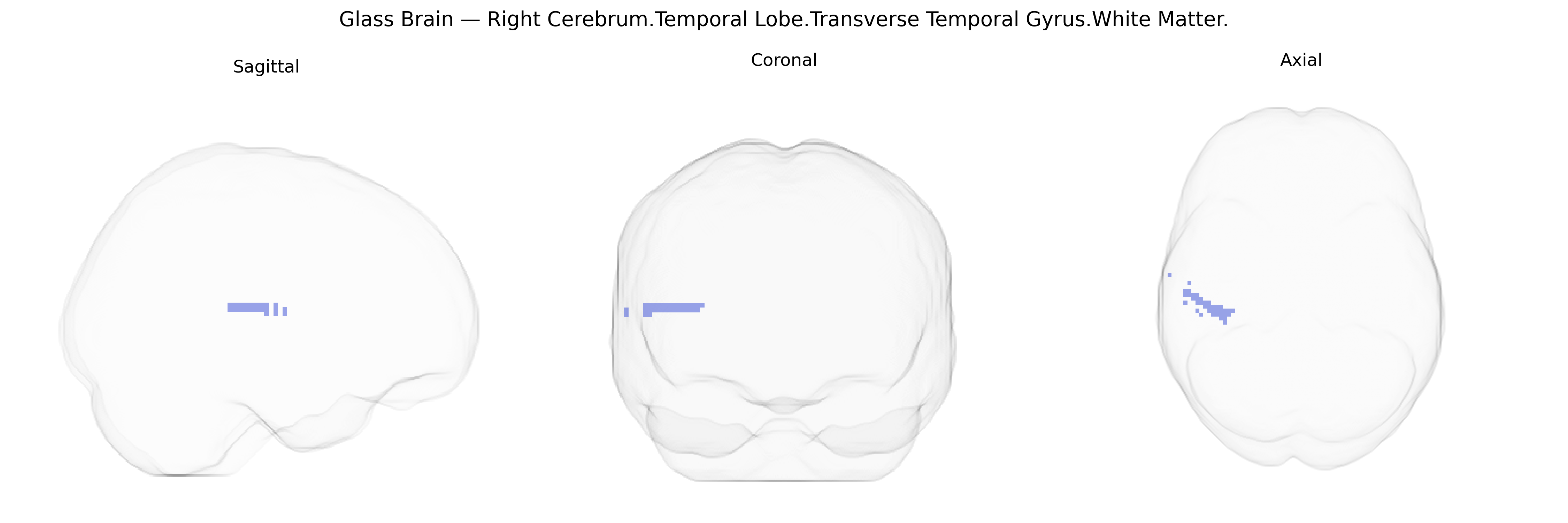
The bilateral Right Cerebrum.Temporal Lobe.Transverse Temporal Gyrus.White Matter corresponds to the subcortical fiber tracts underlying the transverse temporal gyrus (Heschl’s gyrus) within the temporal lobe of the right hemisphere, as defined in the Talairach 2 mm atlas. This white matter region contains association and projection fibers that connect primary auditory cortex and surrounding auditory association areas with other temporal, parietal, and frontal regions, facilitating the rapid transmission and integration of acoustic information underlying sound perception, speech processing, and higher-order auditory functions. Although the atlas label specifies white matter, its functional significance is closely tied to the overlying cortical gray matter of Heschl’s gyrus and the broader auditory network. There is no direct link for this specific white matter label; a related cortical structure is Heschl’s gyrus.
The bilateral right transverse temporal gyrus white matter (Heschl’s gyrus area) is a core substrate of auditory processing, and although few imaging-genetics studies isolate this exact Talairach-2mm label, converging evidence implicates nearby transverse temporal and superior temporal white matter in several genetically influenced traits and disorders. GWAS of brain structure show polygenic influences on temporal lobe white matter volume and fractional anisotropy, with common variants in genes involved in axon guidance, synaptic development, and myelination (e.g., NRG1, CNTNAP2, GRIN2B, BDNF, and various oligodendrocyte-related loci) contributing to microstructural variation in auditory pathway tracts traversing this region. Imaging-genetic studies of schizophrenia, bipolar disorder, and major depression consistently report heritable reductions in temporal lobe white matter integrity, including auditory radiations and fibers passing under Heschl’s gyrus; risk alleles in CACNA1C, ZNF804A, and other neurodevelopmental GWAS hits have been linked to temporal white matter changes and aberrant auditory processing (such as hallucinations). In autism spectrum disorder and language-related GWAS, variants affecting synaptic and cortical development (e.g., FOXP2 pathways, CNTNAP2, DCDC2, KIAA0319) have been associated with altered temporal lobe connectivity and auditory/language phenotypes, likely involving the white matter underlying the transverse temporal gyrus. Large-scale GWAS of functional MRI traits further suggest that polygenic scores for schizophrenia, educational attainment, and cognitive ability modulate activation and connectivity of auditory cortex and its white matter inputs, with diffusion MRI studies indicating that heritable differences in temporal lobe tracts connecting Heschl’s gyrus to superior temporal and frontal regions contribute to individual variability in speech perception, musical aptitude, and susceptibility to tinnitus and hyperacusis. Overall, genetic influences on neurodevelopment, synaptic signaling, and myelination appear to shape the structure and connectivity of this auditory white matter region, mediating risk for several neuropsychiatric and communication-related traits.
Overview generated by GPT-4o (2026).
Region ID: 718
Hemisphere: bilateral
Atlas: Talairach labels 2mm
Full Quality Version: Download MP4
Full Quality Version: Download MP4
Wali Sidiqyar*, Gaurav Rudravaram*, Elyssa M. McMaster, Trent M. Schwartz, Adam M. Saunders, Kurt G. Schilling, Bennett A. Landman "Introducing SPINS: A Shared Public Visualization Library of Neuroanatomical Structures." Medical Imaging with Deep Learning- short paper
This resource is licensed under CC0 1.0 Universal (Public Domain).