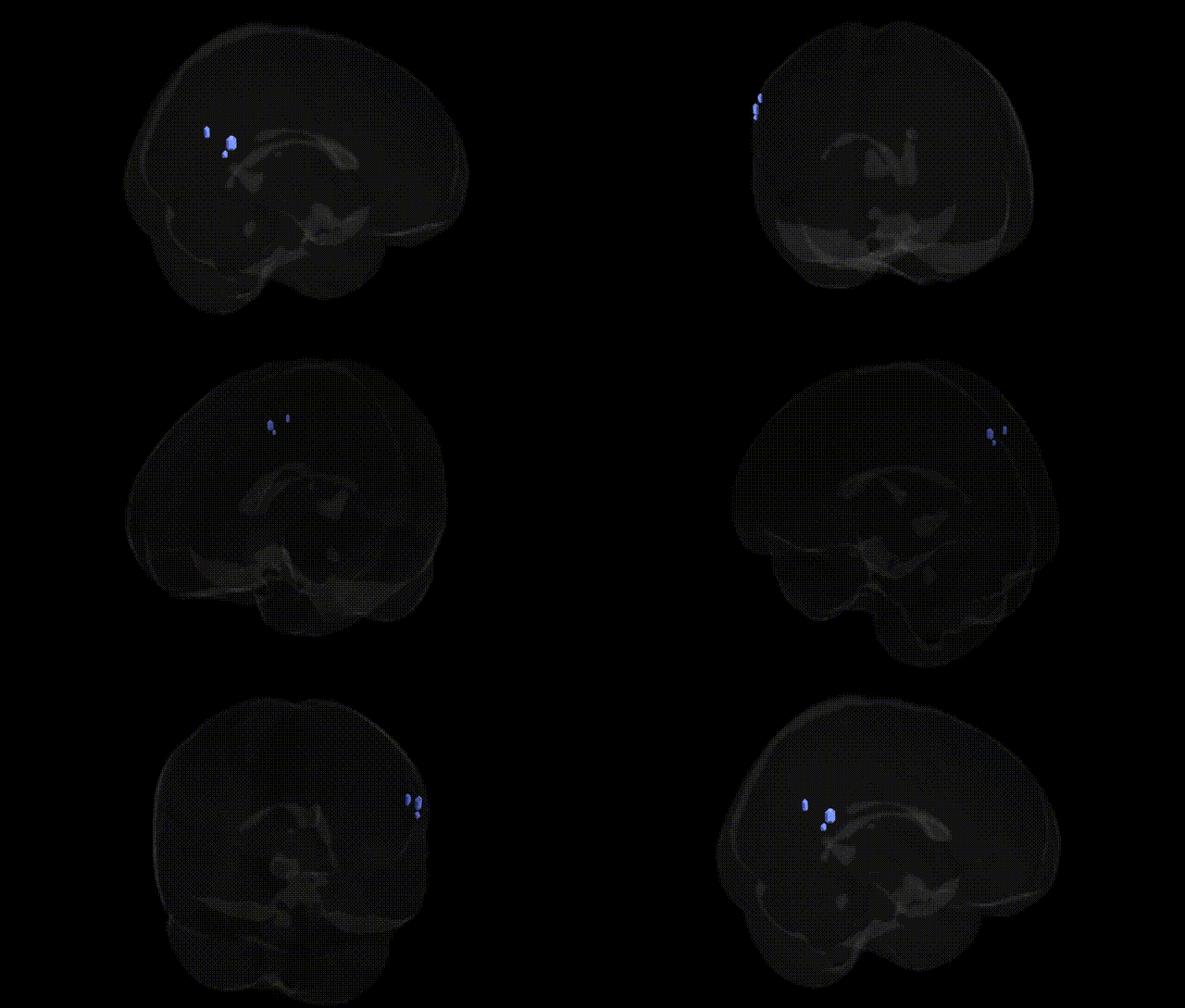
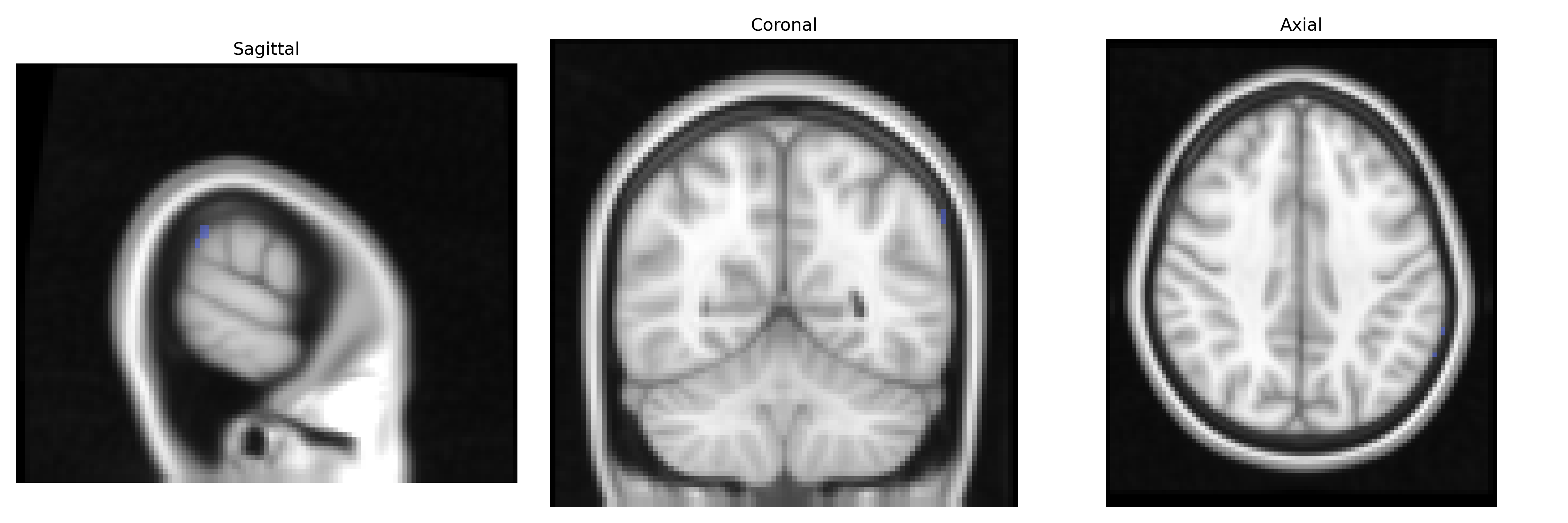
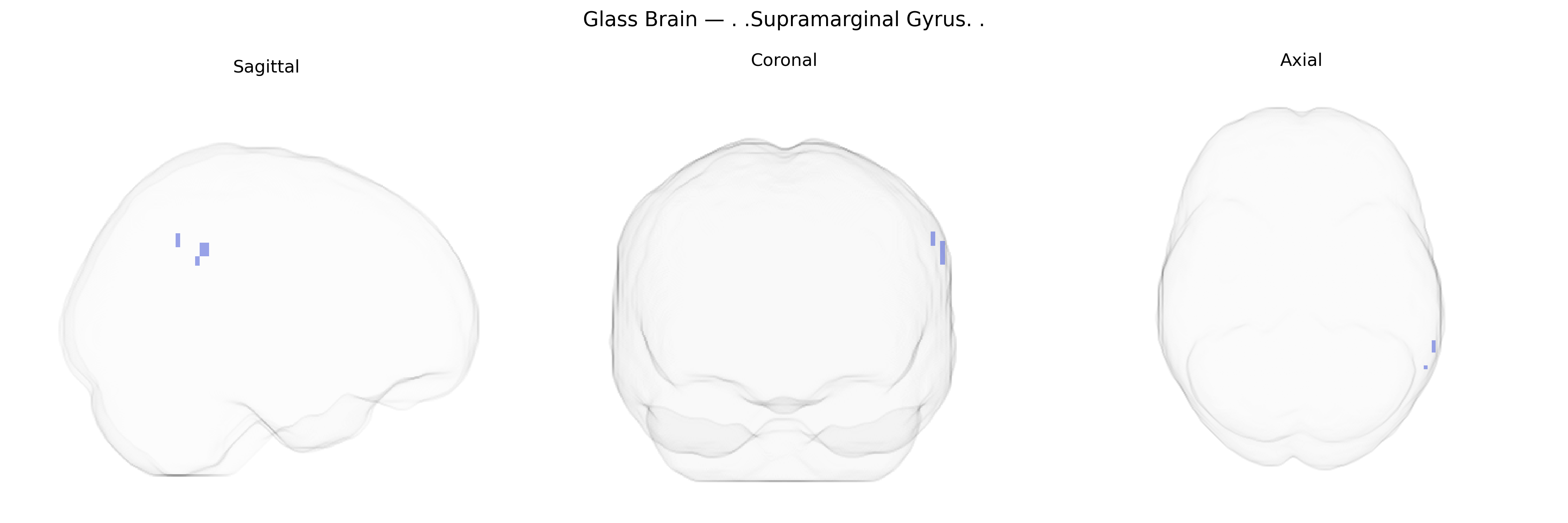
The bilateral supramarginal gyrus is a cortical region of the inferior parietal lobule that curves around the posterior end of the lateral (Sylvian) fissure, situated dorsal to the superior temporal gyrus and anterior to the angular gyrus. Cytoarchitectonically, it is part of Brodmann area 40 and is heavily interconnected with language-related regions of the frontal and temporal lobes, multimodal association areas, and somatosensory cortices. Functionally, the supramarginal gyrus is implicated in phonological processing, articulation, reading, and aspects of verbal working memory, as well as in spatial attention, body schema, and the integration of tactile and proprioceptive information. It also plays a role in social cognition and empathy via its contribution to perspective-taking and the interpretation of others’ actions and intentions. Supramarginal gyrus
Genetic associations involving the bilateral supramarginal gyrus, as defined in the Talairach 2 mm Atlas, emerge primarily from neuroimaging GWAS that examine cortical thickness, surface area, and activation patterns, as well as from studies of language, reading, and social cognition. Variants near or within genes such as FOXP2, CNTNAP2, and DCDC2, implicated in speech and reading disorders, have been associated with structural and functional differences in temporoparietal regions that include the supramarginal gyrus, consistent with its role in phonological processing and language integration. Large-scale GWAS of cortical morphology (e.g., ENIGMA consortium studies) have identified multiple loci influencing temporoparietal cortical measures, though often reported at a lobar or regional level rather than specifically labeled supramarginal gyrus, with enriched signals in genes involved in neuronal migration, synaptic development, and axon guidance. Additional GWAS linking supramarginal gyrus structure or activity to psychiatric and neurodevelopmental disorders—including schizophrenia, ADHD, and autism spectrum disorder—suggest polygenic effects on social cognition, empathy, and theory-of-mind networks, with implicated genes frequently overlapping broader brain-development pathways (e.g., GRIN2A, CACNA1C and other glutamatergic or calcium-channel genes). Finally, GWAS of cognitive traits such as general intelligence, working memory, and reading ability have reported associations between polygenic scores for these traits and measures of supramarginal gyrus volume or activation, reinforcing the view that this region’s genetic architecture is distributed across many common variants that shape higher-order language and cognitive functions rather than being driven by a small number of highly specific loci.
Overview generated by GPT-4o (2026).
Region ID: 931
Hemisphere: bilateral
Atlas: Talairach labels 2mm
Full Quality Version: Download MP4
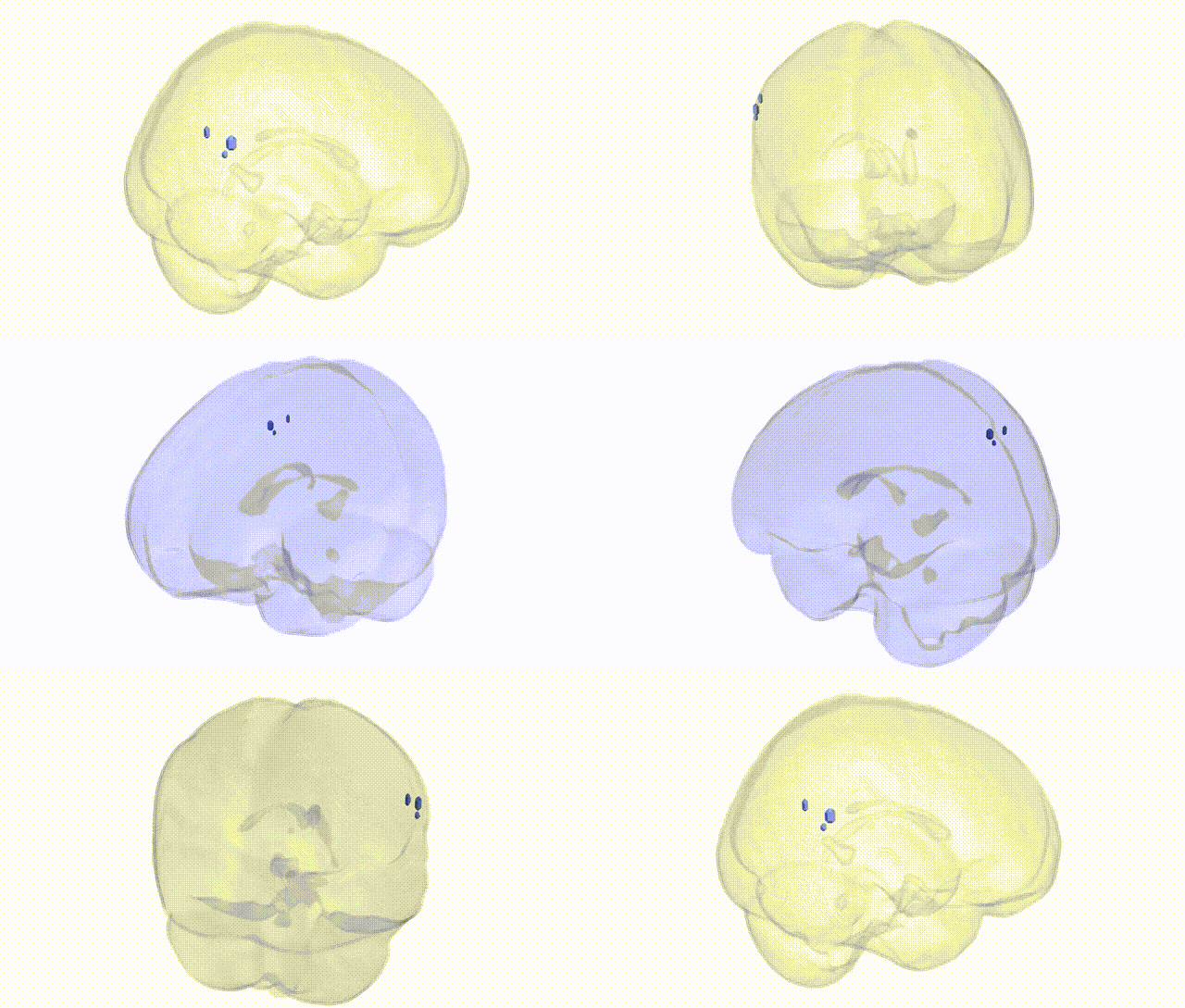
Full Quality Version: Download MP4
Wali Sidiqyar*, Gaurav Rudravaram*, Elyssa M. McMaster, Trent M. Schwartz, Adam M. Saunders, Kurt G. Schilling, Bennett A. Landman "Introducing SPINS: A Shared Public Visualization Library of Neuroanatomical Structures." Medical Imaging with Deep Learning- short paper
This resource is licensed under CC0 1.0 Universal (Public Domain).