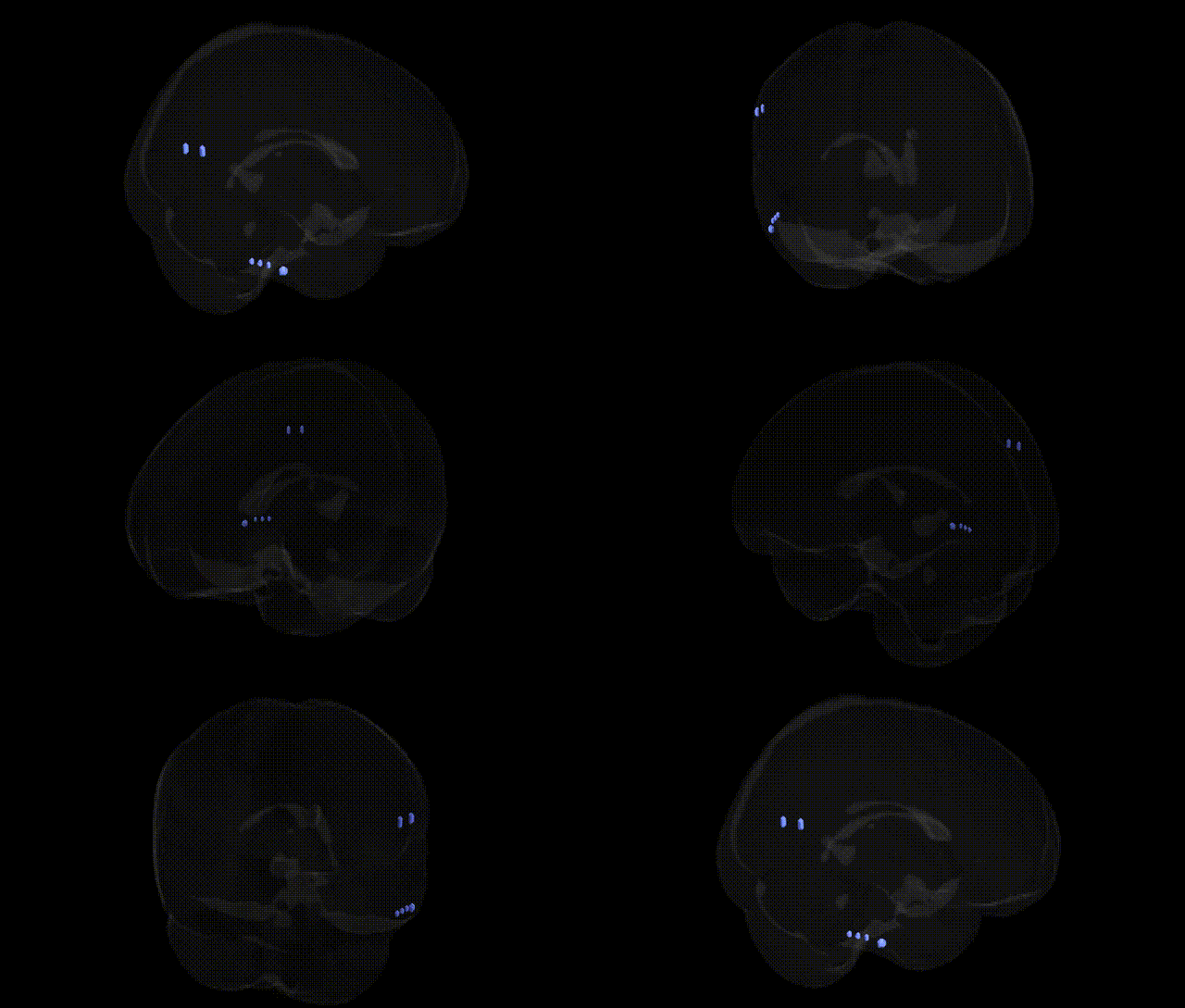
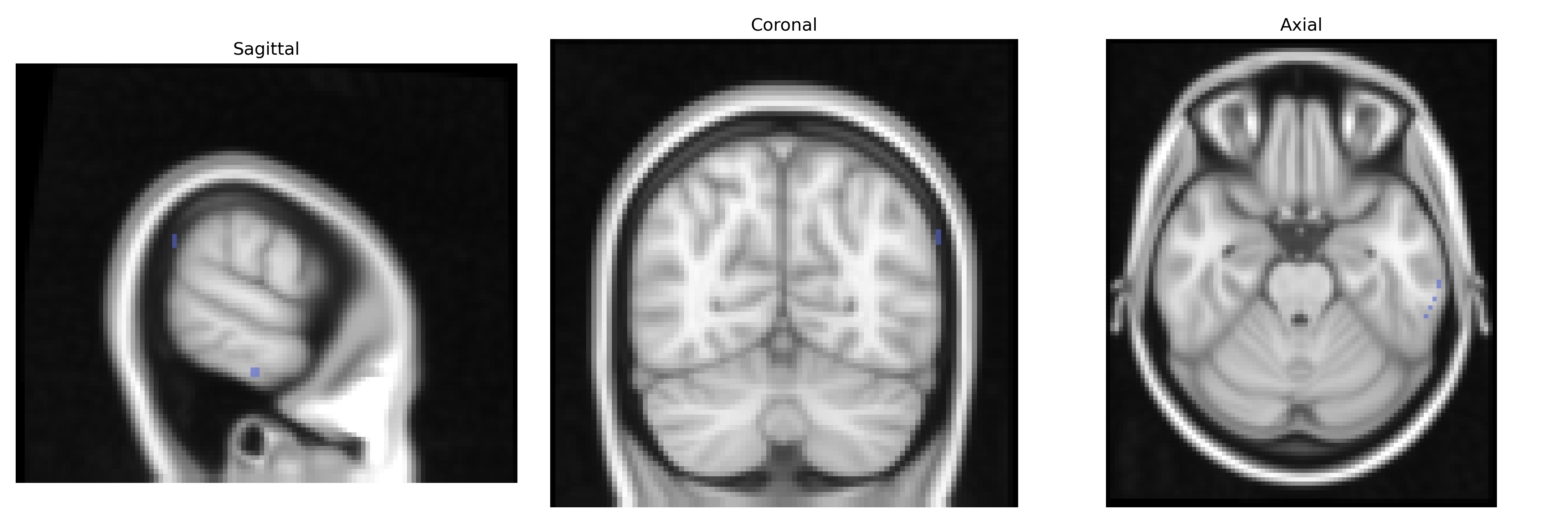
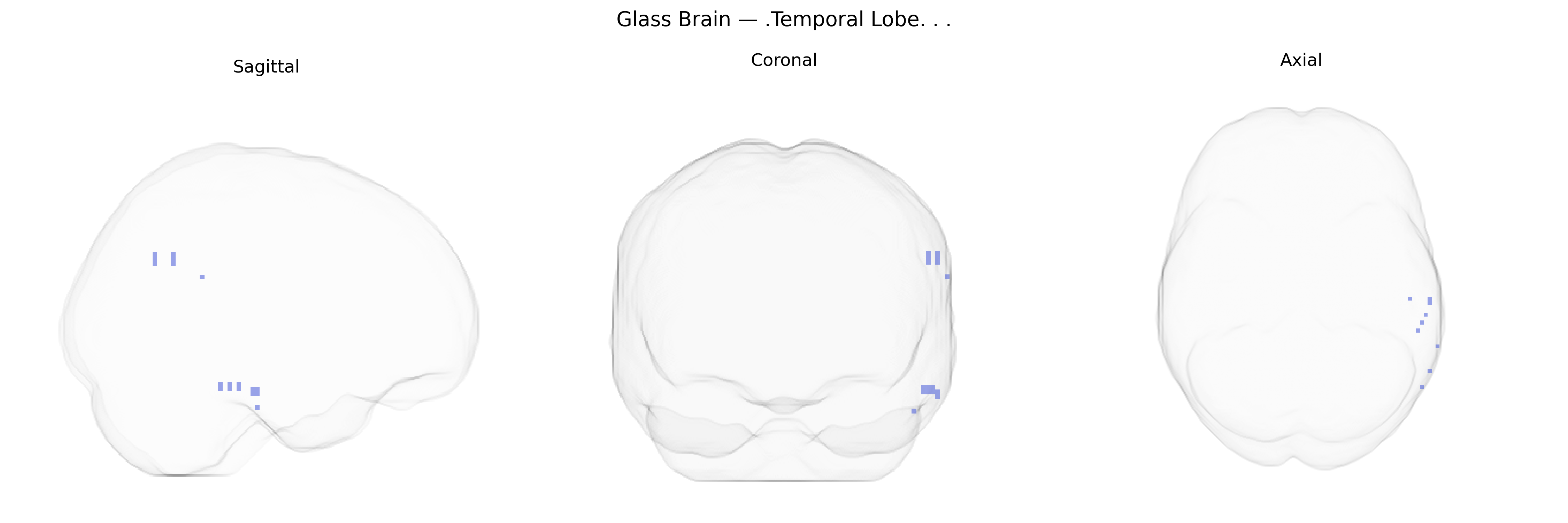
The bilateral temporal lobes are paired cortical regions situated laterally beneath the Sylvian fissure, extending from the anterior temporal pole to the posterior temporal cortex, and are delineated in the Talairach 2 mm Atlas as encompassing superior, middle, and inferior temporal gyri as well as associated cortical areas. These lobes are critically involved in auditory processing, speech and language comprehension (particularly in the left hemisphere), high-level visual object and face recognition, and aspects of semantic memory and episodic memory encoding, with medial temporal structures contributing to declarative memory functions. The temporal lobes also participate in emotional processing and social cognition via connections with limbic and prefrontal regions, and exhibit hemispheric specialization, with the right side more engaged in music perception, prosody, and certain visuospatial functions.
The bilateral temporal lobes, encompassing structures involved in language, memory, social cognition, and auditory processing, have been repeatedly implicated in genetic studies of neuropsychiatric and cognitive traits. GWAS and imaging–genetics work show that common variants (e.g., in genes such as KIAA0319, CNTNAP2, FOXP2, DCDC2, and ROBO1) are associated with temporal lobe volume and function, and are linked to reading disability, dyslexia, and language impairment through altered temporal cortex activation. Polygenic risk for schizophrenia and bipolar disorder correlates with reduced temporal lobe cortical thickness and surface area, and specific loci in genes like GRM3, CACNA1C, and ZNF804A have been associated with temporal lobe structural and functional abnormalities. Variants in APOE (especially ε4) and CLU, PICALM, and BIN1 are strongly associated with Alzheimer’s disease risk and correspond to accelerated atrophy and hypometabolism in medial and lateral temporal regions, including hippocampus and surrounding cortex. In autism spectrum disorder, risk variants in synaptic and cell-adhesion genes (e.g., NRXN1, SHANK3, CNTNAP2) are linked to atypical temporal lobe development and altered activation during social and language tasks. GWAS of cognitive performance and educational attainment show polygenic influences on temporal lobe morphology, supporting a genetic contribution to memory and language-related abilities mediated through this region.
Overview generated by GPT-4o (2026).
Region ID: 90
Hemisphere: bilateral
Atlas: Talairach labels 2mm
Full Quality Version: Download MP4
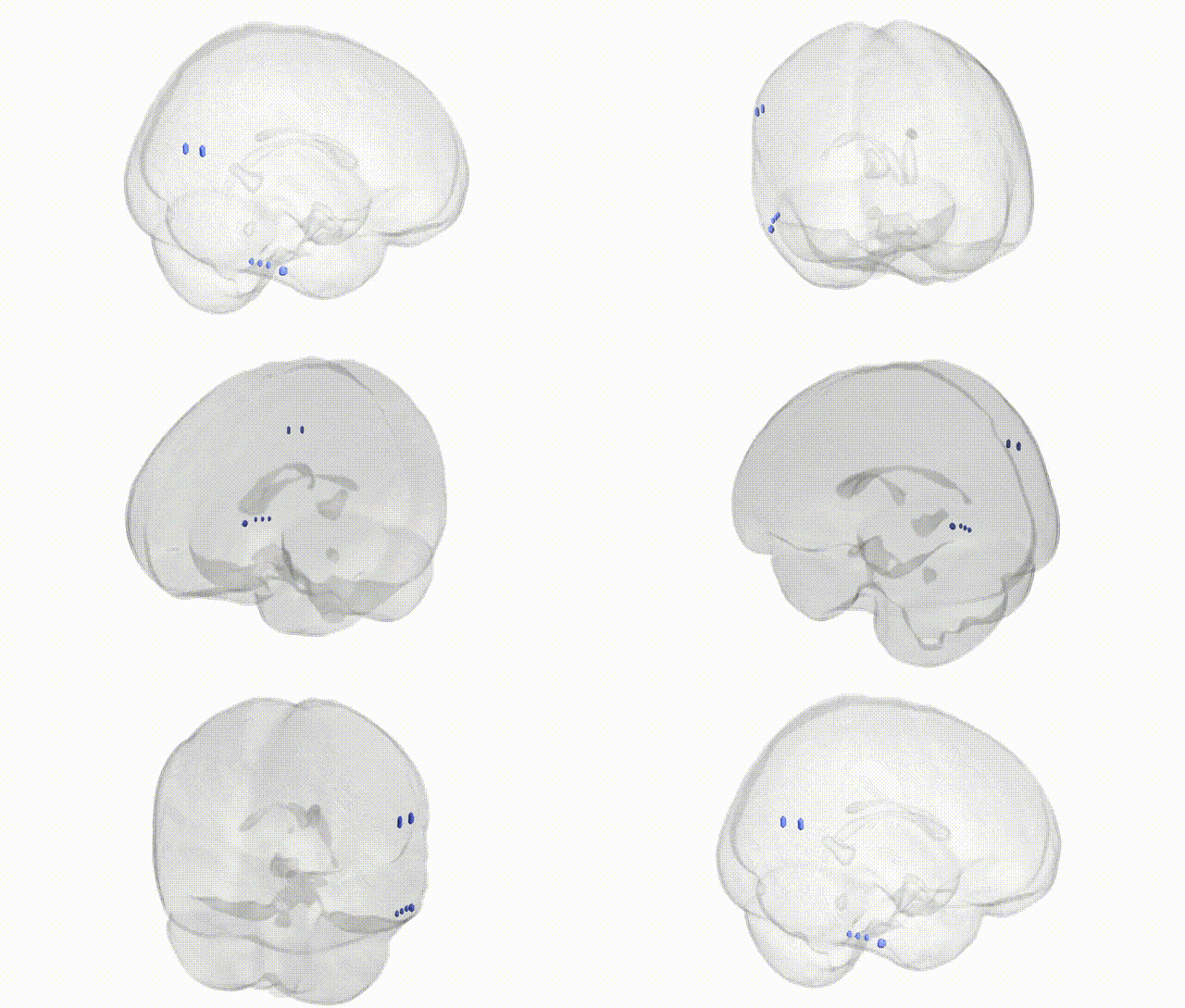
Full Quality Version: Download MP4
Wali Sidiqyar*, Gaurav Rudravaram*, Elyssa M. McMaster, Trent M. Schwartz, Adam M. Saunders, Kurt G. Schilling, Bennett A. Landman "Introducing SPINS: A Shared Public Visualization Library of Neuroanatomical Structures." Medical Imaging with Deep Learning- short paper
This resource is licensed under CC0 1.0 Universal (Public Domain).