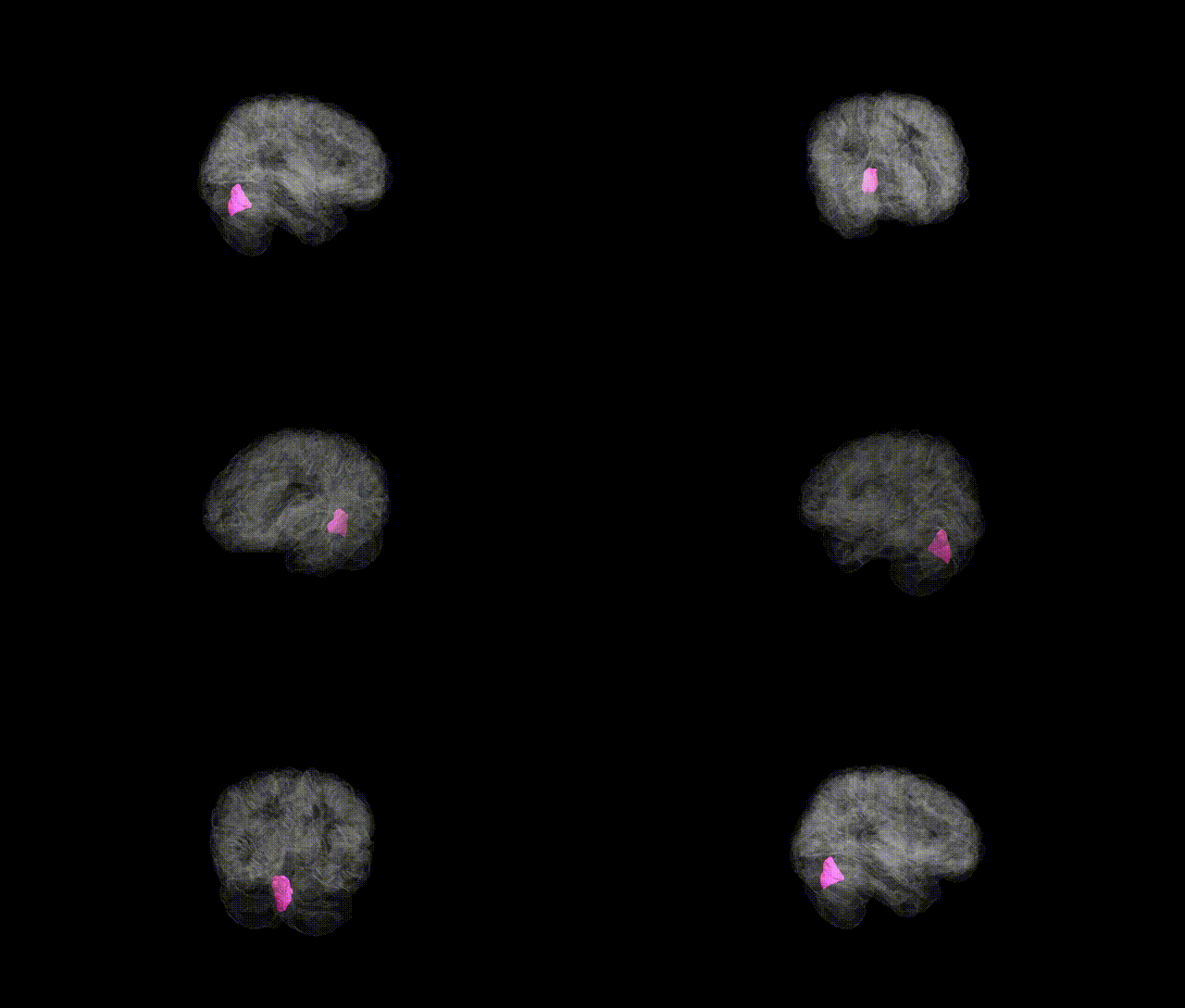
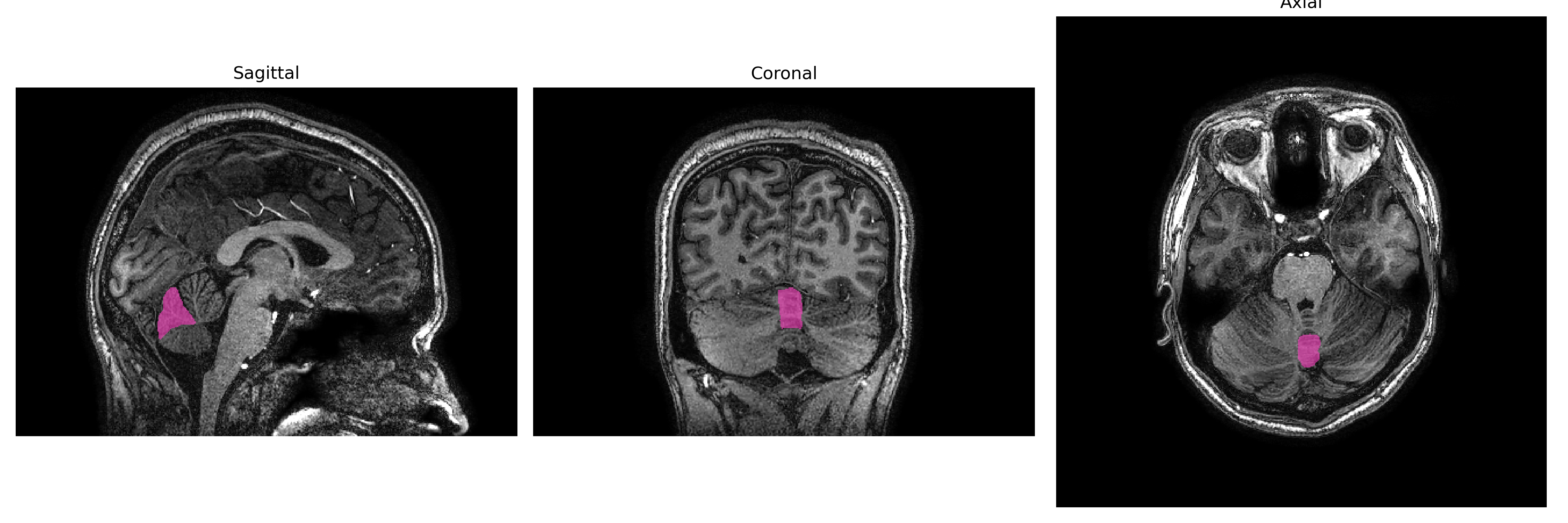
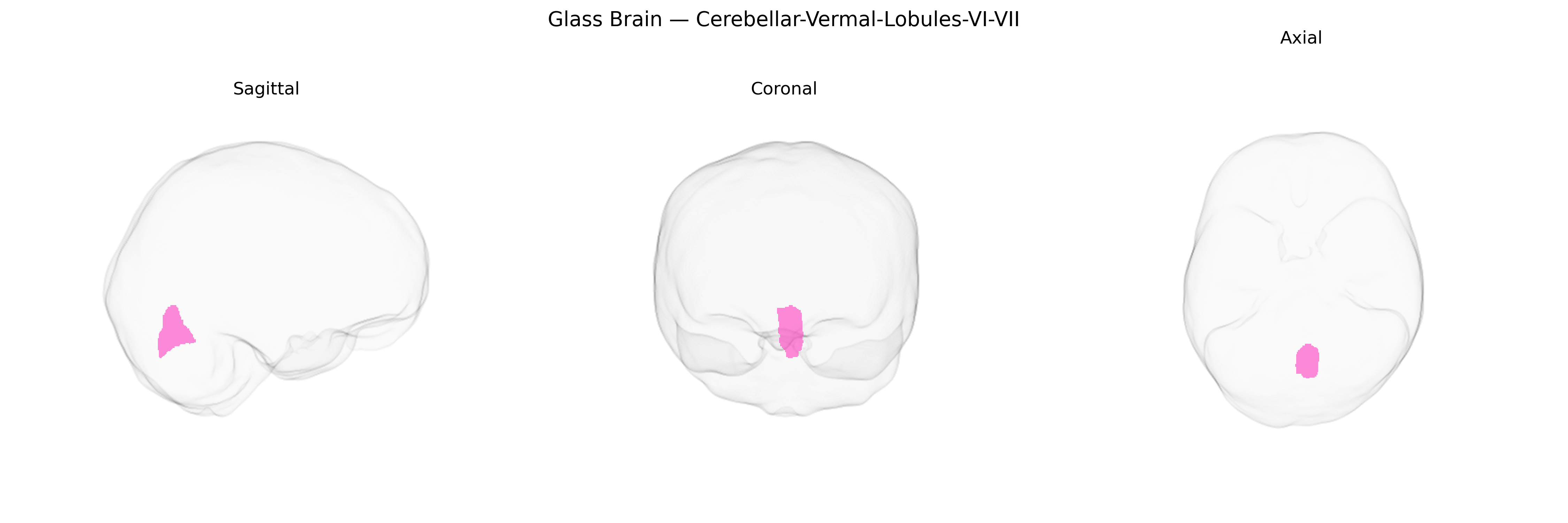
The Midline Cerebellar-Vermal-Lobules-VI–VII region, as defined in the brainCOLOR Atlas, corresponds to the vermal portions of cerebellar lobules VI and VII, forming part of the posterior cerebellar vermis that lies along the midline between the cerebellar hemispheres. This region is involved in higher-order cerebellar functions including aspects of cognitive processing, oculomotor control, and affective regulation, complementing the traditional role of the cerebellum in motor coordination and timing. Vermal lobules VI–VII receive inputs from cerebral association cortices via pontine nuclei and project through deep cerebellar nuclei to thalamic and cortical targets, integrating multimodal sensory and motor information. Functionally and anatomically, this region is often grouped within the “cognitive–affective” cerebellum, with alterations reported in neurodevelopmental, psychiatric, and movement disorders. There is no direct Wikipedia article for this specific subregion; see the related structure: Cerebellar vermis.
The Midline Cerebellar-Vermal-Lobules-VI–VII region, as defined in the brainCOLOR Atlas, has been implicated in several genetic and genome-wide association studies, particularly in relation to cerebellar volume and functional connectivity. Large-scale imaging genetics consortia (e.g., ENIGMA, UK Biobank–based GWAS) have identified multiple loci influencing cerebellar structure, including variants near genes involved in neurodevelopment, synaptic function, and axon guidance (such as RELN, FOXP2, and genes in the WNT and SHH pathways), although many findings reference broader cerebellar or vermal measures rather than lobules VI–VII specifically. Genetic correlations and polygenic score analyses indicate shared genetic architecture between cerebellar vermis morphology and psychiatric and cognitive phenotypes, including schizophrenia, autism spectrum disorder, attention-deficit/hyperactivity disorder, major depressive disorder, and general cognitive ability, consistent with the role of lobules VI–VII in cognitive and affective processing. Vermal lobules VI–VII have also been implicated indirectly via Mendelian and rare variant studies in developmental and cerebellar ataxias and certain copy-number variants (e.g., 22q11.2 deletion syndrome), which often feature structural or functional abnormalities in the posterior vermis. Overall, genetic studies support the view that variants influencing neurodevelopmental and synaptic pathways contribute to individual differences in the structure and function of midline cerebellar vermal regions VI–VII, in turn modulating risk for neurodevelopmental, psychiatric, and cognitive traits, although fine-grained, parcel-specific GWAS focused explicitly on the brainCOLOR Midline Cerebellar-Vermal-Lobules-VI–VII region remain limited as of current literature.
Overview generated by GPT-4o (2026).
Region ID: 20
Hemisphere: Midline
Atlas: brainCOLOR
Full Quality Version: Download MP4
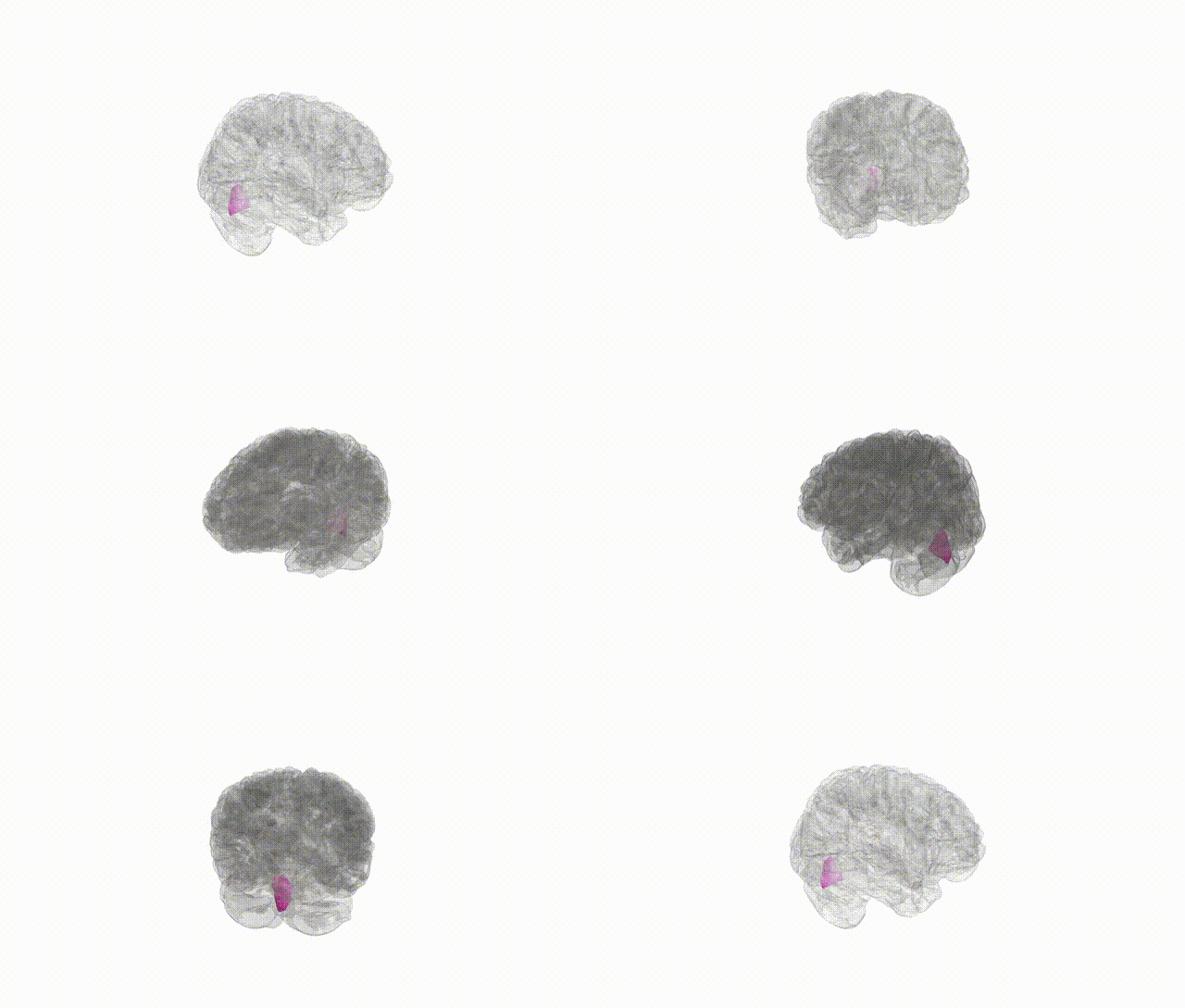
Full Quality Version: Download MP4
Wali Sidiqyar*, Gaurav Rudravaram*, Elyssa M. McMaster, Trent M. Schwartz, Adam M. Saunders, Kurt G. Schilling, Bennett A. Landman "Introducing SPINS: A Shared Public Visualization Library of Neuroanatomical Structures." Medical Imaging with Deep Learning- short paper
This resource is licensed under CC0 1.0 Universal (Public Domain).