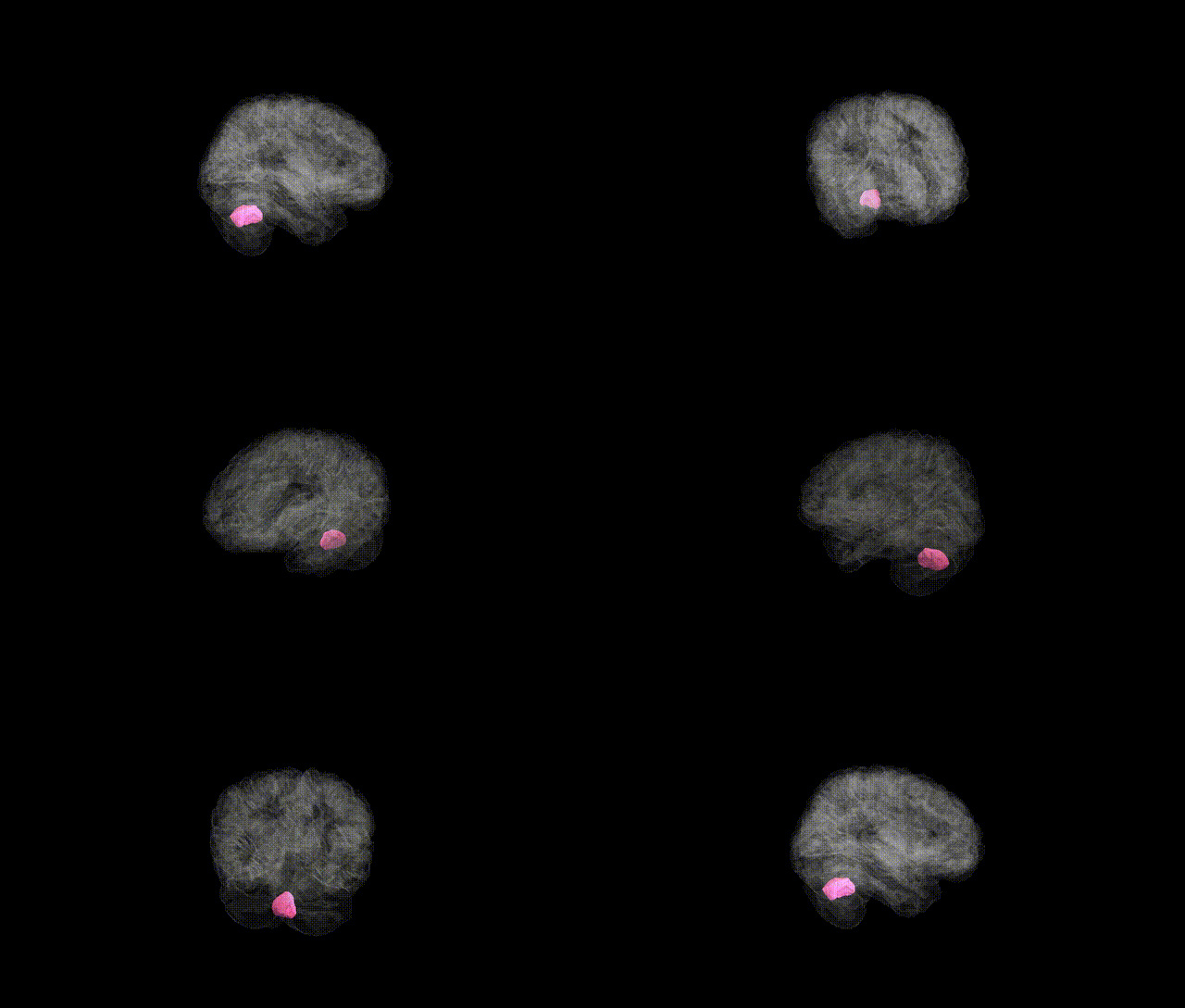
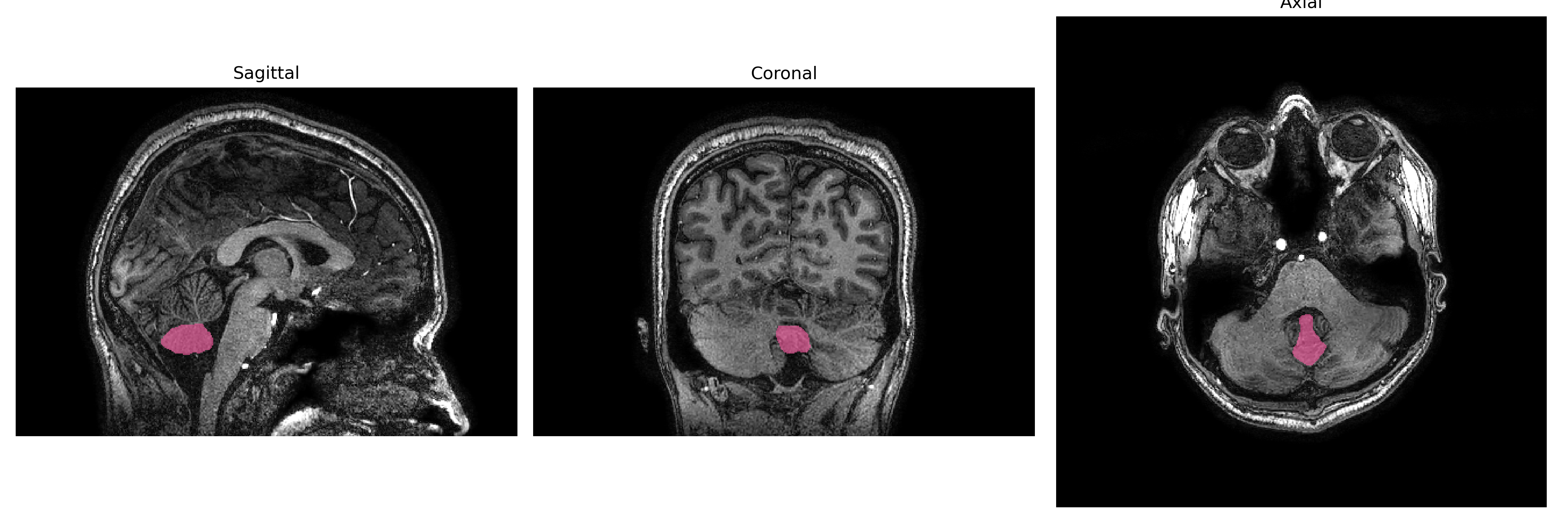
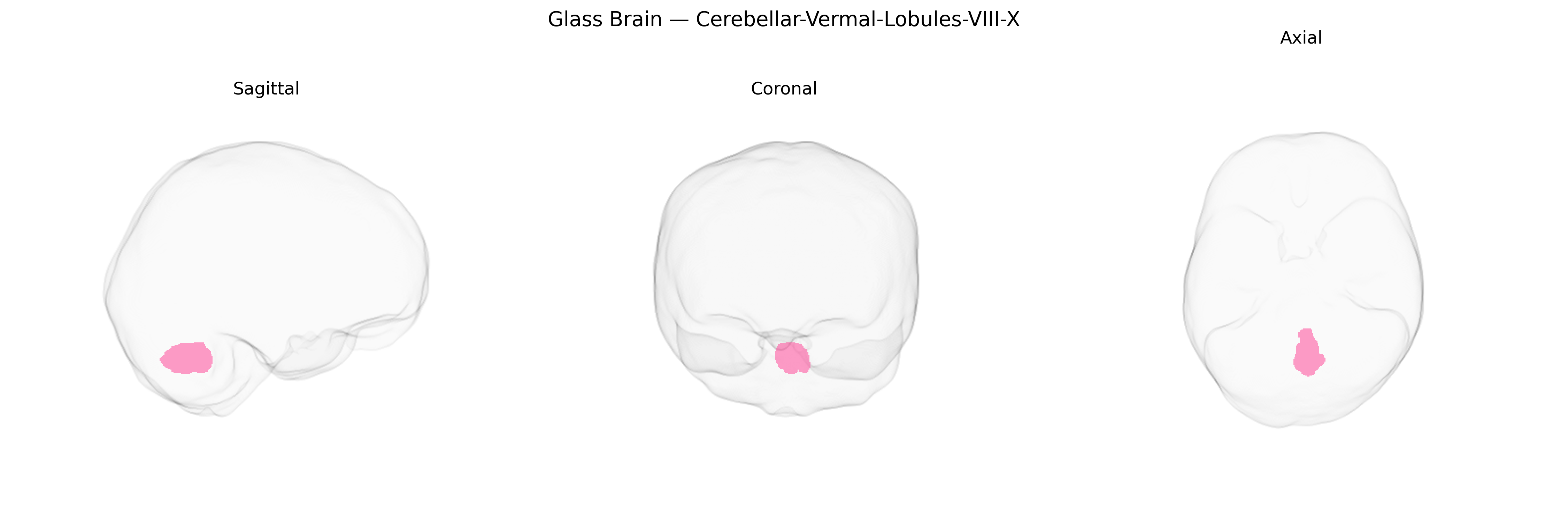
The Midline Cerebellar-Vermal-Lobules-VIII–X region, as defined in the brainCOLOR Atlas, corresponds to the posterior-inferior vermis of the cerebellum, encompassing vermal portions of lobules VIII, IX, and X. These lobules lie along the cerebellar midline and are primarily involved in the regulation of balance, posture, eye movements, and aspects of autonomic and vestibular control, integrating sensory input from the vestibular system with motor outputs to maintain equilibrium and coordinate axial musculature. Lobule VIII participates in sensorimotor coordination, lobule IX (the uvula) contributes to oculomotor and postural adjustments, and lobule X (the nodulus) is a core component of the vestibulocerebellum that fine-tunes vestibulo-ocular reflexes and head–eye coordination. There is no single dedicated Wikipedia article for “Midline Cerebellar-Vermal-Lobules-VIII–X”; a closely related structure is the Cerebellar vermis.
The midline cerebellar vermis, particularly lobules VIII–X as defined in the brainCOLOR atlas, has been implicated in several genetic and GWAS-based associations primarily through studies of cerebellar volume, neurodevelopmental and psychiatric disorders, and brain-wide imaging genetics. Large-scale MRI–GWAS consortia (e.g., ENIGMA, UK Biobank) have identified loci in genes such as KIAA0586 (involved in ciliogenesis), PAX6, FOXC1, ZIC1/ZIC4, and RELN that influence cerebellar vermis morphology or overall cerebellar volume, with some variants contributing to posterior fossa malformations including Dandy–Walker spectrum and Joubert syndrome, which prominently affect midline vermis structures and often extend to lobules VIII–X. Rare variant and exome studies in autism spectrum disorder, intellectual disability, and developmental coordination disorder (e.g., involving CHD8, DYRK1A, TSC1/2, and SHANK genes) frequently report reduced or dysplastic vermis volume, and imaging–genetics work has linked polygenic risk for schizophrenia, bipolar disorder, and major depression to alterations in midline cerebellar regions, including inferior vermal lobules involved in affective and vestibulocerebellar functions. Additional GWAS of brainstem–cerebellar volumes have highlighted loci near genes related to neurodevelopment (e.g., MAPT region on 17q21, NCAN, and variants in synaptic/axon guidance pathways) that show spatial expression gradients enriched in vermal and flocculonodular territories, suggesting that polygenic architecture for cognitive ability, neuroticism, and balance-related traits partly converges on midline cerebellar lobules VIII–X, although current evidence remains largely indirect and regionally coarse rather than specific to this exact atlas parcel.
Overview generated by GPT-4o (2026).
Region ID: 21
Hemisphere: Midline
Atlas: brainCOLOR
Full Quality Version: Download MP4
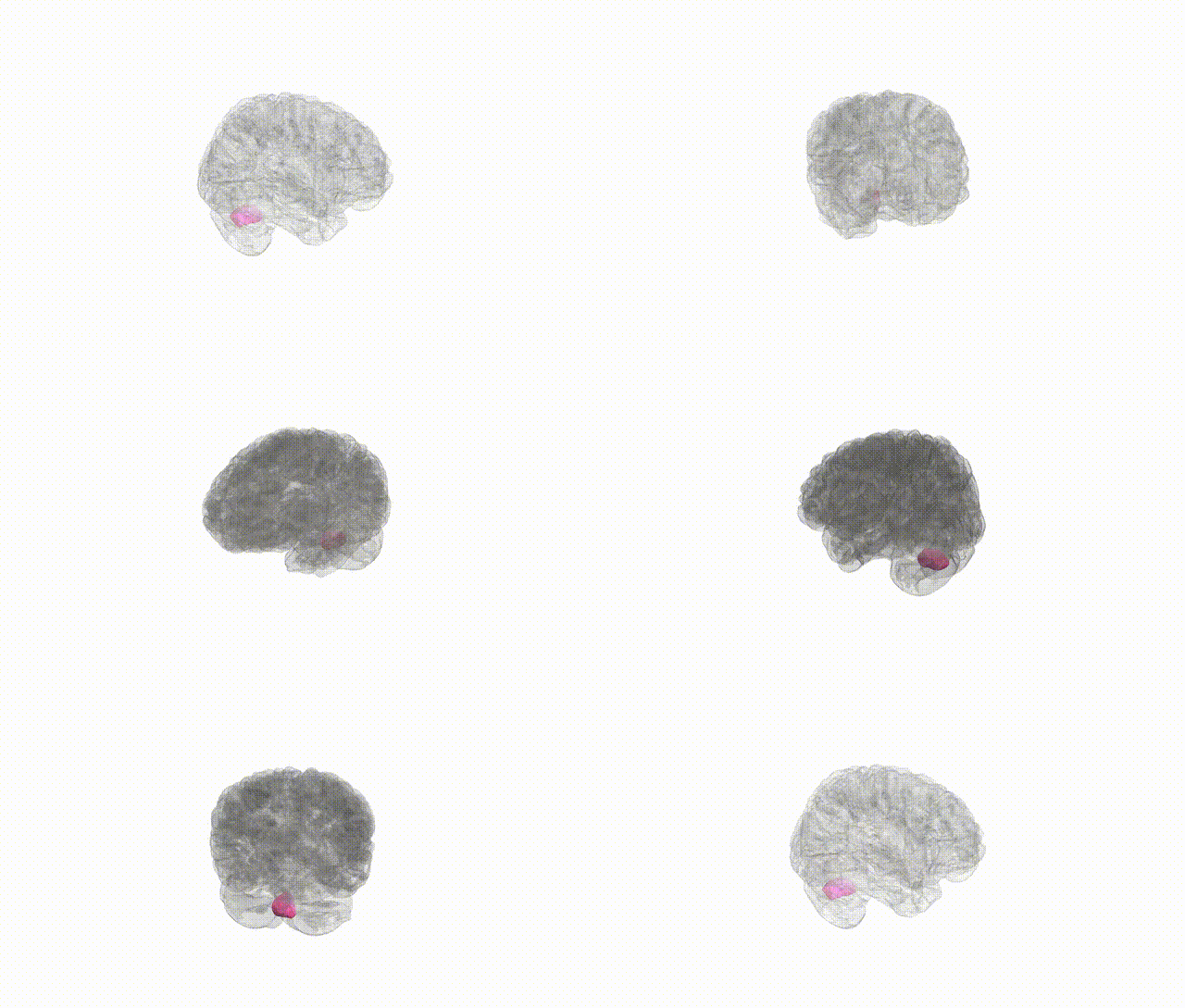
Full Quality Version: Download MP4
Wali Sidiqyar*, Gaurav Rudravaram*, Elyssa M. McMaster, Trent M. Schwartz, Adam M. Saunders, Kurt G. Schilling, Bennett A. Landman "Introducing SPINS: A Shared Public Visualization Library of Neuroanatomical Structures." Medical Imaging with Deep Learning- short paper
This resource is licensed under CC0 1.0 Universal (Public Domain).