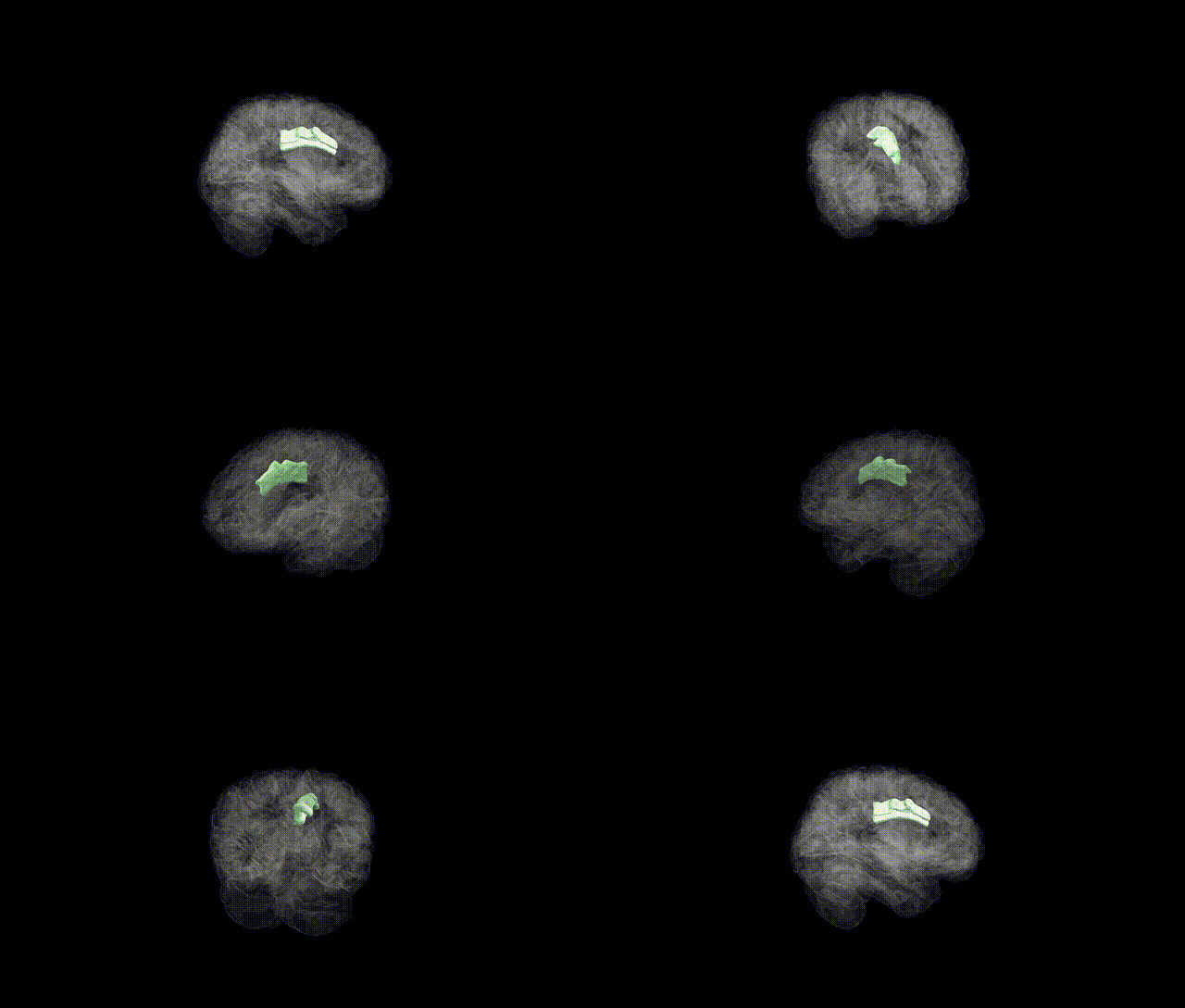
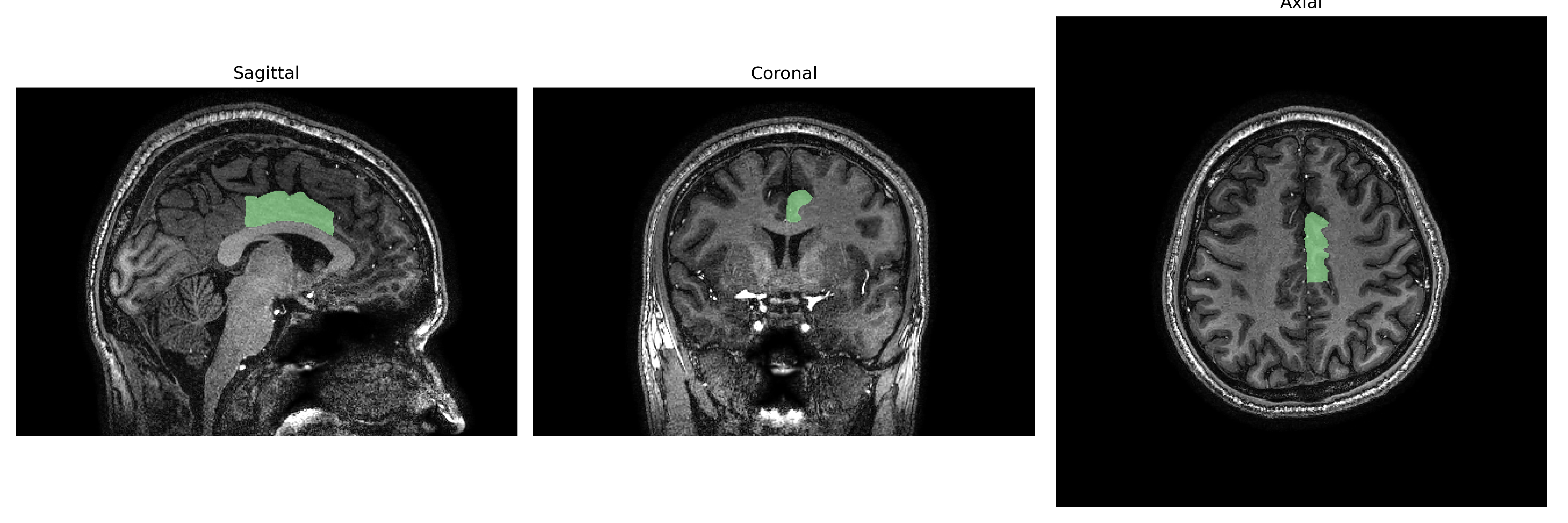
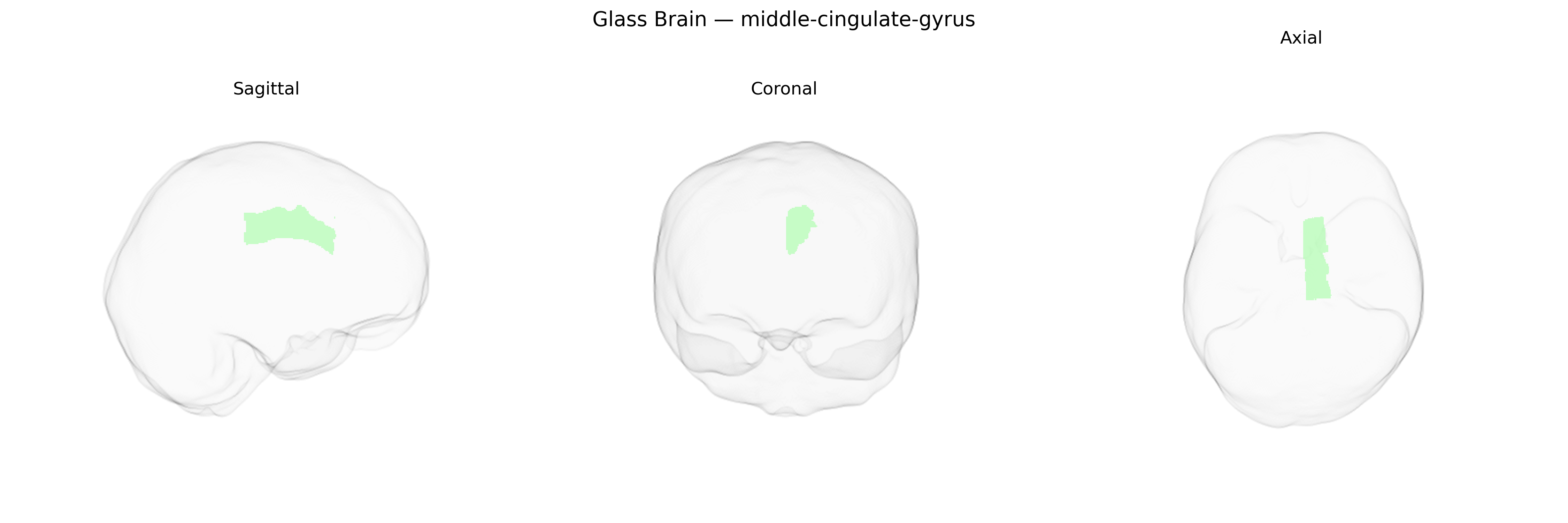
The Left middle-cingulate-gyrus, as defined in the brainCOLOR Atlas, is a portion of the cingulate cortex located on the medial surface of the cerebral hemisphere within the cingulate gyrus, situated dorsal to the corpus callosum and intermediate between anterior and posterior cingulate regions. It is generally classified as part of the mid-cingulate cortex, a transition zone between limbic and associative cortices that participates in cognitive control, performance monitoring, and response selection, as well as in the integration of nociceptive, motor, and affective information. Functionally, this region is implicated in processes such as error detection, conflict monitoring, motor preparation and execution, and the motivational aspects of pain, often showing activation during tasks requiring effortful control or adaptive behavioral adjustments. Cytoarchitectonically, it exhibits intermediate laminar organization between agranular anterior cingulate and more granular posterior cingulate areas, reflecting its role as an interface between emotion-related and higher-order cognitive networks. There is no direct link for “middle-cingulate-gyrus,” but it is a subregion of the Cingulate cortex.
The left middle cingulate gyrus (as delineated in the brainCOLOR atlas within the mid-cingulate region) has been implicated in several genetic and GWAS-based associations that converge on cognitive control, pain processing, and affective regulation. Large-scale imaging-genetics studies (e.g., ENIGMA, UK Biobank) have identified common variants influencing cingulate cortical thickness and surface area, including loci near genes involved in synaptic development and axon guidance (such as ROBO and NRXN family members), as well as variants in or near genes like HMGA2 and IGF1 that contribute broadly to cortical morphology. GWAS of pain sensitivity and chronic pain conditions have reported variants whose effects are partly mediated through mid- and anterior-cingulate activity or structure, consistent with this region’s role in pain evaluation and avoidance learning. In psychiatric genetics, polygenic risk for major depressive disorder, schizophrenia, ADHD, and anxiety traits has been associated with structural or functional alterations in the mid-cingulate, including the left middle cingulate gyrus, with some mediation by variants in glutamatergic, GABAergic, and calcium-channel–related genes (e.g., CACNA1C, GRM and GAD gene families) that show enriched expression in cingulate circuitry. Additionally, GWAS of cognitive performance, executive function, and risk-taking or impulsivity have linked polygenic scores to left mid-cingulate volume or activation patterns, suggesting that many small-effect variants influencing frontal–cingulate networks contribute jointly to interindividual differences in attention, conflict monitoring, and goal-directed behavior.
Overview generated by GPT-4o (2026).
Region ID: 57
Hemisphere: Left
Atlas: brainCOLOR
Full Quality Version: Download MP4
Full Quality Version: Download MP4
Full Quality Version: Download MP4
Full Quality Version: Download MP4
Wali Sidiqyar*, Gaurav Rudravaram*, Elyssa M. McMaster, Trent M. Schwartz, Adam M. Saunders, Kurt G. Schilling, Bennett A. Landman "Introducing SPINS: A Shared Public Visualization Library of Neuroanatomical Structures." Medical Imaging with Deep Learning- short paper
This resource is licensed under CC0 1.0 Universal (Public Domain).