Full Quality Version: Download MP4
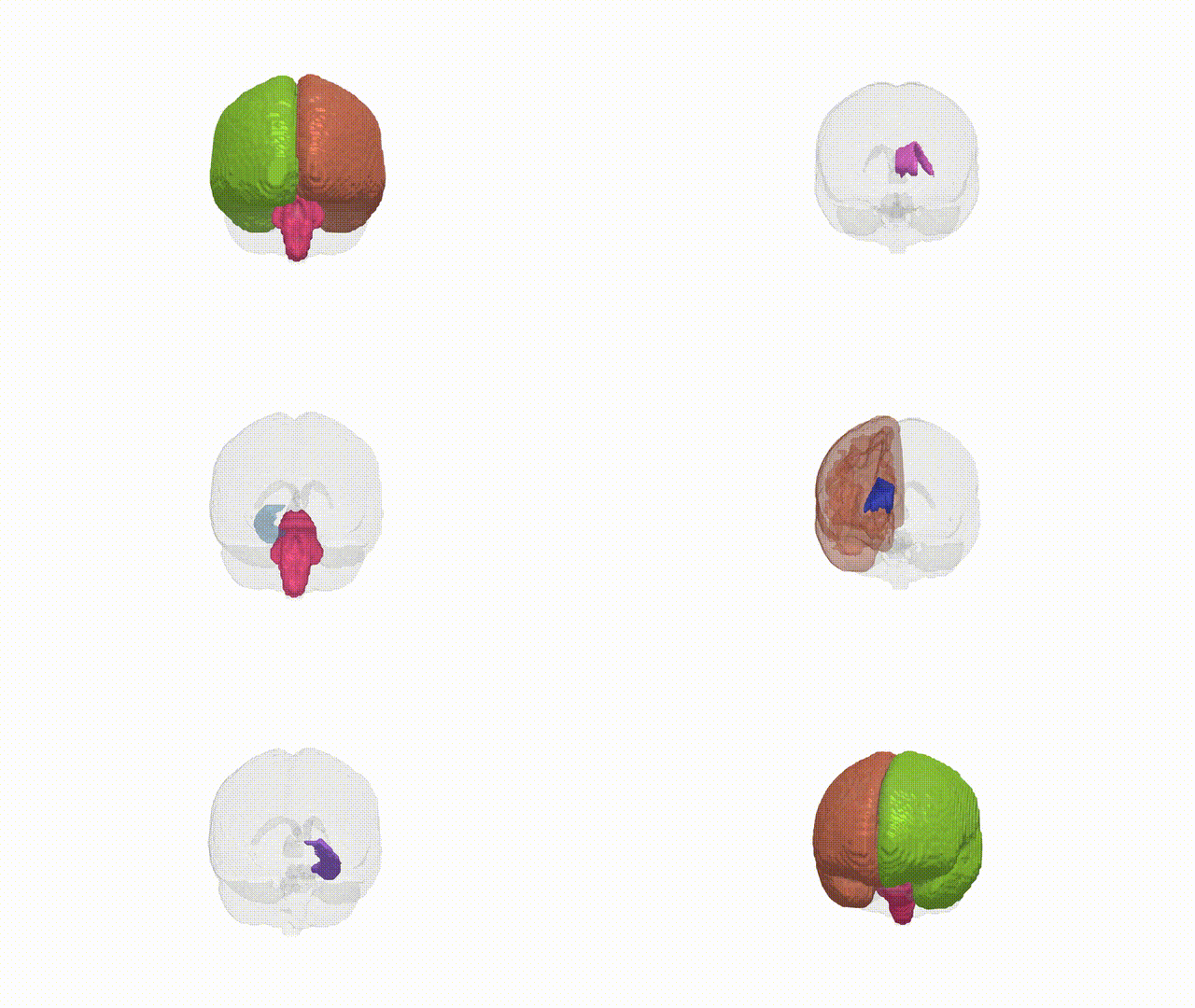
The Harvard-Oxford Subcortical Maximum Probability Threshold 25% 2 mm brain atlas is a probabilistic parcellation of major subcortical gray-matter structures, including bilateral thalamus, caudate, putamen, pallidum, nucleus accumbens, hippocampus, amygdala, and brainstem, defined in standard MNI152 space at 2 mm resolution. It was constructed from manual segmentations of high-resolution structural MRI scans of healthy adult volunteers, with individual labels nonlinearly registered to a common template and combined to yield voxel-wise probability maps for each structure; the “maxprob thr25” version assigns each voxel to the subcortical region with the highest probability provided that this probability exceeds 25%, producing a discrete, maximum-likelihood parcellation. Biologically and neuroscientifically, the atlas captures core components of the basal ganglia, limbic system, and thalamocortical relay nuclei, and is widely used for region-of-interest definition in functional and structural MRI studies, normalization and comparison of subcortical anatomy across individuals, and automated labeling in neuroimaging pipelines such as FSL. Atlas Website
Overview generated by GPT-4o (2026).
Click any region name to view its full visualization and description.
Wali Sidiqyar*, Gaurav Rudravaram*, Elyssa M. McMaster, Trent M. Schwartz, Adam M. Saunders, Kurt G. Schilling, Bennett A. Landman "Introducing SPINS: A Shared Public Visualization Library of Neuroanatomical Structures." Medical Imaging with Deep Learning- short paper
This resource is licensed under CC0 1.0 Universal (Public Domain).